

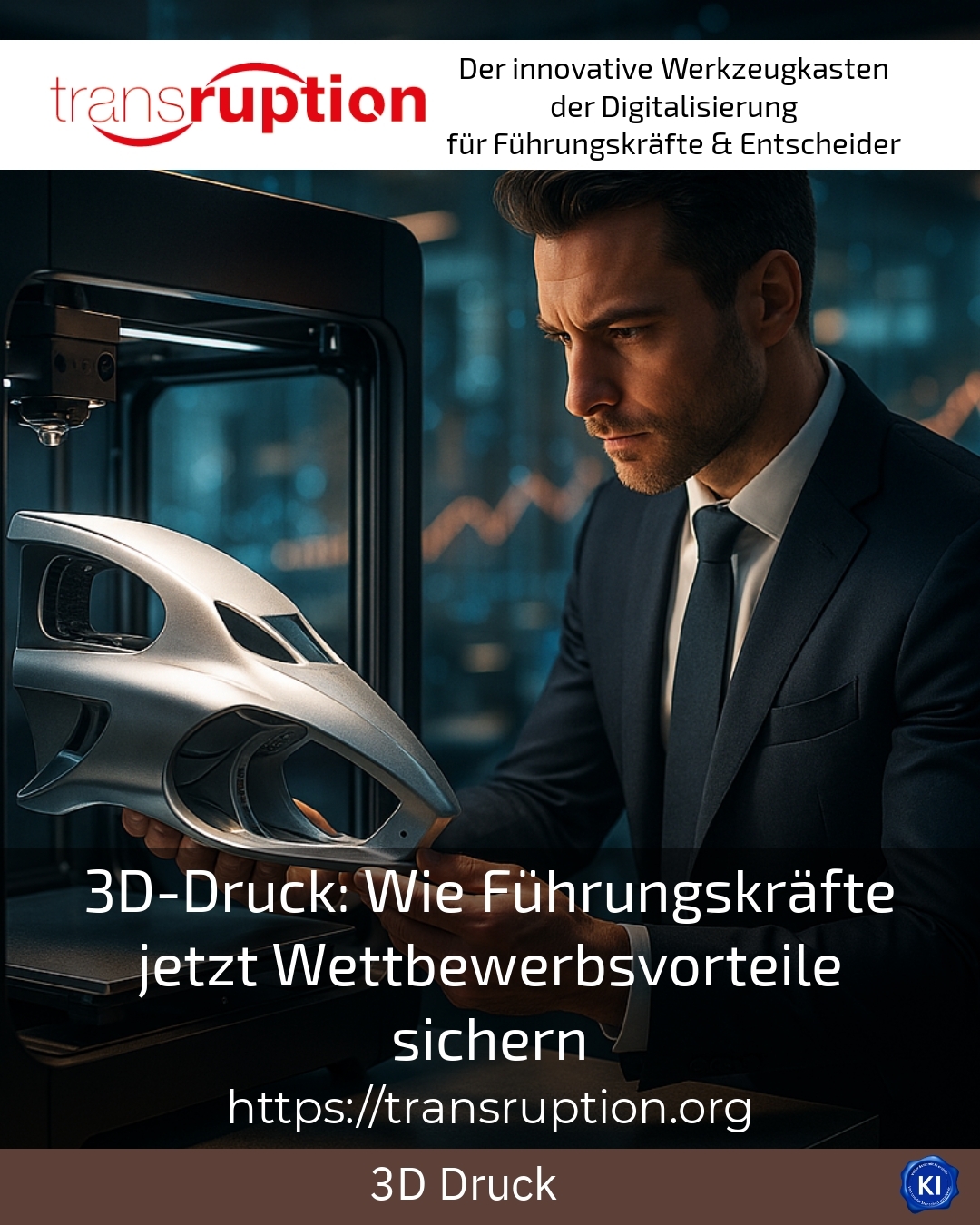
Digital transformation is having a profound impact on almost all areas of business, and leaders are faced with the question of how to secure sustainable competitive advantages through innovation. 3D printing is long past being a mere technical trend – it offers real opportunities to accelerate processes, reduce costs, and cater to individual customer requirements. Those who use 3D printing strategically are actively shaping the future of their company with digital tools[1].
Why 3D printing is making a difference now
Many executives come with the desire to make their operations future-proof and are looking for impetus for growth and innovation. Clients often report that traditional manufacturing methods are too inflexible to respond to individual customer requirements or short-term market changes. This is where 3D printing comes in: the technology overcomes classic limitations and allows the production of individual pieces and small batch sizes – without complex and expensive tools such as injection moulds[2].
A real-world example: a medium-sized mechanical engineering company managed to create complex prototypes within a few days using 3D printing. Errors could be identified early, while the competition was still waiting for conventional manufacturing steps. The time-to-market decreased and the product reached the market weeks earlier [2]. Such success stories show what is possible when innovation is understood not just as a buzzword, but as a lived strategy.
In the consumer goods sector, personalised products such as jewellery or design objects have become the new standard. In mechanical engineering too, special parts or wear-prone components are now manufactured specifically on-site to minimise warehousing costs and shorten delivery times[1]. The flexibility of additive manufacturing is a clear added value for companies that want to position themselves as innovation leaders.
In skilled trades, limited editions or seasonal products create new revenue streams. The confectionery trade, in turn, uses 3D printing to produce individual decorations, promotional items, or collector's pieces for customers – thereby opening up entirely new business areas [8]. The use of digital manufacturing technologies acts as a springboard for new services and increased revenue.
Practical examples from the industry
Rapid Prototyping and Time-to-Market
Prototypes and sample parts can be manufactured in record time using 3D printing. This significantly accelerates product development and enables a faster response to market demands [2]. Start-ups and medium-sized companies in particular benefit from this, as it allows them to develop innovative products with limited resources. Design changes can be implemented without high investment costs, and customer feedback can be directly incorporated into product development [5].
Components are also manufactured in the automotive sector using 3D printing – often as custom parts or for rapid verification of new designs. The ability to realise complex geometries and lattice structures opens up entirely new possibilities for lightweight and stable components, which would be difficult to produce using conventional methods [10].
Individualisation and customer proximity
3D printing allows products to be manufactured to customer specifications – even in small quantities or as individual items[2]. For example, medical technology companies produce custom-fit prosthetics and implants that are precisely tailored to the individual patient, thereby ensuring greater satisfaction[1]. However, the medical sector isn't the only one benefiting: in the consumer goods or service sectors too, individuality is increasingly becoming a cornerstone of the business model.
Cost-effectiveness and economic benefits
3D printing reduces fixed tooling costs and enables the production of small batches without additional effort – a clear advantage, particularly for companies with complex products or a high variety of models [3]. In the aerospace industry, for example, spare parts or prototypes are manufactured directly and just-in-time, which reduces inventory and increases flexibility.
Another example: an international architectural firm relies on 3D printing for scale models of its designs. This allows clients to experience a realistic representation of their project even before construction begins, and potential errors in the planning phase are identified early on.
BEST PRACTICE at the customer (name hidden due to NDA contract) A company from the medical technology sector used 3D printing to systematically accelerate the development of new product generations. Prototypes produced by the 3D printer made it possible to obtain early feedback from practical application in order to specifically optimise products. The market launch was more flexible and faster than with competitors, and feedback from doctors flowed directly into further development.
BEST PRACTICE at the customer (name hidden due to NDA contract) A family-run jeweller expanded its offerings to include personalised jewellery made using a 3D printer. Customers could submit their own designs and purchase small runs as limited collections. This unique selling point led to a significant increase in customers from the design and art lover community, strengthening its positioning as a pioneer in traditional craftsmanship.
BEST PRACTICE at the customer (name hidden due to NDA contract) A mechanical engineering company integrated 3D printers directly into the production line to manufacture spare parts and small batches on demand. Warehousing costs were reduced, delivery times decreased, and customer service became significantly more flexible. Several customers confirmed the high reliability and quick availability of the manufactured components.
Challenges on the path to 3D printing success
The potential of 3D printing is enormous, but the path to practical implementation also holds stumbling blocks. The initial investment in technology and expertise should not be underestimated, and familiarising oneself with new software and processes requires time and patience. Quality control remains a crucial factor, as only products that meet industry standards will convince on the market[5].
For companies that only receive orders sporadically, the market offers professional 3D printing service providers who take over the entire process – from setup to the finished part. This allows businesses to gain initial experience without having to invest heavily upfront.
Clients often report that getting started is significantly easier with external support. Whether through workshops, transruption coaching, or individual strategy sessions – targeted assistance helps to identify the right steps and overcome obstacles.
Transruption Coaching as a Catalyst
Many leaders approach us with the question of how to make their team or company fit for the use of 3D printing. Transruption Coaching will guide you in recognising the opportunities of additive manufacturing, identifying suitable application areas and jointly developing a strategy.
In our coaching sessions, we'll reflect together on where 3D printing makes the most sense for your company, how to involve your employees, what investments are necessary, and how you can achieve initial successes quickly. The focus is on the sustainable integration of new technologies into your business model – with clear goals and measurable achievements.
An open exchange about challenges, concerns, and success factors is central to this. In this way, you develop an individual roadmap for the future of your production – with 3D printing as the core of an innovation-driven growth strategy.
My analysis
3D printing is not a magic bullet, but a powerful driver for innovation, individual solutions, and economic success. Those who use the technology correctly can redesign business models, save costs, shorten development times, and delight customers with tailor-made offers [1][2][3]. The examples from a wide range of industries show: flexibility, customisation, and speed are the key competitive advantages that become possible with 3D printing.
At the same time, it's clear: success will only be achieved if companies plan their entry into the market systematically, gain experience and provide targeted training for their teams. Transruption coaching can make a real difference here as support and a catalyst – and help to shape the path into your company's digital, customer-oriented future.
Further links from the text above:
- 3D printing technology: How decision-makers are shaping competition now [1]
- 3D Printing Methods: Competitive Advantages for Decision Makers [2]
- Advantages of 3D printing for small businesses [3]
- Success strategy – 3D printing competitive advantage [4]
- 3D printing for small businesses: A competitive advantage [5]
- voxeljet: 3D printer manufacturer for industry [6]
- Competitive advantage thanks to 3D printing [7]
- New business areas and competitive advantages through 3D printers [8]
- 3D printing service providers provide a competitive advantage [9]
- Competitive advantages with 3D printing in the automotive sector [10]
For more information and if you have any questions, please contact Contact us or read more blog posts on the topic TRANSRUPTION here.












 Deutsch
  English (UK)