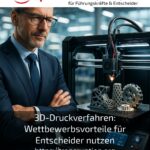
Innovation drivers such as 3D printing now offer significant competitive advantages across industries. Decision-makers face the challenge of how to unlock the potential of additive manufacturing for their business model. 3D printing allows for faster, more flexible, and more individual production than ever before. This opens up completely new markets and sustainably strengthens existing business areas.
Flexibility and customisation as a market opportunity
For a long time, the possibilities for realising individual solutions were limited with conventional manufacturing methods. The 3D printing process removes these limitations. Companies benefit from the option of producing products and components precisely according to customer requirements – even in small quantities or as single items. Especially in the field of prosthetics, but also in the consumer goods industry, this opens up new business models and sustainably strengthens customer loyalty[1].
Individual adaptations are not only possible with 3D printing methods, they are becoming the standard. From personalised jewellery to precisely fitting machine components: the technology makes it possible to respond directly to specific wishes. This flexibility is a clear competitive advantage in dynamic markets.
Another example can be found in the transport and logistics sector. Here, spare parts are produced directly at the point of use in order to save on storage costs and shorten delivery times. In crafts, 3D printing processes are also proving to be a springboard for new services, such as the production of limited collector's items or seasonal products [7].
Rapid Prototyping and shorter time-to-market
Prototypes and sample parts can be produced in record time using 3D printing methods. This significantly accelerates product development and enables faster reaction to market changes. Start-ups and SMEs in particular benefit from this, as it allows them to develop innovative products even with limited resources [2].
Additive manufacturing not only saves time but also costs. This is because complex tools such as injection moulds are completely dispensed with for small batch sizes. This allows companies to respond quickly to customer feedback, implement design changes and test new ideas – without making high investments.
BEST PRACTICE at the customer (name hidden due to NDA contract) A medium-sized mechanical engineering company used the 3D printing process to realise functional prototypes within a few days. This allowed errors to be identified and corrected early on, while competitors were still waiting for traditional manufacturing steps. As a result, the time to market was reduced by several weeks.
Cost-effectiveness and profitability
In a direct comparison, 3D printing is often more economical than traditional methods for small production runs and complex geometries. The elimination of expensive tools and setup times saves costs and simplifies the production of highly varied components. This technology is therefore particularly attractive for niche products or spare parts.
Modern industrial 3D printing processes even enable the production of large components or high quantities. Companies from the automotive and aerospace industries are already using this to manufacture entire assemblies efficiently and flexibly. The technology thus supports not only individual production but also series production.
BEST PRACTICE at the customer (name hidden due to NDA contract) A company operating in the automotive supply industry is utilising 3D printing processes for the on-demand production of spare parts. This has enabled them to reduce warehousing costs while simultaneously improving delivery capability. Customers benefit from customised solutions, while the company realises cost advantages.
Conserve resources and promote sustainability
Additive manufacturing helps to save material and reduce waste because only as much is applied as is actually needed. This not only supports profitability but also sustainable corporate goals [6]. For example, lightweight components for vehicles or aeroplanes are specifically designed and realised.
Furthermore, the 3D printing process often eliminates the need to transport spare parts when they are printed locally. This saves CO₂ emissions and promotes decentralised, resilient value creation[1]. Sustainability thus becomes a competitive factor that convinces more and more customers.
BEST PRACTICE at the customer (name hidden due to NDA contract) A regional craft business offered special, sustainable products manufactured exclusively using 3D printing processes. This allowed them to specifically differentiate themselves from the competition and reach new, environmentally conscious customer groups.
Addressing implementation challenges
Many decision-makers see the advantages of 3D printing processes but face the question of how to successfully integrate the technology into existing processes. Typical challenges include selecting suitable systems, integration into the IT landscape, and employee qualification[1].
In such cases, transruption coaching can offer targeted support. It accompanies companies on a project-by-project basis, provides impetus and helps to find individual solutions. Clients often report that this has enabled them to overcome obstacles more quickly and safely achieve innovation goals[1].
Initial investments in hardware and software should be well-planned. Particularly for companies that only sporadically use 3D printing processes, cooperating with specialised service providers is worthwhile. This allows for flexible responses to demand without making large investments in their own systems[8].
Practical tips for getting started
For a successful launch, it is recommended to first define pilot projects and gain experience. Collaboration with an experienced partner, such as a professional service provider or a coach, significantly accelerates the learning curve.
Training and workshops help to build up in-house expertise. This enables employees to actively use new opportunities and contribute innovative ideas.
Exchanging ideas with other companies and participating in networks reveals new fields of application. Many businesses discover how they can fulfil individual customer wishes or develop completely new business models using 3D printing processes[7].
My analysis
3D printing processes are a central component of modern production strategies today. They offer a variety of competitive advantages, from manufacturing flexibility to sustainable resource utilisation. Companies can thus produce more individually, faster and more cost-effectively – and thus position themselves sustainably in dynamic markets.
The right support, for instance through coaching or external service providers, makes getting started easier and helps to fully exploit potential. Those who invest in 3D printing processes today are actively shaping the future of their industry and providing important impetus for innovation and growth.
Further links from the text above:
[1] 3D printing technology: utilising competitive advantages for decision-makers
[2] Benefits of 3D Printing for Small Businesses – Sculpteo
[5] voxeljet: 3D printer manufacturer for industry
[6] 3D Printing: Prototypes, Spare Parts & Series Production – Plus Manufact
[7] New business areas and competitive advantages through 3D printers
[8] 3D printing service providers provide a competitive advantage
For more information and if you have any questions, please contact Contact us or read more blog posts on the topic TRANSRUPTION here.






 Deutsch
  English (UK)