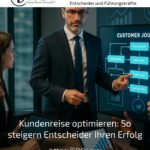
How companies optimise the customer journey and decisively increase success
The intensity and complexity of modern markets increasingly demand that decision-makers have a detailed understanding of the entire customer journey. Those who want to optimise the customer journey should take a systematic approach to meet customer expectations and create positive experiences at every stage. This is not just about pure sales transactions, but about holistic support for customers, from the first interaction to well after the purchase.
Optimising the customer journey: Why the customer experience is key
Many executives approach us with questions on how to optimise the customer journey without overwhelming complex technical systems. Clients often report that a lack of understanding of essential touchpoints and emotional customer needs present the biggest challenges. This is because only when the points of contact with customers are clearly defined can interventions be targeted and success be increased.
Optimising the customer journey primarily means knowing exactly where customers are and what their expectations are at each stage. Functionally, this can include website visits, social media interactions, or customer service. Emotionally, however, decisions must be linked to security and trust. Companies that consider this measurably increase their conversion rates and customer satisfaction.
Practical steps for optimising the customer journey
A crucial impetus is the systematic planning of the customer journey as a basis. This particularly includes capturing and mapping all existing touchpoints. This makes breaks or confusion visible and can be addressed. Companies then understand at which point customers drop out or falter.
Subsequently, it is important to personalise the customer experience at every touchpoint. For example, through individual offers or targeted follow-up after a purchase. Customer expectations are changing rapidly, which is why continuous analysis helps to keep improving the customer journey. Integrating feedback from customer surveys is also very helpful here.
BEST PRACTICE at company XYZ (name changed due to NDA contract) By precisely mapping the customer journey, the company was able to identify weaknesses in the user guidance on the website. Subsequently, simple navigation elements were introduced and content was adapted to be target-group-oriented. The result was a significant increase in dwell time and an improvement in the conversion rate for online sales.
It is also often observed that companies need to actively maintain dialogue in the post-purchase phase. Loyalty does not arise automatically, but through demonstrable added value and communication that addresses individual needs. Customer retention management thus becomes an integral part of the optimised customer journey.
Connecting technical and content aspects meaningfully
Decision-makers often tell us they want to optimise the customer journey, but linking marketing, IT and sales is a challenge. The technical implementation should therefore not be considered in isolation – quite the opposite: a user-friendly website and fast loading times are fundamental prerequisites for a positive customer experience to even materialise.
These technical requirements also positively influence search engine rankings. This is because Google and other search engines reward good user experiences with better placements. Therefore, SEO and customer journey optimisation are closely intertwined: a clear website structure, relevant content and fast loading times work together to guide visitors throughout their journey.
BEST PRACTICE at ABC (name changed due to NDA contract) A company has identified and resolved the technical weaknesses of its online platform through the use of feedback tools. In particular, mobile loading times have been improved and the product search has been made more intuitive. The resulting user experience helped the company achieve significantly more conversions and positively influence customer feedback.
In terms of content, optimising the customer journey also means providing high-quality texts, videos, or graphics that precisely meet the information needs at each stage. In the initial phase, this involves helpful information that builds trust, followed by product details, and finally support offers. Transparency and understandable solutions help to break down barriers and simplify the decision-making process.
Coaching spielt eine wichtige Rolle bei der Optimierung der Customer Journey, indem es Unternehmen dabei hilft, ihre Kunden besser zu verstehen und auf ihre Bedürfnisse einzugehen.
Many decision-makers seek external support when they want to optimise their customer journey. Coaching helps with the critical analysis of existing processes and provides impetus for targeted improvements. It is important here that no quick promises are made, but rather a collaboration takes place that is oriented towards individual challenges and projects.
Transruption coaching often supports the practical implementation of measures – for example, how marketing strategies can be specifically optimised or internal processes made more customer-oriented. This allows obstacles to be identified early and eliminated sustainably, so that the entire customer journey runs more smoothly and customers are reached more effectively.
BEST PRACTICE at DEF (name changed due to NDA contract) In the coaching process, the focus was placed on aligning sales and marketing. Through structured workshops and targeted process adjustments, both teams were able to collaborate more closely and make customer outreach more effective. This resulted in a more seamless customer experience and increased success in acquiring new customers.
Many companies report that a neutral external perspective provides important impetus. Even if the result is not immediately noticeable, positive long-term effects develop, which are reflected in turnover and customer satisfaction. Thus, coaching is a meaningful accompaniment in optimising the customer journey and a practical tool for decision-makers.
My analysis
Optimising the customer journey is more than just a buzzword. It’s about guiding customers in a comprehensible and emotionally positive way through all phases to their goal. For decision-makers, this means understanding the customer's reality and shaping their experiences with precise measures. The integration of technical know-how, content quality, and an open feedback culture is essential in this process.
Accompanying coaching offers the space to critically examine and improve these processes. It is not a quick fix, but a continuous journey that often leads to reported successes and stronger customer relationships. In this way, competitiveness can be significantly improved by focusing customer expectations at the heart of actions.
Further links from the text above:
[1] 6 effective tactics for optimising the customer journey – Spocket
[8] What is the customer journey and what does it have to do with SEO?
[4] Customer Orientation That Works: 7 Effective Strategies – vtiger CRM
[6] A Complete Blog Post SEO Checklist to Boost Rankings – AIOSEO
For more information and if you have any questions, please contact Contact us or read more blog posts on the topic TRANSRUPTION here.






 Deutsch
  English (UK)