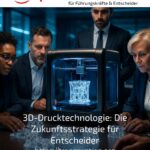
Introduction to 3D Printing Technology: A Strategic Advantage for Decision-Makers
3D printing technology is gaining increasing importance as a modern manufacturing method. Decision-makers from various industries face the challenge of understanding and effectively implementing innovative technologies. At the same time, they wish to increase efficiency, reduce costs, and establish sustainable processes. In this context, 3D printing technology offers diverse possibilities to fundamentally transform product development and manufacturing and secure competitive advantages.
This post shows practical examples and provides inspiration for how companies can shape their future strategy with 3D printing technology.
Diverse applications of 3D printing technology in industry and crafts
3D printing technology offers numerous applications across a wide range of fields. The following sectors are particularly noteworthy:
- Aerospace: Here, 3D printing processes enable the cost-effective production of complex components like engine parts or fuel tanks. Such parts are characterised by lightweight construction and high load-bearing capacity, which is essential for the industry.
- Automotive Industry: Additive manufacturing supports rapid prototyping, the production of customised tools or small batches, as well as the on-demand production of spare parts. This significantly shortens development cycles.
- Medical technology: Customised implants, prosthetics or surgical instruments can be manufactured precisely and quickly using 3D printing, allowing for optimal patient adaptation.
These examples illustrate the practical benefits of 3D printing technology for a wide range of manufacturing processes.
BEST PRACTICE at the customer (name hidden due to NDA contract) A medium-sized automotive supplier in Southern Germany implemented 3D printing technology to produce prototypes of its new component series in the shortest possible time. This reduced development times from several weeks to just a few days, crucially accelerating the market launch.
Optimisation of product development and manufacturing with modern 3D printing technology
Decision-makers benefit from the diverse advantages of additive manufacturing:
- Reduced development times through rapid prototyping and iterative design adjustments.
- Greater design freedom, allowing the manufacture of complex geometries that are difficult to achieve with conventional processes.
- Cost savings through reduced material consumption and minimised tooling costs.
- Improved sustainability thanks to the ability to use recycled or bio-based materials and reduce waste.
It is precisely the combination of advanced materials and AI-powered manufacturing that simplifies process flows and increases product quality.
BEST PRACTICE at the customer (name hidden due to NDA contract) A manufacturer of specialised tools is using AI-powered slicing in its 3D printing process. This allows them to minimise material consumption while precisely controlling the mechanical strength of the parts.
Practical benefit: From tool production to customised small batches
In the workshop and production, it is particularly evident how 3D printing technology strengthens areas such as toolmaking and small-batch production:
- Manufacturing of tools, jigs, and assembly aids directly at the point of use, which reduces logistics costs.
- Production of custom-made parts according to customer requirements, for example for mechanical engineering or medical technology.
- Flexible reaction to market changes through rapid adjustments and remanufacturing.
BEST PRACTICE at the customer (name hidden due to NDA contract) A company in the electronics industry uses industrial 3D printing processes to manufacture specific components. This allows it to flexibly produce smaller batches while significantly reducing time-to-market.
Looking to the future: 3D printing technology as an integral part of the innovation strategy
Decision-makers should view 3D printing technology not just as a technical option, but as a strategic tool for innovation. This is how competitiveness and adaptability can be strengthened. Furthermore, digitisation and automation support the integration of this technology into existing production systems.
Many teams report that clear guidance and targeted coaching are important success factors in implementing their 3D printing projects – for example, through expertise in materials science, process design, and quality control.
BEST PRACTICE at the customer (name hidden due to NDA contract) A medium-sized company from the mechanical engineering sector relied on external consulting for the implementation of 3D printing technologies. This allowed the team to build internal expertise and gradually optimise production processes, leading to improved products and higher customer satisfaction.
My analysis
3D printing technology offers decision-makers an outstanding opportunity to increase their competitiveness across a wide range of industries. Its diverse applications – from rapid prototype development and efficient small-batch production to sustainable material solutions – open up new potential. It is crucial to understand the technology as a strategic building block and to embed it within the company through targeted support and coaching.
Continuous innovations, particularly in materials and automated processes, will also strengthen this trend in the coming years. Thus, 3D printing remains a pioneering future strategy for modern production and development decisions.
Further links from the text above:
Top Trends 2025 in 3D Printing: Materials, Machines and AI
3D printing applications - overview & examples
Five industries that benefit most from 3D printing
How to choose the right industrial 3D printer
Industrial Applications of Plastic 3D Printing
3D Printing in Industrial Applications
25 (unexpected) applications for 3D printing
Areas of application: What industry frequently uses 3D printing for
3D Printing Trends 2025 – Fabrica GmbH
Industrial applications for 3D printing: Best practices
For more information and if you have any questions, please contact Contact us or read more blog posts on the topic TRANSRUPTION here.






 Deutsch
  English (UK)