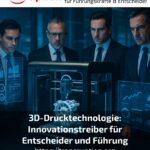
The role of 3D printing technology in industry transformation
3D printing technology has established itself as a key driver of innovation for decision-makers and executives. It is fundamentally changing production processes and offering new opportunities to design products faster, more flexibly, and more cost-effectively. For many executives, understanding the potential of this technology is crucial for successfully implementing projects and ensuring their company's competitiveness.
The 3D printing technology is by no means just a niche tool for prototypes, but is finding application in numerous industries. It assists companies in minimising material waste and saving valuable resources. At the same time, new processes such as printing with liquid metal or multi-material manufacturing enable innovative product designs that were previously unthinkable.
3D printing technology as a strategic companion in leadership and decision-making processes
Decision-makers are utilising 3D printing technology to realise various advantages in their strategic projects. This includes, among other things, the ability to produce complex components individually and quickly without relying on large inventories or external suppliers. This achieves greater flexibility in production and shortens the path from idea to finished product.
In some cases, clients also report on simplified innovation management, as creative development iterations are significantly easier to carry out due to rapid prototyping. Thus, 3D printing technology can accelerate the implementation of new product ideas while simultaneously reducing the error rate in series production. These effects help managers to oversee projects more efficiently and provide relevant impetus for teams.
Another area where technology is providing support is in value chain issues. The increased regionalisation of production, aided by 3D printing, makes companies less reliant on global supply chains and minimises transportation costs and times. This often leads to increased local advantages and can encourage on-site investment.
Examples from industry of the practical application of 3D printing technology
BEST PRACTICE at company XYZ (name changed due to NDA contract)
A mechanical engineering company has revolutionised the production of spare parts with 3D printing technology. Instead of large-scale warehousing, components are printed as needed. This has optimised warehouse logistics and significantly improved product availability. Furthermore, individual customer requirements can be flexibly realised in this way.
BEST PRACTICE at ABC (name changed due to NDA contract)
A manufacturer in the medical industry is employing 3D printing to produce patient-specific implants and prostheses. The technology allows for precise adaptation to individual anatomical needs, significantly improving patient care while simultaneously reducing development time and costs.
BEST PRACTICE at DEF (name changed due to NDA contract)
In the automotive industry, one operation accelerated the development of concept cars by using 3D printing for rapid prototyping. Parts that previously took several weeks to manufacture could be produced in days. This led to faster decision-making in the design process and facilitated communication between engineering and management.
Challenges and realistic expectations when using 3D printing technology
Many executives turn to specialised coaches or consultants for support with project management when asking about the integration of 3D printing technology into existing production processes. The path from idea to successful implementation is often complex. It is important to select suitable technologies and realistically assess the impact on material flow, quality assurance and cost structure.
However, expectations of 3D printing technology should not be set in stone. The technology can often support developments and provide accompanying impulses, but it cannot solve all challenges. Careful planning is required, particularly for highly complex or mass-producible applications. Customers reliably report that professional support during integration is often helpful to avoid typical stumbling blocks.
My analysis
3D printing technology remains a promising driver of innovation for leaders across various industries. It offers new opportunities for custom product development, flexible production, and value creation optimisation. Nevertheless, this also comes with the task of developing suitable strategies to integrate the technology meaningfully into business processes and set realistic goals. Support from specialised guidance is often a crucial success factor in this regard.
Further links from the text above:
[1] 5 Exciting Innovations in 3D Printers
[3] How 3D Printing Technology Could Change World Trade
For more information and if you have any questions, please contact Contact us or read more blog posts on the topic TRANSRUPTION here.






 Deutsch
  English (UK)