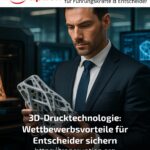
How 3D printing technology creates decisive competitive advantages
3D printing technology opens up entirely new possibilities for companies to position themselves in the market and increase their competitiveness. Decision-makers in particular are increasingly relying on this innovation to implement projects more effectively and streamline processes. This technology helps to accelerate product development, reduce costs, and react flexibly to market needs.
Implementing innovations faster with 3D printing technology
A significant advantage lies in the implementation of prototypes. 3D printing technology makes it possible to quickly turn concepts into tangible models. This significantly shortens product development time. The rapid availability of prototypes facilitates the testing and further development of products.
This method's strengths are also evident in small-scale production. Parts can be economically produced in small quantities without large tools or moulds. This creates flexibility, especially when customers want individual solutions or frequently changing variants are needed.
Another advantage is the ability to produce complex components that are difficult to realise using conventional methods. Innovative lattice structures or internal channels can be created in a single printing process, which reduces weight while simultaneously increasing stability.
Process optimisation and sustainable production through 3D printing technology
Companies frequently report that they have been able to make maintenance and repair processes more efficient by using 3D printing technology. Spare parts can be quickly manufactured on-site as needed, which minimises production downtime.
Decentralised manufacturing with 3D printing simultaneously contributes to reducing transport routes and thus to more sustainable value creation. This aspect is gaining importance, especially in times of increased environmental requirements.
The technology integrates well into digital production chains and supports companies in developing their processes towards Industry 4.0. This allows individual production steps to be better networked and controlled, which increases overall efficiency.
Practical examples from various industries
BEST PRACTICE at company XYZ (name changed due to NDA contract) The company used 3D printing technology to create product prototypes in days rather than weeks. This allowed for early market validation and adjustments based on customer feedback, which accelerated time to market.
BEST PRACTICE at ABC (name changed due to NDA contract) Here, 3D printing technology was used to produce spare parts directly at the production site. This significantly reduced storage costs and prevented long machine downtimes.
BEST PRACTICE at DEF (name changed due to NDA contract) This company developed lightweight yet stable components with innovative lattice structures using 3D printing. This reduced energy consumption and material costs, strengthening its competitiveness.
How decision-makers can support the use of 3D printing technology
For a successful implementation, it is recommended to support the use of 3D printing technology throughout the project. Key aspects include selecting suitable materials and printing technologies, as well as integrating them into existing production and development processes.
Furthermore, sufficient time should be allocated for training and adjustments so that employees can make the most of the new possibilities. Clients often report valuable impulses that arise from accompanying coaching, which helps to identify challenges early on.
This ensures that 3D printing technology genuinely contributes to strengthening competitiveness and is sustainably integrated into the corporate strategy.
My analysis
3D printing technology offers a versatile opportunity to secure competitive advantages. Faster product development, flexible manufacturing, process optimisation, and sustainability aspects are just some of the benefits of this technology. Decision-makers should strategically support the introduction of 3D printing and ensure that companies benefit from its diverse potential with targeted support.
Further links from the text above:
[1] Advantages of 3D printing for small businesses – Sculpteo
[2] 3D Printing in Small and Medium-sized Enterprises: Efficient Production | GAMUNICH
[4] Success Strategy – 3D Printing – Resin Prototyping
[5] What are the benefits of a 3D printing project for my company?
[7] 3D Printing for Small Businesses: A Competitive Advantage – jsadd 3d
For more information and if you have any questions, please contact Contact us or read more blog posts on the topic TRANSRUPTION here.






 Deutsch
  English (UK)