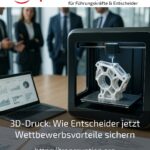
In today's competitive environment, companies are constantly seeking innovative ways to stand out from the competition. One of the most effective technologies for achieving these goals is 3D printing. By integrating 3D printing technologies, firms can make their production processes more efficient, reduce costs, and adapt flexibly to customer needs. This approach allows them to create genuine competitive advantages and strengthen their market position[1][2].
Flexibility and customisation through 3D printing
One of the most significant advantages of 3D printing is its ability to manufacture products and components precisely according to customer requirements. This can be done in small batches or even as individual items, thereby overcoming traditional manufacturing limitations [1]. A good example of this can be found in medical technology companies that use 3D printing to produce custom-fit prosthetics and implants. This specific customisation leads to high customer satisfaction and enables companies to develop new business models [1].
Furthermore, 3D printing in the consumer goods sector, for example in jewellery or design objects, offers the possibility of providing tailor-made solutions. A family-run jeweller's, for instance, uses 3D printing to produce personalised jewellery. Customers can submit their own designs and buy small runs as limited collections, making the business a pioneer in the industry.
Cost-efficiency and economic benefits of 3D printing
3D printing also offers companies significant cost advantages. The production of small batch sizes without additional tooling costs, in particular, is a clear benefit. Companies with complex products or a high degree of variety particularly benefit from this, as they can produce smaller batches without expensive moulds[2][3]. For example, companies in the aerospace industry use 3D printing to produce spare parts or prototypes directly and just-in-time, which reduces inventory and increases flexibility[2].
Another example is a mechanical engineering company that has integrated 3D printers directly into its production line to manufacture spare parts and small batches to order. This leads to significantly lower warehousing costs, shorter delivery times, and more flexible customer service[2].
Individualised solutions in 3D printing
A significant advantage of 3D printing is the ability to create personalised products. This capability allows companies to clearly differentiate themselves from the competition and occupy specific market niches. A good example of this is the production of bespoke jewellery or design items, which are often offered as limited editions[2].
Even in the transport and logistics sector, 3D printing offers significant opportunities through the on-site production of spare parts. This considerably shortens delivery times and reduces storage costs [1].
Integration of external expertise for 3D printing
For companies looking to integrate 3D printing into their business processes, collaborating with external experts can be a sensible strategy. These experts can help with the successful implementation of projects if the necessary competencies are not available internally[6].
This allows companies to leverage the benefits of 3D printing without having to invest heavily in internal development. This enables them to respond quickly and efficiently to market demands.
Successful business models through the use of 3D printing
Several companies are using 3D printing to open up new business areas or strengthen existing ones. For example, many firms see potential in reaching new customer groups through personalised products[8].
Overall, 3D printing offers companies a wide range of opportunities to stand out in the market and secure competitive advantages. By combining flexibility, cost-effectiveness, and customisation, 3D printing can become a key to sustainable success[3][4].
My analysis
In summary, 3D printing offers companies a variety of opportunities to assert themselves in today's competitive environment. By integrating 3D printing technologies, firms can optimise their production processes, reduce costs, and clearly distinguish themselves from the competition. The flexibility and customisation that 3D printing provides are crucial factors for securing competitive advantages and achieving long-term success.
Further links from the text above:
3D Printing Technology: How Decision Makers Will Now Compete…
3D Printing: How Business Leaders Can Now Gain Competitive Advantages…
Advantages of 3D printing for small businesses
For more information and if you have any questions, please contact Contact us or read more blog posts on the topic TRANSRUPTION here.






 Deutsch
  English (UK)