
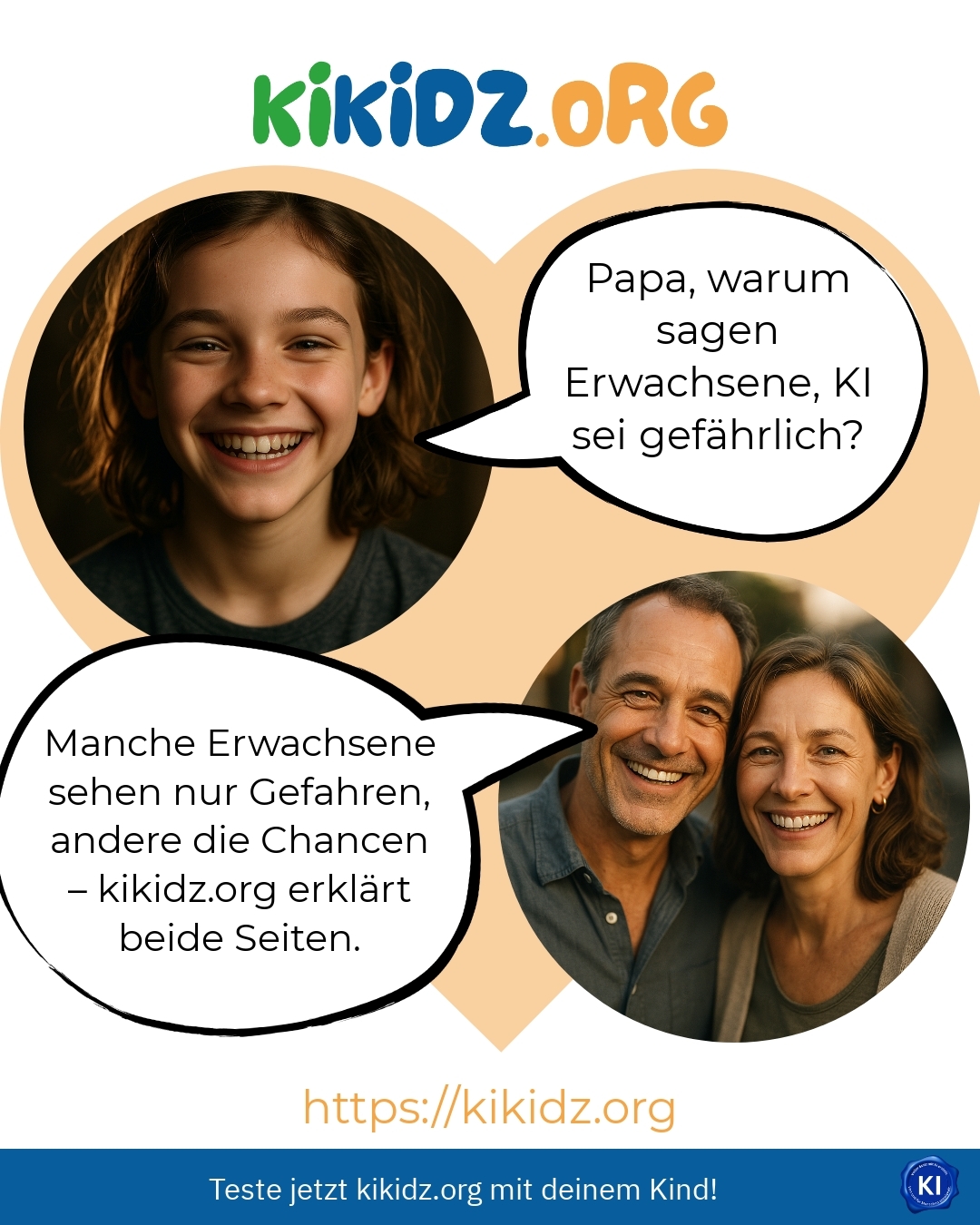
„Dad, why do adults say AI is dangerous?“ Many children ask their parents this question when they hear about Artificial Intelligence (AI). Adults are aware of the opportunities AI offers, but also of the risks involved. In this article, I would like to explain to parents why some adults are warning about AI, what topics concern them, and how to guide children and teenagers in an age-appropriate manner.
Dad, why do adults say AI is dangerous? – Behind the concerns
Parents often encounter anxieties and uncertainties among adults regarding Artificial Intelligence. Adults see that AI can make our lives easier, but they also know that AI is not free from errors or biases. A major concern involves so-called „biases“ – that is, distorted, prejudiced decisions by AI systems. For example, if an AI systematically disadvantages certain genders or ethnic groups in personnel selection, this can create real problems and exacerbate societal inequalities[1][2][3].
The data with which AI is „trained“ often reflects societal prejudices. This means that AI can reflect the darker sides of our society – unintentionally, but with major consequences. Adults are concerned about fairness, data protection, and the impact of AI on jobs and social justice.
BEST PRACTICE for parents and teachers Maria, a mother of two, reports: „My son asked me at home: ‚Dad, why do grown-ups say AI is dangerous?‘ I explained to him that AI can do a lot, but it also makes mistakes. That's how I show him that technology always involves responsibility.“
What makes AI perceived as dangerous?
Many parents wonder what the real risks of AI are. In everyday life, it's often apparent that AI systems are unfortunately not always neutral. If an AI reproduces rare or historical discrimination when granting credit, this can put affected individuals at a disadvantage. Furthermore, privacy protection is a major issue, as AI systems collect a lot of data and it's not always clear how it's being used[2][3].
Ethical questions are also present. How does an AI make decisions when it is used to hire or evaluate people? Transparency and human control are often lacking here – this causes uncertainty among adults. Not least, many fear a loss of control over smart systems or the impact on the job market.
BEST PRACTICE for parents and teachers Thomas, a father of one daughter, says: „I often answer my daughter honestly: ‚AI can help us, but it can also cause problems. That's why we have to understand it and use it correctly.‘ That way, she learns that technology also raises questions.“
How can parents answer the question: „Dad, why do adults say AI is dangerous?“
The best approach is openness. Explain to children in simple terms that AI are tools that support people. At the same time, demonstrate that technology also comes with responsibility and rules. This way, children can build trust without developing fears.
Examples from everyday life are helpful: If a voice assistant doesn't understand questions correctly or gives wrong answers, children learn that AIs can also make mistakes. This fosters understanding and critical thinking.
Many parents report that they talk about AI with their children, either online or in workshops. Training in AI is particularly recommended kikidz.org, which provides age-appropriate, important impulses on how to understand and reflect on AI. The training supports parents and teachers in guiding children safely in their use of AI.
BEST PRACTICE for parents and teachers Julia, a mother, shares: „After the kikidz workshop, I was able to explain to my son professionally why some people are critical of AI. This made our conversations about it much easier.“
Dad, why do grown-ups say AI is dangerous? – a thought-provoking question
When children ask this question, it opens up an important opportunity for parents to talk about the opportunities and challenges of AI. Adults see artificial intelligence not only as a technical innovation but also as a social responsibility. They want to equip children with knowledge and allay fears.
Parents can provide guidance on how to use AI safely and thoughtfully in everyday life through honest but understandable answers. After all, AI is complex and is changing the world, but with good guidance, this development can be shaped collaboratively.
BEST PRACTICE for parents and teachers Michael, father of three children: „We explain at home that AI helps us, but we also need to know the problems. This way, my children learn that technology isn't just for playing, but also comes with responsibility.“
My analysis
The question „Dad, why do grown-ups say AI is dangerous?“ highlights the tension between enthusiasm and scepticism towards Artificial Intelligence. Adults see the possibilities, but also the challenges posed by biases, data protection, and ethical questions. Parents should address these topics openly and empower children to handle AI with knowledge and critical thinking.
Training like kikidz.org offer valuable support for this. Only in this way can we collectively promote responsible use of AI and reduce anxieties.
Further links from the text above:
AI as a Mirror of Our Society: Stereotypes and Limitations
What is AI bias? Causes, impacts and strategies for avoidance
Artificial intelligence and discrimination – what you need to know
Bias in Artificial Intelligence: Risks and Solutions
Discriminated by algorithm – Hans Böckler Foundation
Discriminated against by AI? When machines have prejudices
For more information and if you have any questions, please contact
Contact us or read more blog posts on the topic
TRANSRUPTION here.













 Deutsch
  English (UK)