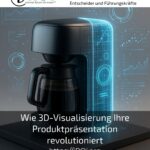
3D visualisation has established itself as a key technology for taking product presentations to a whole new level. Thanks to this innovative technique, companies can not only present their products in a lifelike manner but also stage them in an impressive way. This creates compelling experiences that enthuse customers and foster trust.
Why 3D visualisation is indispensable today
3D visualisation allows products to be viewed virtually from any angle and explored in minute detail. This advantage is particularly evident with complex products from the electronics or furniture industries. For example, a furniture manufacturer uses 3D models to present different colour and material variations in a lifelike way. This allows potential buyers to conveniently compare different fabric types or designs without touching physical samples. The automotive industry also benefits by realistically visualising and individually customising vehicle models before production.
3D visualisation not only supports visual representation. Technical details such as circuit diagrams, internal parts or operating functions can be conveyed interactively and in an easily understandable way, which are crucial sales arguments, particularly in the medical technology and mechanical engineering industries.
BEST PRACTICE with one customer (name hidden due to NDA contract)
A manufacturer of high-end electronics used 3D visualisation to digitally develop complex product variations and coordinate directly with customers. This allowed a wide range of configurations to be displayed virtually and feedback to be incorporated immediately, thereby shortening development times and increasing customer satisfaction.
Efficiency improvement through early visualisation and cost savings
Traditional product presentations often require expensive prototypes and elaborate photoshoots. 3D visualisation replaces these cost traps with virtual models that can be easily adapted and used in high quality. In the fashion industry, designers use this method to digitally optimise cut lines and colour combinations before a physical sample is produced. This saves materials, time and costs, as inaccurate production is reduced.
In industry too, digital representation saves considerable resources. Mechanical engineers showcase their systems in photorealistic renderings that serve as a convincing communication tool not only for customers but also for investors and partners. Adjustments can be made quickly, for example, to present new features or construction variants without the need for new prototypes or photoshoots.
BEST PRACTICE with one customer (name hidden due to NDA contract)
A furniture supplier significantly reduced development costs through 3D visualisation. Customers could participate digitally during the design process and directly contribute their wishes. This eliminated costly remanufacturing and sped up market launch.
How 3D visualisation contributes to better customer loyalty
The interactive possibilities of 3D visualisation bring another significant advantage: customers can experience products virtually and configure them individually. In e-commerce, for example, this technology allows a product to be rotated in real-time, colours changed, or technical features activated. This promotes understanding and creates a strong emotional connection to the product.
Architects and interior designers use 3D visualisation to vividly present construction projects or interior design concepts. Clients can immediately see the effect of different materials, lighting, or furnishings. This experience makes decisions easier and significantly increases confidence before purchasing.
In medical technology too, 3D presentations make it possible to clearly explain the functions or handling of medical devices. The combination of realism and interactive display makes it easier to convey complex technologies – a valuable competitive advantage.
BEST PRACTICE with one customer (name hidden due to NDA contract)
A provider of technical medical devices used interactive 3D visualisations to help retailers and end customers better understand how to use its products. The clear depictions and animations increased customer engagement and effectively supported sales.
Practical tips for using 3D visualisation
For a successful product presentation, the following approach is recommended:
- Define the target audience and their information needs from the outset.
- Use 3D models to appealingly visualise different variations, product details, and features.
- For complex products, focus on interactive elements that allow for individual exploration.
- Plan the integration of the visualisations across different channels, such as your website, social media or presentations.
- Involve your customers and partners early on to implement feedback directly.
These tips support companies in impressively showcasing extensive product worlds with 3D visualisation and facilitating decision-making processes.
My analysis
3D visualisation offers diverse opportunities to significantly improve product presentations. It gives companies the ability to showcase products realistically, flexibly, and interactively. This allows them to provide customers with impressive insights and individual experiences. At the same time, the technology enables significant cost and time savings by eliminating the need for elaborate prototypes and photoshoots. In many industries – from furniture manufacturing to medical technology – iROI Coaching supports the optimal integration of 3D visualisation and guides projects to success with confidence. Due to these advantages, 3D visualisation is a valuable tool in an increasingly digital world to sustainably strengthen marketing and sales strategies.
Further links from the text above:
How 3D visualisation revolutionises your product presentation
30 Great 3D Product Showcase & Visualisation Videos
Warum 3D-Visualisierung ein Muss für Produkte ist
Top 20 Examples of 2D Product Presentation Videos…
3D Product Visualisation – Examples, Costs & Benefits
For more information and if you have any questions, please contact Contact us or read more blog posts on the topic internet Return on Investment - Marketing here.






 Deutsch
  English (UK)