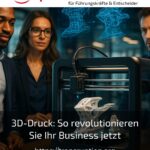
3D Printing: Impulses for Your Business
Those who wish to remain competitive today will find in 3D printing a key technology that is changing not only mindsets but also workflows and product worlds. Additive manufacturing – the synonym for 3D printing – allows companies to implement ideas faster, more individually and often more cost-effectively than with classic processes. From prototyping to series production, from individualisation to sustainability: 3D printing holds opportunities for almost every industry.
How 3D printing speeds up processes and reduces costs
3D printing is synonymous with the rapid and flexible production of components, prototypes and tools. Companies often report that this technology significantly reduces their time-to-market because product design iterations are possible in a very short time. The automotive industry, for example, uses 3D printing to test new models more quickly and make adjustments directly, thereby shortening development cycles by weeks or even months[6]. In the aerospace industry too, 3D printing leads to lighter, more durable components that reduce fuel consumption and thus enable significant savings over the service life of an aircraft[5].
In manufacturing and mechanical engineering, additive manufacturing has long been commonplace: complex clamping devices, spare parts on demand, or individually adapted tools can be produced without long delivery times and warehousing [3]. A major car manufacturer uses 3D printing to recreate spare parts for historic vehicles that would otherwise no longer be available [4]. This not only reduces costs but also increases customer satisfaction.
Industry examples: 3D printing in practice
In medical technology, 3D printing is revolutionising the production of custom implants, prosthetics, and dental prostheses. Doctors benefit from perfectly fitting solutions that support recovery and reduce complications. In education, 3D printing imparts practical technical and creative skills, as pupils and students can design and print their own models. Artists and designers are also using the technology to realise unique sculptures and installations that would not be possible with traditional methods.
The jewellery and fashion industries are developing bespoke accessories and shoes that are precisely tailored to the body – a trend that combines customisation and sustainability[4]. 3D printing is even being used in space, as astronauts can produce tools and spare parts directly on-site, without waiting for deliveries from Earth[4].
Disruptions coaching for 3D printing projects
Many companies face the challenge of how to optimally integrate 3D printing into their processes. Transruption Coaching supports you through this transformation because it's not just about technology, but also about people, structures, and mindsets. Clients often report uncertainty when selecting suitable materials, quality assurance, or integrating additive manufacturing into existing workflows.
In coaching, we will jointly analyse where 3D printing can bring the greatest added value to your company. We will support you in developing new business models, optimising internal processes, and training your teams. This is how a technology becomes a real competitive advantage, making your company fit for the future.
Example from practice: 3D printing in mechanical engineering
BEST PRACTICE at the customer (name hidden due to NDA contract) A medium-sized mechanical engineering company initially only used 3D printing for prototypes. In a coaching session, we jointly recognised that series-producible components could also be manufactured cost-effectively and quickly. Today, the company produces critical parts directly on-site, saving warehousing costs and reducing delivery times. Furthermore, the integration of 3D printing led to greater flexibility for special requests and short-term orders.
Vorbild aus der Praxis: Personalisierung in der Medizintechnik
BEST PRACTICE at the customer (name hidden due to NDA contract) A medical device manufacturer used 3D printing to produce customised implants for patients. The coaching helped to optimise the processes from data capture to the finished product, enabling shorter lead times, reduced error rates and increased patient satisfaction. The technology made it possible to precisely address individual anatomical conditions.
Real-world example: Sustainability in the consumer goods industry
BEST PRACTICE at the customer (name hidden due to NDA contract) A provider of lifestyle products integrated 3D printing to offer sustainable, tailored accessories. In coaching sessions, we analysed together how material consumption and waste could be minimised. Today, the company not only reduces resources but also differentiates itself from the competition with unique designs. Customers appreciate the individuality and the ecological aspect.
Actionable recommendations for getting started with 3D printing
Start with a pilot project to explore the possibilities of 3D printing. Choose a component or product that you currently produce or store with significant effort. Test how additive manufacturing affects costs, time, and quality. Use the experience gained to identify further applications and gradually expand them.
Invest in the training of your employees, as 3D printing requires new skills in design, material selection, and post-processing. Work with experienced service providers before building your own capacity – this way, you gain practical experience without making high investments[7].
Consider new business models that are made possible by customisation, on-demand production, or sustainable manufacturing. 3D printing opens up avenues to address customer needs more precisely and to stand out from the standard.
My analysis
3D printing is no longer a futuristic vision, but a lived reality in many industries. The technology accelerates innovation processes, promotes individualisation and helps to conserve resources. Companies that strategically use 3D printing report greater flexibility, shorter delivery times and new business opportunities. Transruption Coaching will support you in identifying potential, overcoming hurdles and actively shaping the transformation. This way, 3D printing becomes a tool for sustainable business success.
For more information and if you have any questions, please contact Contact us or read more blog posts on the topic TRANSRUPTION here.
Further links from the text above:
Areas of use for 3D printing (3d-model.com) [1]
Innovative 3D printing applications (stratasys.com) [2]
3D printing in industrial applications (bigrep.com) [3]
15 Business Ideas for 3D Printing (sculpteo.com) [4]
Which industries use 3D printing (trumpf.com) [5]
25 (unexpected) applications for 3D printing (formlabs.com) [6]
3Faktur: Your 3D Printing Service Provider (3faktur.com) [7]






 Deutsch
  English (UK)