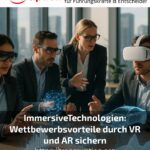
Immersive technologies as the key to increasing competitiveness
Immersive technologies have become highly relevant across all industries in recent years. They offer a wide range of opportunities to optimise business processes and create new customer experiences. Companies that make targeted use of immersive technologies often benefit from increased efficiency, cost savings and improved innovation management.
Efficiency and innovation through immersive technologies in development and production
In the area of product development, immersive technologies enable the creation and testing of virtual prototypes. This allows design changes to be realised quickly and cost-effectively without having to produce physical models. This significantly reduces development time and minimises sources of error. Production processes can also be planned and simulated in virtual environments in order to recognise inefficiencies at an early stage. In production, immersive solutions also help to display work instructions directly in the employees' field of vision, thereby reducing error rates and time expenditure.
BEST PRACTICE at company XYZ (name changed due to NDA contract) In the automotive industry, a VR system was implemented that enabled engineers to perform interactive 3D modelling. The team could therefore virtually assemble vehicles in real-time and make optimisations before physical prototypes were created. This led to significant time savings in the development phase and considerably improved product quality.
In mechanical engineering too, simulating production processes using immersive technologies proved valuable for reducing costs and making processes more efficient.
New approaches to marketing and sales through immersive experiences
Immersive technologies are also fundamentally changing customer interaction. Augmented reality (AR) allows customers to virtually experience products in their own environment, for example, seeing furniture items directly in their living room. Virtual reality (VR) creates immersive showrooms or realistic product presentations, generating an emotional and intense purchasing experience. Such applications help companies increase customer attention and engagement, which also has a knock-on effect on conversion rates.
BEST PRACTICE at company XYZ (name changed due to NDA contract) A provider from the fashion industry implemented VR-based runway shows that virtually place customers in the front rows. The experience of being close to the event created a strong bond with the brand and increased sales of selected collections through emotional storytelling.
This immersive world of experience also supports search engine optimisation, as interactive offers increase the time spent on websites and improve the user experience.
Immersive technologies for training and collaboration
Many companies use immersive technologies for training and further education. Employees learn hands-on in simulated work environments, without risks and with individual customisation of the learning pace. In addition to qualification, this also promotes commitment and motivation. At the same time, VR-based virtual meetings enable location-independent collaboration, which reduces business travel costs and increases the quality of communication.
BEST PRACTICE at company XYZ (name changed due to NDA contract) In the field of medical technology, VR training was used for complex operating procedures on new devices. Employees could avoid errors in virtual scenarios and safely learn how to handle the technology, which subsequently increased productivity.
International teams also benefit from immersive technologies because they create a common basis without physical distance through virtual environments.
Challenges and support for immersive technologies
Of course, there are also challenges when introducing immersive technologies: The costs for hardware and customised software development are high. In addition, technical expertise and strategic planning are required to ensure that the deployment actually creates added value and can be meaningfully integrated into existing processes. Many companies report that accompanying advice and coaching are helpful in providing impetus, overcoming internal resistance and implementing projects in a targeted manner. Coaching helps to define realistic goals, utilise resources correctly and ensure that the benefits of immersive technologies are sustainable.
My analysis
Immersive technologies offer diverse approaches to give businesses in various sectors a competitive edge. From product development and marketing through to employee training, they open up new perspectives for more efficient and customer-oriented solutions. Integration is most successful with supportive consulting that addresses the specific challenges within a company and guides practical implementation. In this way, companies can achieve sustainable competitive advantages through immersive technologies.
Further links from the text above:
[1] An overview of AR and VR technologies: 8 benefits for businesses
[2] How Augmented and Virtual Reality Are Used in Marketing
[3] Augmented Reality and Its Influence on SEO
[4] Immersive Technologies: A Look at Opportunities and Risks
[6] Virtual reality: challenges, advantages & use cases in the industry
For more information and if you have any questions, please do not hesitate to contact us regarding the topic. Immersive technologies or read more blog posts on the topic Immersive technologies here.






 Deutsch
  English (UK)