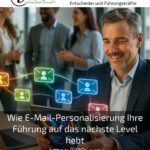
Email personalisation has proven to be a powerful tool for enhancing communication with recipients and significantly increasing the impact of messages. Executives, in particular, are increasingly using personalised email techniques to elevate their internal and external leadership to the next level. Targeted, individualised approaches can sustainably strengthen engagement, trust, and loyalty.
How Email Personalisation Supports Executives in Their Communication
In today's world, characterised by a multitude of information, recipients are less willing to pay attention to generic messages. High-level leadership therefore requires tailoring communication with employees, partners, and customers. This is where the value of email personalisation clearly emerges.
A good example of this is personalised communication within internal exchanges. For instance, a team leader at a medium-sized software company sends emails with specific success figures and individual goal reminders to each team member. This makes everyone feel included and more motivated. This visibly increases team performance and improves cohesion.
The benefit is also great in sales: A sales manager in the consumer goods industry uses personalised emails to take customer data and purchase histories into account. This ensures that offers are precisely tailored to the customer's current situation and the conversion rate increases. Feedback shows that customers appreciate the individual support and are more willing to place repeat orders.
Not least, project managers benefit: A project manager in the automotive supply industry informs stakeholders via personalised updates tailored to their roles and relevant milestones. This reduces information overload and avoids misunderstandings. Project communication thus becomes more efficient and focused.
Practical tips on applying email personalisation in everyday leadership
Anyone who wants to implement email personalisation effectively should consider the following approaches:
First, careful segmentation of the recipient list is essential. Managers could filter their contacts by departments, functions or individual interests. For example, in an international financial company, separate mailings were created for marketing, sales and support, which led to significantly higher engagement rates.
Furthermore, it is worthwhile to use dynamic content. For example, a car manufacturer can integrate personal service tips and product recommendations into its newsletters, based on previous customer contact. This contributes significantly to positive perception and loyalty.
Furthermore, managers should use meaningful subject lines that communicate individual added value. A communications manager in the healthcare sector reports that such lines increased the opening rate by up to 25 %, because recipients felt the email had been written specifically for them.
Not least, the integration of feedback elements, such as short surveys or direct questions, can deepen the relationship. An example is an educational institution that uses personalised emails to combine inquiries about course offerings with targeted response options – this creates new, valuable dialogues.
BEST PRACTICE with one customer (name hidden due to NDA contract)
BEST PRACTICE with one customer (name hidden due to NDA contract) The company in the sustainable consumption sector uses targeted email personalisation to inform executives and employees about ongoing change processes. With the help of segmented lists and individual progress updates, all stakeholders feel directly addressed and better involved. This significantly supported the agile transformation and strengthened internal collaboration.
What concrete effect does email personalisation have on your leadership?
Personalised emails achieve significantly higher open and click-through rates. Studies prove that personalised subject lines can increase open rates by up to 20% and click-through rates by double compared to unpersonalised emails.
This allows e-mail personalisation to sustainably increase recipient engagement, which in leadership means: information is received more precisely and effectively. This facilitates decision-making processes, increases motivation and supports the development of trusting relationships.
Another advantage is the optimisation of email communication for efficiency and time-saving. With well-segmented and intelligently designed newsletters, managers can anticipate frequently recurring questions, thereby simplifying daily work.
This not only strengthens the perception of the leader as approachable and confident, but also fosters long-term employee and customer loyalty. This gives leaders a clear competitive advantage and creates momentum that leads to sustainable success.
My analysis
Email personalisation goes beyond just using a name and opens up diverse opportunities for leaders to purposefully enhance their communication. It fosters dialogue, creates appreciation, and increases efficiency in information dissemination. Those who systematically employ this technique not only support dialogue with employees and customers but also elevate their own leadership quality to a new level.
iROI-Coaching would be delighted to support you in projects related to email personalisation and to show you practical ways to make your communication strategy individual and effective. This will give you impulses that tangibly strengthen your leadership and enable sustainable results.
Further links from the text above:
Advantages of personalised emails – Adobe Business
Personalisation in Email Marketing – OMR
How does personalisation work? – Appvizer
Email Personalisation: A Must-Have – Kameleoon
Why personalise emails? - IM RM
For more information and if you have any questions, please contact Contact us or read more blog posts on the topic internet Return on Investment - Marketing here.






 Deutsch
  English (UK)