kiroi.org

KIROI - Artificial Intelligence Return on Invest
The AI strategy for decision-makers and managers

Business excellence for decision-makers & managers by and with Sanjay Sauldie

KIROI - Artificial Intelligence Return on Invest: The AI strategy for decision-makers and managers

KIROI - Artificial Intelligence Return on Invest: The AI strategy for decision-makers and managers

Start » KIROI step 9: Rethink management development
20 August 2025

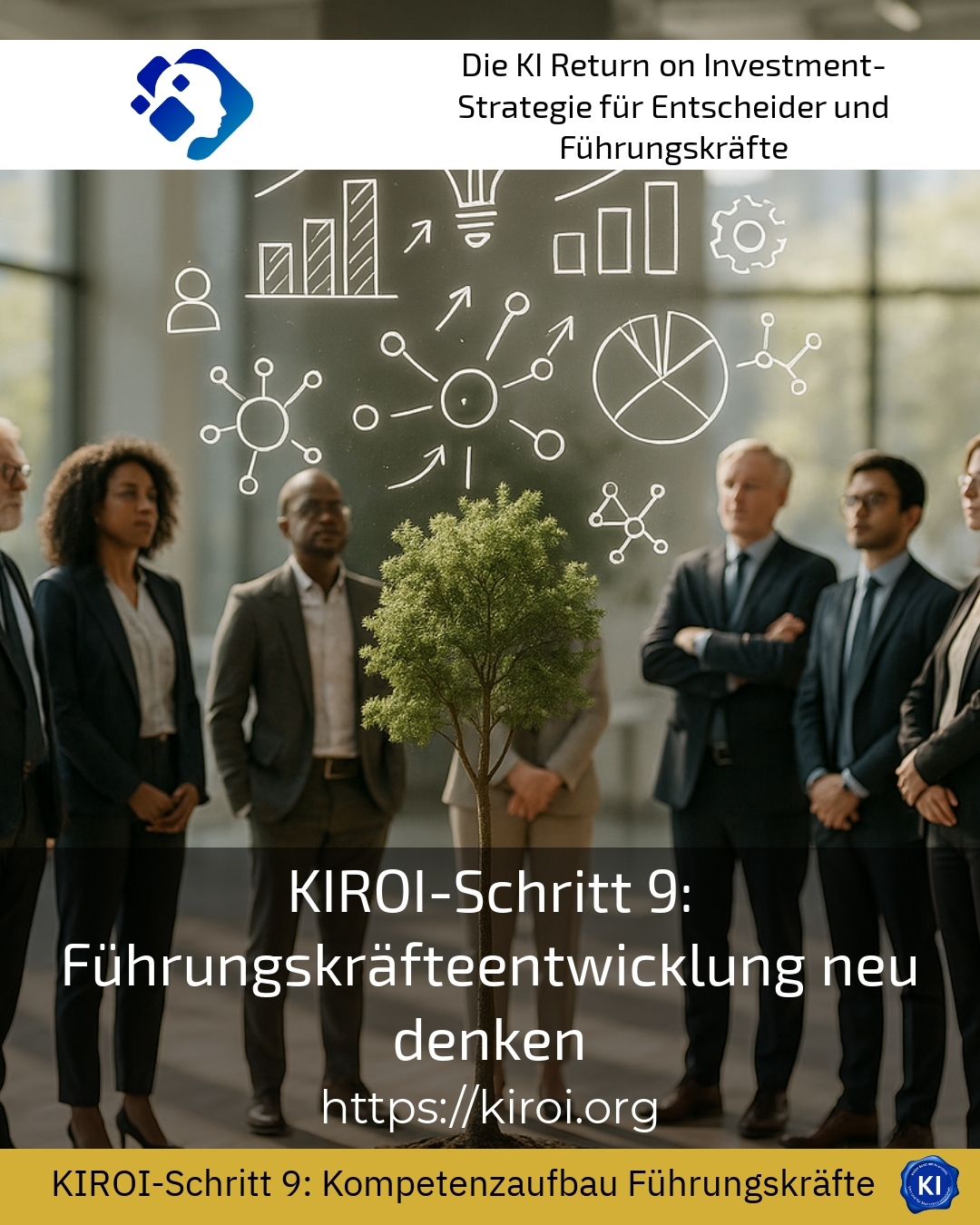
KIROI step 9: Rethink management development

4.3
(658)


Rethinking Leadership Development – KIROI Step 9


A company's future depends heavily on its leaders. This is why leadership development is more important today than ever. This ninth step of the KIROI method addresses a central issue: how organisations can promote their leaders in a targeted and sustainable manner. Modern leadership development means more than just classic seminars. It combines individual coaching with strategic company goals. transruptions-Coaching will accompany you as a competent partner on projects related to leadership development. Together, we will create new ways to strengthen your leaders.

Why leadership development needs to be rethought

The classic approaches to leadership development are showing their limits. Many companies are still relying on one-off training. While these seminars impart knowledge, the connection to reality is often missing. Leaders return to their daily routines and cannot implement what they have learned. This is frustrating for everyone involved.

A systematic approach to leadership development works differently. It directly links development to the company's challenges.[2] Leaders work on real projects and learn in the process. This method is more sustainable and effective. But how do you implement this in practice?

Companies such as Siemens and Bosch have understood that leadership development is a continuous process.[1] They regularly offer internal programmes. These programmes are tailored to the specific requirements of the organisation. Larger corporations invest strategically in their leaders. Medium-sized companies should follow this example.

Core Methods of Modern Leadership Development

There are various proven methods for developing leaders. [3] A combination of several approaches yields the best results. Let's take a closer look at the most important methods.

Coaching and mentoring as the core of leadership development

Coaching is a highly individual method of leadership development. A coach works one-to-one with the leader. Together, they work through personal and professional challenges. The focus is on the individual person. Their specific problems are at the centre.

Mentoring works differently, but is no less valuable.[3] Here, an experienced leader shares their knowledge with a younger colleague. The exchange is personal and designed for the long term. Google and IBM make extensive use of mentoring.[4] They know that human interaction is priceless.

A more recent trend is reverse mentoring.[9] Here, younger employees mentor older executives. They bring new perspectives and digital knowledge. Both sides benefit from this. This model of leadership development suits modern organisations.

BEST PRACTICE with one customer (name hidden due to NDA contract)A large financial services corporation implemented coaching for its junior executives. Each junior executive received an external coach for two years. The coaches supported the executives on their first major projects. In parallel, experienced executives were selected as internal mentors. The company combined both methods. The result: 85 per cent of the junior executives remained with the company and developed into valuable leaders. The investment in executive development paid off.

Leadership training and workshops as a foundation

Seminars and workshops are classic but not outdated. They systematically impart leadership skills. Topics such as communication, conflict resolution, and strategic thinking are the focus. These trainings take place in a structured format. They offer a formal, organised environment for learning.

Bosch regularly offers management training courses. These are aimed at various hierarchical levels. A bank in Stuttgart implemented conflict communication training. After three days of intensive training, the managers were better able to conduct difficult conversations. One year later, the results were clear: staff turnover in their teams fell by 20 percent. Good management development training has a lasting effect.

Modern workshops are interactive and practice-oriented.[9] They encourage active participation rather than passive consumption. Participants work on real cases. They discuss scenarios from their daily lives. This makes the transfer to practice much easier. A large insurance group uses so-called Business Simulation Trainings. Executives make simulated decisions here and experience the consequences. This way they learn faster and more effectively.[1]

Action Learning for Practical Leadership Development

Action Learning combines learning with real problem-solving. [4] Leaders work in groups on real company challenges. They put their knowledge into practice. They experience immediately whether their solutions work. This method of leadership development is highly effective. [3]

Lufthansa has successfully integrated Action Learning. Its managers work together on improvement projects. They optimise processes or develop new services. In parallel, they reflect on their learning processes. This results in genuine leadership development that stems from practical experience. A mechanical engineering company used Action Learning for digitalisation. Managers worked in groups on concrete IT projects. They learned agile methods by applying them. After six months, they were much better able to lead their teams in digital transformation.

BEST PRACTICE with one customer (name hidden due to NDA contract)A pharmaceutical company used Action Learning for leadership development. Small groups worked on real business problems over four months, guided by experienced leaders as coaches. One group optimised the supply chain, saving over a million euros. Another group developed a new sales model. Participants not only gained theoretical knowledge in leadership development, but also experienced how their decisions had a real impact. The company benefited twice over: through improved business results and through developed leaders.

E-learning and digital formats in leadership development

Digital learning platforms open up new opportunities. Leaders can learn flexibly, regardless of time and place. They select their learning modules as needed. An online course on emotional intelligence can be completed at the airport. Webinars enable interaction despite geographical distance.

E-learning offers great flexibility for leadership development.[2] The training units are repeatable. Leaders can work through complex content multiple times. Virtual role-playing exercises train communication skills. A large retail group uses e-learning platforms. Its leaders work through modules on sales psychology. They receive immediate feedback. After three months, measurements show that their sales are increasing.[1]

However, e-learning should only be part of a comprehensive strategy for leadership development. [11] Human interaction cannot be fully replaced digitally. The best solution combines online formats with in-person days. A banking association combines e-learning with virtual coaching sessions. Its leaders complete online modules on strategy topics. They then discuss their findings with a coach. This blended approach to leadership development shows excellent results. [10]

Job rotation and practical learning

Job rotation is an underestimated method of leadership development. Leaders switch to other departments for a defined period. They get to know other business areas. They gain a better understanding of the company's interrelationships. Their horizons widen.

An automotive supplier is deliberately using job rotation. [3] Junior managers go through four different departments consecutively. Each placement lasts for six months. They lead teams but continually gain new experience. After two years, they have a comprehensive overview of the entire company. Later, as managers, they are able to overcome departmental boundaries. [1] This strengthens collaboration throughout the company.

Learning by doing is a principle of practical leadership development. Leaders learn best when they are actually leading. They gain experience in real projects. They sometimes fail and learn from mistakes. A consulting firm quickly gives its junior leaders small teams. They are allowed to experiment and sometimes make wrong decisions. The experienced coach helps with reflection. This is how leadership development works in practice.

Individual development plans as a structure for leadership development

Good leadership development follows a plan. Every leader should receive an individual development plan. This plan outlines any missing skills. It names concrete goals. It describes the measures that are planned.

The first step is an honest assessment of potential. Where does the leader stand today? What are their strengths? Where is there a need for development? This analysis should be based on several pillars. 360-degree feedback provides various perspectives. The superior assesses. Colleagues and employees give feedback. The leader's self-assessment also counts. Development goals arise from this analysis.

BEST PRACTICE with one customer (name hidden due to NDA contract)A large industrial group implemented individual development plans for all 300 managers as part of its leadership development programme. The plans were designed to last two years. Each plan focused on three to four concrete development objectives. At least one action was defined for each objective. This could be coaching, a workshop, or job rotation. The HR team met with each manager quarterly. They reflected on progress and adjusted objectives if necessary. After two years, 240 managers had achieved at least two of their objectives. The staff turnover rate decreased by 15 percent, and the employee satisfaction of these managers' teams increased.

Staff appraisal meetings are central to leadership development.[1] They should take place at least once a year. The supervisor and the manager work together. What goals were achieved? What worked well? What new insights have been gained? What priorities are shifting? These regular discussions bring leadership development to life.[1]

Succession planning and talent pipeline as a strategic aspect

Leadership development also has a strategic dimension.[4] Companies must ensure that leadership positions can be filled. This requires planned succession. A pipeline of talented candidates is needed. High potentials must be identified and developed early.[4]

Deutsche Bank makes systematic use of succession planning. The company identifies high potentials early on. These individuals receive intensive support for leadership development. They are specifically prepared for leadership roles. This ensures there are no gaps in the management ranks. When an important position becomes vacant, there are already prepared candidates.

A medium-sized company in the mechanical engineering sector took a different approach. It recognised that many older managers would retire in the next five years. The company launched a major leadership development programme. It identified high-potential individuals in the lower management ranks. These individuals were prepared over two years in a special programme. Case studies, mentoring, and job rotation were central. Today, the company can fill all positions internally. This would not have been possible without conscious leadership development.

The four core areas of leadership development

Leadership development can be divided into four sub-areas.[5] These four areas interlock.
How useful was this post?

Click on a star to rate it!

Average rating 4.3 / 5. Vote count: 658

No votes so far! Be the first to rate this post.

Spread the love


transruption.org

The digital toolbox for
the digital winners of today and tomorrow

Business excellence for decision-makers & managers by and with Sanjay Sauldie

transruption
transruption

transruption: The digital toolbox for
the digital winners of today and tomorrow

Start » KIROI step 9: Rethink management development
20 August 2025

KIROI step 9: Rethink management development

4.3
(658)


Rethinking Leadership Development – KIROI Step 9


A company's future depends heavily on its leaders. This is why leadership development is more important today than ever. This ninth step of the KIROI method addresses a central issue: how organisations can promote their leaders in a targeted and sustainable manner. Modern leadership development means more than just classic seminars. It combines individual coaching with strategic company goals. transruptions-Coaching will accompany you as a competent partner on projects related to leadership development. Together, we will create new ways to strengthen your leaders.

Why leadership development needs to be rethought

The classic approaches to leadership development are showing their limits. Many companies are still relying on one-off training. While these seminars impart knowledge, the connection to reality is often missing. Leaders return to their daily routines and cannot implement what they have learned. This is frustrating for everyone involved.

A systematic approach to leadership development works differently. It directly links development to the company's challenges.[2] Leaders work on real projects and learn in the process. This method is more sustainable and effective. But how do you implement this in practice?

Companies such as Siemens and Bosch have understood that leadership development is a continuous process.[1] They regularly offer internal programmes. These programmes are tailored to the specific requirements of the organisation. Larger corporations invest strategically in their leaders. Medium-sized companies should follow this example.

Core Methods of Modern Leadership Development

There are various proven methods for developing leaders. [3] A combination of several approaches yields the best results. Let's take a closer look at the most important methods.

Coaching and mentoring as the core of leadership development

Coaching is a highly individual method of leadership development. A coach works one-to-one with the leader. Together, they work through personal and professional challenges. The focus is on the individual person. Their specific problems are at the centre.

Mentoring works differently, but is no less valuable.[3] Here, an experienced leader shares their knowledge with a younger colleague. The exchange is personal and designed for the long term. Google and IBM make extensive use of mentoring.[4] They know that human interaction is priceless.

A more recent trend is reverse mentoring.[9] Here, younger employees mentor older executives. They bring new perspectives and digital knowledge. Both sides benefit from this. This model of leadership development suits modern organisations.

BEST PRACTICE with one customer (name hidden due to NDA contract)A large financial services corporation implemented coaching for its junior executives. Each junior executive received an external coach for two years. The coaches supported the executives on their first major projects. In parallel, experienced executives were selected as internal mentors. The company combined both methods. The result: 85 per cent of the junior executives remained with the company and developed into valuable leaders. The investment in executive development paid off.

Leadership training and workshops as a foundation

Seminars and workshops are classic but not outdated. They systematically impart leadership skills. Topics such as communication, conflict resolution, and strategic thinking are the focus. These trainings take place in a structured format. They offer a formal, organised environment for learning.

Bosch regularly offers management training courses. These are aimed at various hierarchical levels. A bank in Stuttgart implemented conflict communication training. After three days of intensive training, the managers were better able to conduct difficult conversations. One year later, the results were clear: staff turnover in their teams fell by 20 percent. Good management development training has a lasting effect.

Modern workshops are interactive and practice-oriented.[9] They encourage active participation rather than passive consumption. Participants work on real cases. They discuss scenarios from their daily lives. This makes the transfer to practice much easier. A large insurance group uses so-called Business Simulation Trainings. Executives make simulated decisions here and experience the consequences. This way they learn faster and more effectively.[1]

Action Learning for Practical Leadership Development

Action Learning combines learning with real problem-solving. [4] Leaders work in groups on real company challenges. They put their knowledge into practice. They experience immediately whether their solutions work. This method of leadership development is highly effective. [3]

Lufthansa has successfully integrated Action Learning. Its managers work together on improvement projects. They optimise processes or develop new services. In parallel, they reflect on their learning processes. This results in genuine leadership development that stems from practical experience. A mechanical engineering company used Action Learning for digitalisation. Managers worked in groups on concrete IT projects. They learned agile methods by applying them. After six months, they were much better able to lead their teams in digital transformation.

BEST PRACTICE with one customer (name hidden due to NDA contract)A pharmaceutical company used Action Learning for leadership development. Small groups worked on real business problems over four months, guided by experienced leaders as coaches. One group optimised the supply chain, saving over a million euros. Another group developed a new sales model. Participants not only gained theoretical knowledge in leadership development, but also experienced how their decisions had a real impact. The company benefited twice over: through improved business results and through developed leaders.

E-learning and digital formats in leadership development

Digital learning platforms open up new opportunities. Leaders can learn flexibly, regardless of time and place. They select their learning modules as needed. An online course on emotional intelligence can be completed at the airport. Webinars enable interaction despite geographical distance.

E-learning offers great flexibility for leadership development.[2] The training units are repeatable. Leaders can work through complex content multiple times. Virtual role-playing exercises train communication skills. A large retail group uses e-learning platforms. Its leaders work through modules on sales psychology. They receive immediate feedback. After three months, measurements show that their sales are increasing.[1]

However, e-learning should only be part of a comprehensive strategy for leadership development. [11] Human interaction cannot be fully replaced digitally. The best solution combines online formats with in-person days. A banking association combines e-learning with virtual coaching sessions. Its leaders complete online modules on strategy topics. They then discuss their findings with a coach. This blended approach to leadership development shows excellent results. [10]

Job rotation and practical learning

Job rotation is an underestimated method of leadership development. Leaders switch to other departments for a defined period. They get to know other business areas. They gain a better understanding of the company's interrelationships. Their horizons widen.

An automotive supplier is deliberately using job rotation. [3] Junior managers go through four different departments consecutively. Each placement lasts for six months. They lead teams but continually gain new experience. After two years, they have a comprehensive overview of the entire company. Later, as managers, they are able to overcome departmental boundaries. [1] This strengthens collaboration throughout the company.

Learning by doing is a principle of practical leadership development. Leaders learn best when they are actually leading. They gain experience in real projects. They sometimes fail and learn from mistakes. A consulting firm quickly gives its junior leaders small teams. They are allowed to experiment and sometimes make wrong decisions. The experienced coach helps with reflection. This is how leadership development works in practice.

Individual development plans as a structure for leadership development

Good leadership development follows a plan. Every leader should receive an individual development plan. This plan outlines any missing skills. It names concrete goals. It describes the measures that are planned.

The first step is an honest assessment of potential. Where does the leader stand today? What are their strengths? Where is there a need for development? This analysis should be based on several pillars. 360-degree feedback provides various perspectives. The superior assesses. Colleagues and employees give feedback. The leader's self-assessment also counts. Development goals arise from this analysis.

BEST PRACTICE with one customer (name hidden due to NDA contract)A large industrial group implemented individual development plans for all 300 managers as part of its leadership development programme. The plans were designed to last two years. Each plan focused on three to four concrete development objectives. At least one action was defined for each objective. This could be coaching, a workshop, or job rotation. The HR team met with each manager quarterly. They reflected on progress and adjusted objectives if necessary. After two years, 240 managers had achieved at least two of their objectives. The staff turnover rate decreased by 15 percent, and the employee satisfaction of these managers' teams increased.

Staff appraisal meetings are central to leadership development.[1] They should take place at least once a year. The supervisor and the manager work together. What goals were achieved? What worked well? What new insights have been gained? What priorities are shifting? These regular discussions bring leadership development to life.[1]

Succession planning and talent pipeline as a strategic aspect

Leadership development also has a strategic dimension.[4] Companies must ensure that leadership positions can be filled. This requires planned succession. A pipeline of talented candidates is needed. High potentials must be identified and developed early.[4]

Deutsche Bank makes systematic use of succession planning. The company identifies high potentials early on. These individuals receive intensive support for leadership development. They are specifically prepared for leadership roles. This ensures there are no gaps in the management ranks. When an important position becomes vacant, there are already prepared candidates.

A medium-sized company in the mechanical engineering sector took a different approach. It recognised that many older managers would retire in the next five years. The company launched a major leadership development programme. It identified high-potential individuals in the lower management ranks. These individuals were prepared over two years in a special programme. Case studies, mentoring, and job rotation were central. Today, the company can fill all positions internally. This would not have been possible without conscious leadership development.

The four core areas of leadership development

Leadership development can be divided into four sub-areas.[5] These four areas interlock.

How useful was this post?

Click on a star to rate it!

Average rating 4.3 / 5. Vote count: 658

No votes so far! Be the first to rate this post.

Spread the love


Other content worth reading:

KIROI step 9: Rethink management development

written by:

Keywords:

#action learning #Big Data #Coaching #compliance #Datenintelligenz #Ethikrichtlinien 1TP5Management development #InnovationDurchAchtsamkeit #artificial intelligence #mentoring #nachfolgeplanung #Sustainability #SmartData #Unternehmenskultur #Verantwortungsketten

Follow me on my channels:

Questions on the topic? Contact us now without obligation

Contact us

[wpforms id="331781" title="false"]

More articles worth reading

    Leave a comment