
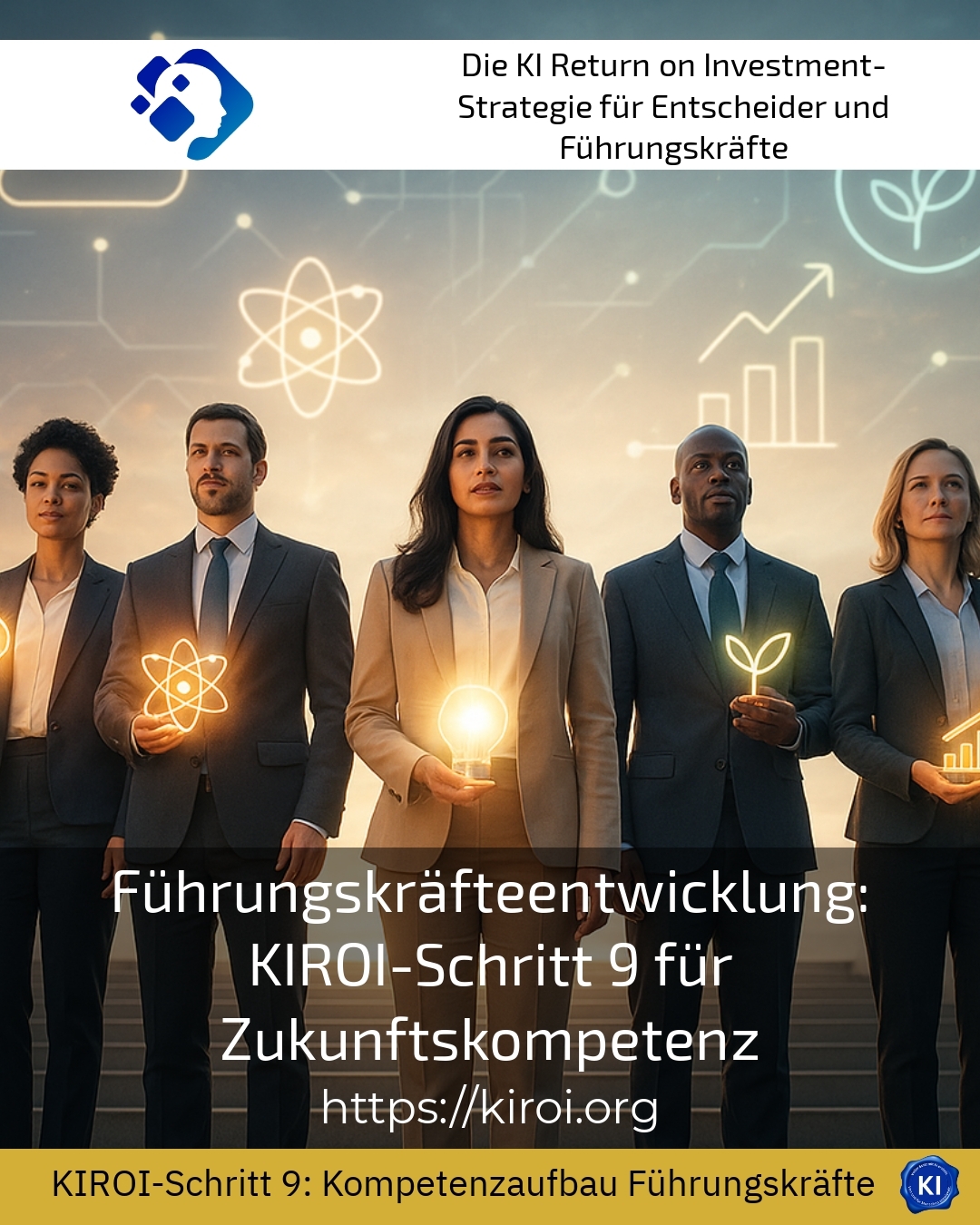
The Leadership Development plays a central role in making companies fit for the future. In particular, step 9 in the KIROI concept provides valuable impetus for fostering the necessary future competence in leaders. This is essential for managers to successfully operate in an increasingly complex and digital working world and to sustainably strengthen their teams.
Leadership Development: The Significance of Future Skills in KIROI Step 9
The ninth step of the KIROI model places a strong focus on future competencies, enabling leaders to act flexibly and responsibly in dynamic environments. In practice, this means developing creative solution approaches, decision-making skills and digital know-how alongside traditional management skills.
An example from the technology sector demonstrates how executives learn to integrate innovative digital tools into decision-making processes through targeted coaching, thereby managing their teams more agilely. Similarly, companies from the manufacturing industry frequently report that the combination of on-the-job learning and structured workshops supports problem-oriented leadership.
Executives in the financial sector also use the methods of KIROI Step 9 to strengthen their self-management skills and make well-founded decisions quickly in uncertain situations. Regular feedback discussions and 360-degree analyses play an important role in promoting reflection and development processes.
Methods for implementing future skills in everyday leadership
For sustainable leadership development, various methods are effective, which are also recommended within the KIROI Step 9:
- Coaching and Mentoring: Individual guidance supports leaders in specifically developing their personal skills.
- Action Learning Groups: In small teams, leaders tackle real-world challenges, thereby enhancing their problem-solving skills.
- Job Rotation: Moving between different areas of the company promotes a holistic understanding and strengthens adaptability.
An international service group has enhanced the decision-making capabilities of its executives through a multi-stage coaching programme. This led to faster response times during crises and a visible improvement in team dynamics.
Small and medium-sized enterprises (SMEs) also report that practical training combined with personal feedback, in particular, helps to anchor strategic competence in everyday life and to encourage self-reflection.
Leadership Development with a Focus on Future Leadership Skills
The development of so-called Future Leadership Skills is increasingly the focus of Leadership Development. This includes, among other things:
- Agility: Rapid adaptation to change and proactive action
- Digital literacy: Safety in handling new technologies and data analysis
- Decision-making ability: Critical thinking and situational judgment
- Empathy and Collaboration: Fostering an Appreciative and Connected Team Culture
- Resilience: Coping with Uncertainty and Stress
BEST PRACTICE with one customer (name hidden due to NDA contract) A medium-sized IT company used the KIROI concept to strengthen the resilience and digital competence of its executives through practice-oriented workshops and accompanying coaching. Participants reported things like now being able to make more confident decisions under uncertainty and proactively shape innovation processes.
Practical tips for integrating future skills into existing development concepts
For leadership development to be successful and future-oriented, companies should consider these aspects:
- Individual needs analysis Identify specific development areas for each manager to implement tailored measures.
- Integrating on- and off-the-job learning Combine practical, everyday learning with phases of reflection and the teaching of theory.
- Regular Feedback Cycles Utilise 360-degree feedback and performance reviews to make development progress visible.
- Flexibility in the choice of methods Adapt programmes to different learning styles and specific company contexts.
A leading pharmaceutical company regularly conducts innovation sprints in which managers in interdisciplinary teams actively test and develop future skills. This creates a living innovation culture and strengthens internal networking.
A logistics company has broadened the perspectives of its managers on business processes outside their own departments through targeted job rotation programmes. This has significantly increased cross-departmental collaboration.
My analysis
The Leadership Development gains continuously in importance through the integration of future skills. KIROI Step 9 offers practice-oriented approaches to prepare leaders for the challenges of the modern working world. In particular, a combination of digital skills, decision-making competence, and personal reflection supports leaders in successfully guiding their teams through uncertainty and change.
Targeted development programmes, integrating methods such as coaching, job rotation, and action learning, create sustainable learning environments. This not only strengthens individual leadership competence but also positively influences the overall company culture. Practical examples from various industries show that these investments pay off many times over and make companies more future-proof.
Further links from the text above:
How to achieve leadership development - general methods
What skills will be in demand for leaders in the future?
Methods of Leadership Development: Effective Tools
Future Skills for Leaders – Competencies of Leaders
Leadership Development: Trends and Measures
Future Leadership as a Future Competence
Methods for leadership development
Future skills as the key to success
For more information and if you have any questions, please contact Contact us or read more blog posts on the topic Artificial intelligence here.













 Deutsch
  English (UK)