
„`html
The modern business world presents leaders with entirely new requirements. Not only do classic management tasks need to be mastered, but technological innovations also demand a deeper understanding. This is where Leadership Development that goes far beyond traditional training methods today[1]. In particular, the integration of artificial intelligence is revolutionising the way leaders manage their teams and drive companies forward. Many organisations report that their leaders are actively seeking inspiration on how to use AI systems in their daily work and support their employees in doing so[2]. The KIROI method offers a structured framework specifically tailored to the needs of contemporary leaders.
Why leadership development in today's world can't do without AI competence
The world of work is changing rapidly and with it the demands on leaders. Artificial intelligence is no longer a future technology, but already a part of everyday working life today[1]. Leaders must understand how these technologies work and what opportunities they offer. At the same time, they must be able to competently discuss ethical questions with their teams.
The Leadership Development must therefore be continuously renewed. Classical seminars alone are no longer enough. Instead, modern managers need a mix of different learning formats[1]. They must be able to make data-driven decisions while simultaneously guiding their teams through transformation processes.
An example from the industry illustrates this: a manager in a manufacturing company learns how AI-driven systems monitor production processes. They understand the technological context and can train their employees effectively. The result is increased efficiency and a greater capacity for innovation throughout the entire operation.
Methods of Modern Leadership Development in the Digital Age
The methods for supporting leaders have fundamentally changed. Today, companies use a thoughtful mix of different approaches[1]. This ensures the sustainable transfer of knowledge, skills, and practical experience.
Seminars and training courses as the basis of leadership development
Classic training formats remain important, but are being enhanced with digital elements [1]. Intensive training lasting from one day to a week imparts in-depth knowledge. Topics range from self-management to the latest leadership trends and specialist content.
In a service company, such workshops took place, where managers learned how to support their employees in using AI tools[2]. They received practical exercises and concrete guidelines for action. Online courses allowed for flexible participation, while in-house training took specific company circumstances into account.
Coaching and mentoring for personalised leadership development
Individual coaching supports leaders in achieving their personal goals. Experienced mentors pass on valuable knowledge to aspiring leaders. This is done through regular discussions and reflective processes.
A particularly innovative approach is AI-based mentoring. An app called KI.m conducts natural dialogues with executives [4]. It acts as a personal coach, advisor, and trusted partner. A young junior executive who notices disagreements after a meeting with her team can discuss the situation directly afterwards with KI.m [4]. Through a structured process, she receives clarification of tasks, opportunities for reflection, and tailored advice.
Job rotation and practical project work
Rotational programmes foster a broader understanding of business processes[1]. Managers become acquainted with different departments, thereby broadening their personal horizons. This promotes knowledge sharing and creates an understanding of operational contexts.
In a trading company, managers learned through such rotations how AI systems support supply chain optimisation [2]. They saw the practical applications and were subsequently able to implement them in their own areas. Action Learning enables managers to work in small groups on real, complex problems [3]. At the same time, they develop their learning and problem-solving skills.
The KIROI Method: A Structured Approach to Leadership Development
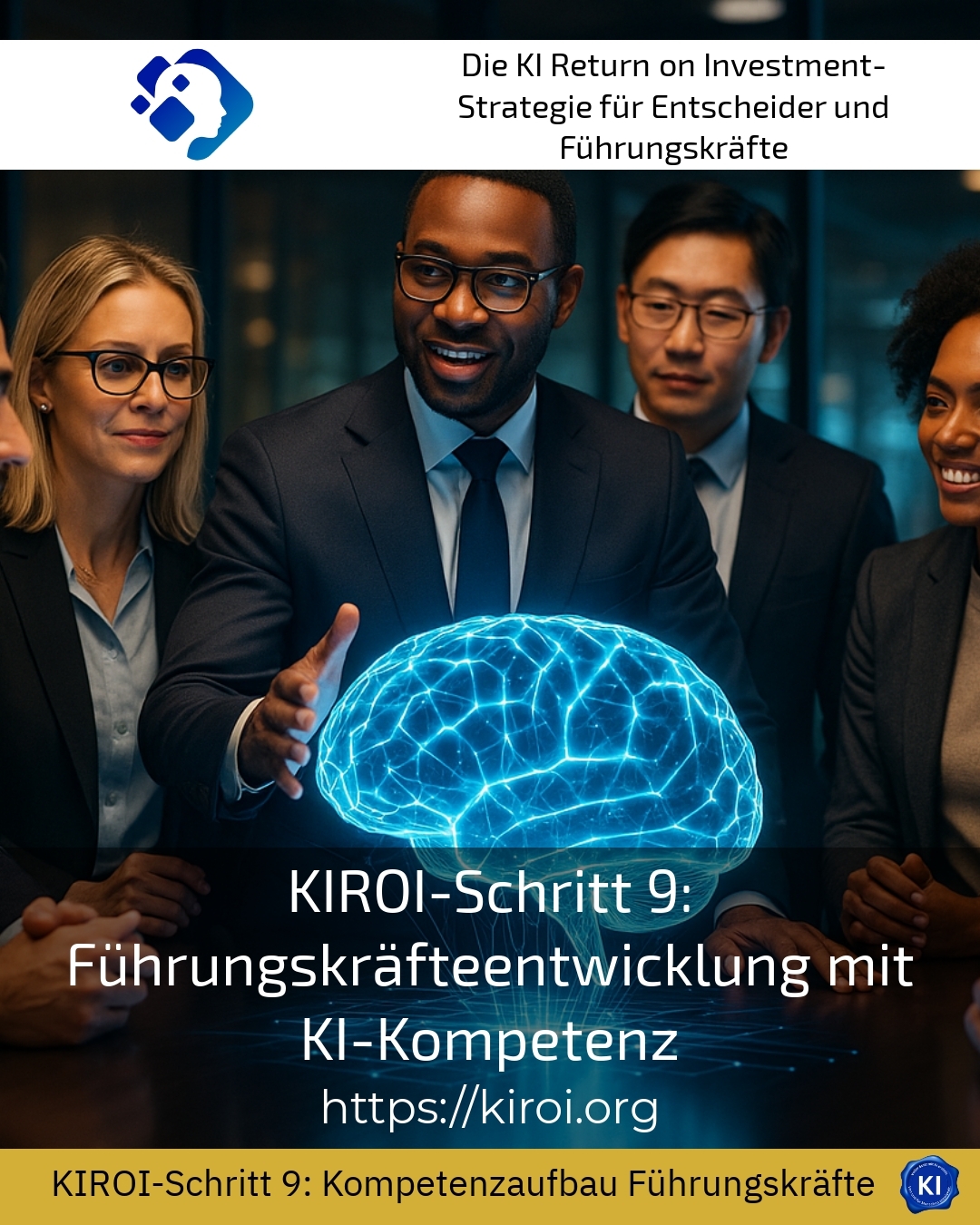
The KIROI method offers a clear framework for Leadership Development in the digital age[2]. It takes into account the specific requirements that AI integration entails. Step 9 particularly focuses on the development of AI competence among leaders.
This method supports leaders in understanding and using AI as a tool [2]. They can make data-driven decisions with it. At the same time, they learn to actively support their teams in transformation processes. The KIROI method continuously supports leaders in their ongoing development.
A concrete example shows the practical effect: In a medium-sized company, a Leadership Development Programme introduced with AI competence[2]. The leaders received workshops and practical exercises. They learned how to use AI tools in their teams. After six months, participants reported increased confidence in using AI technologies. Their employees experienced transparent and responsible leadership. Satisfaction measurably increased.
Practical implementation: From potential analysis to targeted development
A successful Leadership Development begins with a sound analysis of the current situation. It is necessary to identify exactly where the problems and deficits lie. Only then can leaders be strategically developed. This process follows several steps.
Step 1: Conduct a potential analysis
The first phase of leadership development consists of a precise analysis of current potential[7]. What skills do the leaders already possess? Where are the gaps? What new competencies are necessary?
A bank branch carried out such an analysis and identified a need for development in the use of AI for customer advice. A retail group discovered deficits in the understanding of data-driven decision-making. A logistics company recognised the need to understand AI-driven optimisation processes.
Step 2: Define Development Goals
Based on the identified needs, HR departments develop individual objectives for each manager. These objectives serve as the basis for selecting appropriate measures. They must be specific, measurable, and achievable.
A sales manager might aim to train their team members in AI-powered customer analysis. A production manager wants to understand how predictive analytics helps with maintenance planning. A project manager aims to guide their teams in the agile use of AI tools.
Step 3: Select appropriate measures
Now it is time to select the appropriate measures to achieve the goals. A well-thought-out mix is ideal. Seminars on leadership techniques often form the basis. Practice-oriented projects promote direct application. Coaching enables individual support. Peer learning creates mutual knowledge transfer.
A IT company combined online courses on AI fundamentals with practical workshops. Executives worked on real-life challenges from their work environment. A consulting firm used mentoring programmes where experienced partners guided young executives. An industrial company focused on Lunch & Learn sessions with small GPT demos from everyday work and open AI workshops where teams gathered their own use cases.
AI Competence: Key Requirements for Modern Leaders
Leaders today must develop new skills to succeed in the AI era. This encompasses not only technical knowledge but also soft skills and strategic thinking.
Data understanding and data literacy
Leaders must understand how data is collected, processed, and interpreted[8]. They make data-driven decisions. A trading manager uses AI analytics to optimise inventory management. A service area manager relies on data-driven predictions for staff planning. A product developer interprets customer data for product innovation.
Systemic Thinking and AI Integration
Leaders must recognise how AI systems are integrated into existing processes[8]. They understand contexts and consequences. A transport manager sees how AI-powered route optimisation improves efficiency and sustainability. An HR manager recognises how intelligent matching systems help with recruitment. A customer service manager understands how chatbots transform support processes.
Transformational Leadership in the Digital Transformation
Transformational leadership means guiding teams through change. Leaders must convey vision and reduce uncertainty. They support their teams through technological upheaval with transparency and empathy.
A factory manager openly communicates about how AI systems are changing work. He highlights opportunities, addresses concerns and actively involves his team. A sales director establishes training programmes for his employees. A project manager promotes experimental learning and also accepts mistakes as a source of learning. This creates an awareness for the responsible use of AI.
Concrete examples of successful leadership development with AI
The practice shows that integrative approaches to Leadership Development work. Various companies report successful implementations[2].
BEST PRACTICE with a customer (name hidden due to NDA contract): An AI competency leadership development programme was introduced in a medium-sized company. Leaders received workshops and practical exercises on how to use AI tools in their teams. After six months, participants reported increased confidence in using AI technologies and an ability to actively support their teams. Employee satisfaction rose because the leaders handled AI transparently and responsibly. The company was able to implement new business processes more quickly and increase its innovation capacity.
Another example demonstrates the effect of continuous accompaniment: In an industrial company, a consulting team conducted Lunch & Learn sessions with GPT demos [8]. Open workshops allowed the team to gather use cases themselves. The introduction of a Custom GPT with self-developed prompts followed. The result was not fear, but curiosity. Employees took responsibility for using AI. The leader became an enabler of digital self-efficacy.
Challenges and Solutions in Leadership Development
The integration of AI expertise into the Leadership Development presents companies with new challenges. It is not just about technical knowledge, but also about acceptance and continuous adaptation.












 Deutsch
  English (UK)