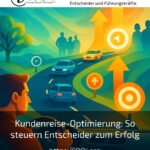
Customer Journey Optimisation: Crucial Impulses on the Path to Success
Customer journey optimisation is a key lever for companies that want to better understand and specifically guide their target audiences. It helps decision-makers to manage processes along the entire customer interaction and thus enable sustainable success. This involves not only technical adjustments but also a holistic view of all touchpoints with the brand.
Customer journey optimisation begins with a deep understanding of the customer.
A well-founded understanding of customers is the first step towards optimising the customer journey. Decision-makers gather insights into how and where the customer interacts with the company and what needs and challenges arise in the process. Different target groups exhibit different behavioural patterns. Therefore, it is important to define personas precisely – from age group and purchasing behaviour to preferred communication channels. Only then can tailor-made experiences be created that are relevant and engaging.
Analysing data from web traffic, social media and support requests plays an important role in identifying weak points and drop-off points in the customer journey. Hidden clues to optimisation potential are often found in customer dialogues and feedback.
BEST PRACTICE at company XYZ (name changed due to NDA contract)
A technology provider systematically mapped out its customer's digital touchpoints. It quickly became apparent that many prospective customers dropped off during the product comparison phase. Through targeted adjustments to the website's information, personalised recommendations, and improved contact options, the conversion rate increased significantly. The structured customer journey optimisation provided sustainable support for the sales team.
Seamless and personalised: How decision-makers steer the customer journey
Successful customer journey optimisation ensures that customers have a seamless and personalised experience at all times. Decision-makers manage processes across all channels – from websites and social media to personal customer conversations. They pay particular attention to fast loading times, mobile optimisation, and intuitive usability, as these factors significantly improve the user experience.
Targeted communication through relevant content also has a positive effect: the right information at the right time reduces friction and fosters a trusting relationship. Furthermore, structured data and automation can increase efficiency for key decision-makers, for example, through personalised newsletters or chatbots that support customer communication.
BEST PRACTICE at ABC (name changed due to NDA contract)
A retailer implemented mobile optimisation for their online shop, and at the same time introduced an automated newsletter campaign that used customer data to personalise product recommendations. This led to significantly higher customer loyalty and more repeat purchases.
Continuous monitoring and adaptation as key
Decision-makers support customer journey optimisations through regular success checks. Key performance indicators such as bounce rate, dwell time, and conversion rate indicate how well the measures are working. The insights gained serve as impetus for continuous process improvement and adaptation to new requirements. This keeps the customer journey agile and customer-centric.
It is important to closely observe customer interactions using technical tools such as web analytics or heatmaps. Collaboration between marketing, sales, and customer service is essential, as they provide different perspectives on the customer journey.
BEST PRACTICE at DEF (name changed due to NDA contract)
In a service company, weaknesses in the consulting process were quickly identified using regular user data analyses. Targeted adjustments to the consulting tools and closer integration of online and offline channels sustainably increased customer satisfaction.
Digital Tools to Support Customer Journey Optimisation
Digital tools offer valuable support for customer journey optimisation. From simple CRM systems to marketing automation and complex customer journey mapping solutions, they help to capture, structure and evaluate customer data. This allows decision-makers to derive and implement concrete measures.
Furthermore, aspects such as data security and data protection play an important role in maintaining customer trust. Those who consider these standards strengthen their credibility and protect sensitive customer data.
My analysis
Customer journey optimisation is a complex process that requires comprehensive understanding and continuous commitment. Decision-makers successfully steer this process by placing customer needs at the centre and integrating suitable technical and organisational solutions. They thereby support companies in fostering closer customer loyalty and leveraging every interaction as an opportunity.
It is important that customer journey optimisation is not seen as a one-off action, but as ongoing support in the development of customer-oriented strategies. This creates sustainable relationships that often go beyond pure product features.
Further links from the text above:
Customer Journey Optimisation: Definition & Implementation
[2] SEO Optimisation: More Success Through Good Rankings on Google
Customer Journey: Definition, Phases and Practice-Oriented Approaches
[5] SEO Optimisation 2025 – Your Guide to More Growth
For more information and if you have any questions, please contact Contact us or read more blog posts on the topic TRANSRUPTION here.






 Deutsch
  English (UK)