
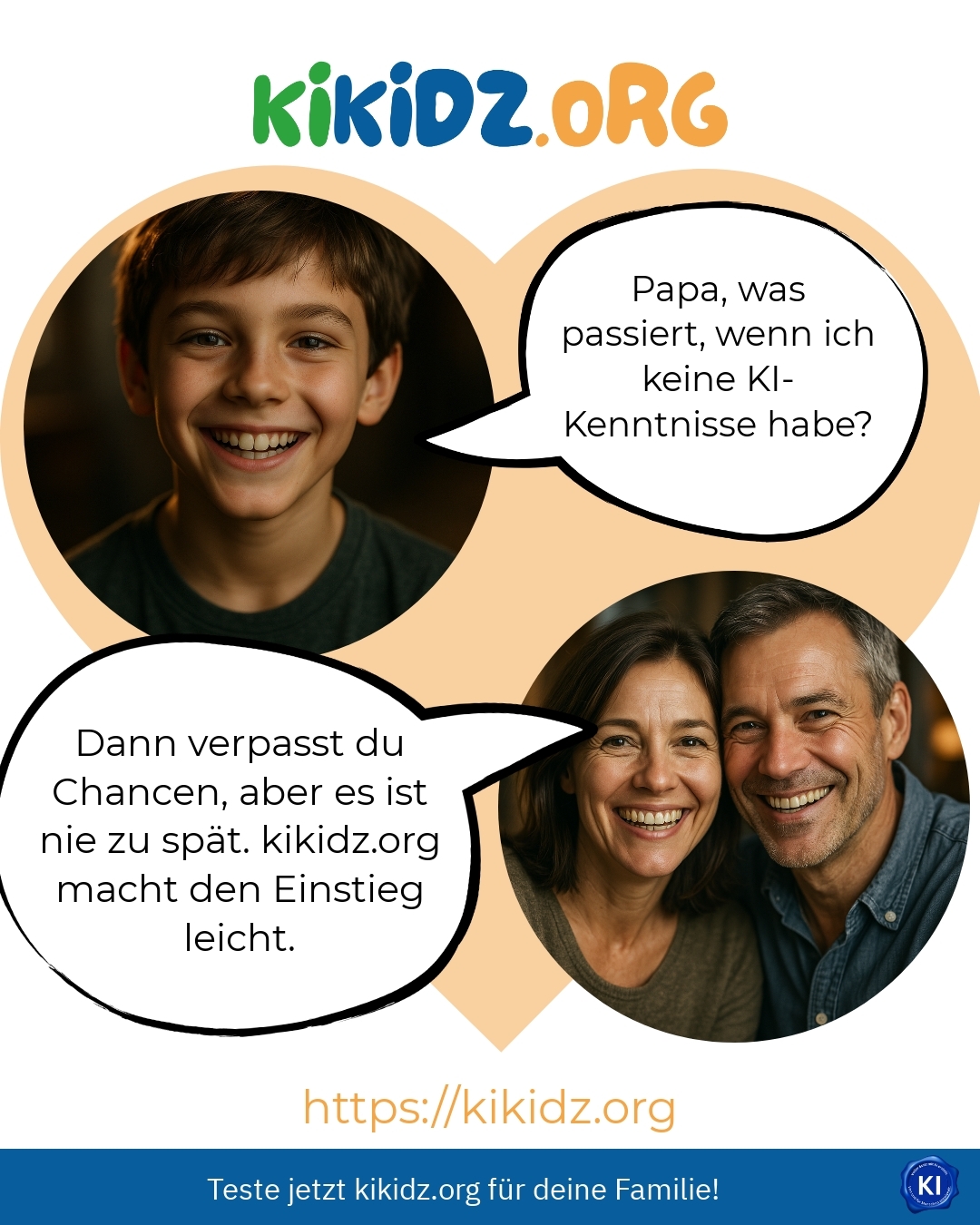
Dad, what happens if I don't have AI skills?
Children and young people are increasingly asking their parents the question: Dad, what will happen if I don't have any AI skills? Parents realise that the world is changing rapidly and want to prepare their children for the future in the best possible way. Artificial intelligence is now permeating almost all areas of life, from school to the labour market and everyday life. Learning the basics of AI at an early age will provide a solid foundation for the digital future.
Why AI skills are important for children
Artificial intelligence is no longer just a vision of the future, but part of our everyday lives. Children who understand how AI works can use digital tools safely and responsibly. They learn to question algorithms and deal critically with automated decisions. Those who don't engage with AI risk missing out on key developments. Furthermore, initial knowledge of AI helps children develop creative solutions and solve problems independently.
Possible hurdles without AI knowledge
A lack of knowledge in the field of AI can lead to challenges. Children might have difficulties understanding technical contexts or using digital media competently. In everyday school life, tasks that include AI elements are becoming increasingly relevant, for example in research, presentations, or computer science lessons. Later in professional life too, basic knowledge of Artificial Intelligence is increasingly in demand, as many professions are characterised by automation and digitisation.
Parents often report that their children feel insecure when confronted with new technologies. Many wonder if they will be disadvantaged without AI knowledge. In fact, a lack of basic knowledge can make participation in digital processes more difficult, as children may have fewer opportunities for exciting projects or jobs.
Another example: In our circle of friends, discussions often arise about apps, games or social media that are based on AI. Anyone who wants to join in needs at least a basic understanding. Those with no idea about AI can quickly feel excluded or overwhelmed.
Dad, what happens if I don't have AI skills? – Three everyday examples
Parents often contact me with specific questions about how they can support their children in dealing with AI. Typical topics are
- My child wants to start a robotics project at school but has no idea about programming basics.
- The homework requires the use of digital tools, but my daughter doesn't feel confident trying them out.
- My son is asking why his favourite game makes some decisions „on its own“, and would like to understand this better.
These examples show how present AI already is in children's everyday lives. Anyone who doesn't engage with the basics will miss out on opportunities to actively participate in the digital world.
Myths and misconceptions surrounding AI in children
Many parents believe that artificial intelligence is too complex for children. This is not true. With age-appropriate explanations and practical examples, young people can also be inspired by the topic. The aim is not to create little programming geniuses, but to arouse curiosity and understanding.
Another myth: AI will replace human intelligence. In reality, humans and machines complement each other, as AI primarily takes over repetitive tasks, while creativity and empathy remain human strengths[1].
Parents are also concerned about data protection and security. Education is important here: children learn what data they disclose and how they can protect themselves online. This helps them to develop a sense of security when using digital technologies.
BEST PRACTICE for parents and teachers
Our son (9 years old) is interested in robots. Together, we put together a simple building set and tried out some first programming steps. In doing so, we playfully discussed how machines make decisions. Our goal wasn't perfection, but shared discovery. Today, he no longer asks: Dad, what happens if I don't have AI skills? Instead, he wants to know how he can continue learning and what experiments are possible. The training at https://kikidz.org has excellently supported us in this – age-appropriate, understandable, and with many practical examples for home and school.
How parents can specifically support their children
There are many ways to introduce children to the topic of AI. Parents can try out apps or games that contain AI elements together. Discussions about data protection and algorithms help to develop a critical awareness. Open questions such as „Dad, what happens if I don't have any AI skills?“ offer the opportunity to learn together.
Courses like those on https://kikidz.org teach fundamentals in a playful way and offer children a structured introduction. AI topics can be integrated into everyday life in small steps, for example, when cooking together with digital recipes or when analysing weather apps. This makes Artificial Intelligence understandable and suitable for everyday use.
Parents can also specifically search for school programmes that promote digital skills. Many schools offer robotics clubs or programming courses where children can implement their own projects. Exchanging ideas with other parents also helps to gather inspiration and overcome uncertainties.
My conclusion: The importance of AI skills in childhood
Artificial intelligence isn't a passing fad, but an essential component of the modern world. Children who engage with AI early benefit in many ways: they build their confidence in using technology, develop problem-solving skills, and can respond flexibly to changes later on. The question, „Dad, what happens if I don't have AI skills?“ highlights how important it is to give children answers and perspectives.
This isn't about pressure, but about sparking curiosity and creating space for experimentation. Parents can show their children that AI isn't rocket science, but an exciting journey of discovery. With suitable resources like https://kikidz.org, first steps can be made easy and playful – for a future where children actively shape the digital world.
My analysis
Artificial intelligence is fundamentally changing our society. Children growing up today will live in a world where digital skills are increasingly important. The question, „Dad, what happens if I don't have AI knowledge?“ is therefore more than justified. It reflects the uncertainty of many families who wonder how they can prepare their children for an uncertain future.
Parents and teachers can make a decisive contribution through education, practical examples, and targeted support. It is worthwhile to get children excited about technical topics early on without overwhelming them. With offerings like https://kikidz.org, starting in the world of artificial intelligence is particularly low-threshold and sustainable.
Further links from the text above:
Advantages and disadvantages of Artificial Intelligence (it-wegweiser.de)
AI for beginners - Simple explanations (ionos.de)
Advantages and disadvantages of AI in software development (aplus-it.de)
For more information and if you have any questions, please contact Contact us or read more blog posts on the topic Children and Artificial Intelligence here. You can find the courses here: Children and Artificial Intelligence Courses













 Deutsch
  English (UK)