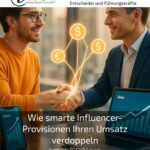
Influencer commissions play a central role when companies want to sustainably increase their revenue through targeted partnerships with influencers. These intelligent commission models reward influencers for their performance, thus creating a win-win situation that supports sales success. This opens up diverse opportunities to effectively improve reach and conversion rates. In the following article, you will gain practical insights into how smart influencer commissions can double your revenue.
The significance of influencer commissions in modern marketing
Influencer commissions are far more than mere payment. They are a crucial tool to foster influencer motivation and engagement. Implementing compensation systems that are linked to actual sales performance can significantly increase creators’ loyalty to your brand. For example, companies in the fashion industry award a commission per item sold, which makes product presentations more authentic and enhances the target audience's willingness to buy.
Even in the lifestyle segment, influencers show a stronger identification with brands when they benefit from success through performance-related commission. This not only supports short-term sales but also long-term brand loyalty because influencers proactively make product recommendations that demonstrably lead to purchases.
Cosmetics companies working with affiliate commissions also provide best practice examples. Here, influencers receive individual discount codes that offer an advantage to their followers. This creates purchasing incentives that encourage more customers to be willing to try and buy the product. The commissions create a direct link between content creation and sales growth.
How to structure influencer commissions effectively
The design of influencer commissions requires a strategic and transparent approach. It begins with a precise definition of goals: Do you want to increase traffic to your website, boost the conversion rate, or influence the average order value? Based on this, you can develop tiered commission models that, for example, provide higher percentages for particularly successful influencers.
A proven example is setting different commission levels based on revenue achieved. Influencers with a strong community can be further motivated to increase their performance through higher commissions. In the sports and fitness sector, brands observe that influencers engage more intensely with product presentations and vary different forms of use, such as live shows or product reviews, due to tiered commissions.
Furthermore, automated sales tracking tools are recommended, which minimise the effort for you and the influencers. This allows you to precisely track which contribution generated which revenue. This transparency supports trust and creates a fair basis for both smaller micro-influencers and larger creators.
BEST PRACTICE with one customer (name hidden due to NDA contract) A tiered commission model was introduced, offering influencers different percentage rates based on their monthly revenue. Collaborating with authentic influencers in the sustainable fashion sector resulted in an almost 90 percent increase in overall revenue within half a year. The influencers felt valued by the transparent remuneration and became significantly more engaged in content creation.
Recommendations for practice
To optimally benefit from influencer commissions, selecting the right influencers is essential. They should authentically align with the brand and appeal to a relevant target audience. Another tip is to make commission models flexible and to periodically review how they impact purchasing behaviour.
In the technology sector, customers often show interest in new products when influencers present them in „unboxing“ videos or tutorials. Here, individual commissions for each purchase made via the influencer's link can provide an incentive to dedicate themselves creatively and regularly to plugins, gadgets, or software solutions.
Commissions linked to discount promotions also encourage purchasing decisions. Customers from the food industry rely on seasonal sales supported by influencers. The creator receives a commission on all sales generated through their individual code. This leads to measurable increases in sales and strengthens brand awareness in the long term.
Another point is long-term partnerships, which enhance brand credibility. Influencers who advertise for a company continuously, rather than sporadically, build trust. Their recommendation has a greater impact when it is tangibly linked to the commission model, thus creating regular impulses for the customer base.
BEST PRACTICE with one customer (name hidden due to NDA contract) An influencer campaign with fixed and variable commissions was implemented here over a full year. Particularly in the fitness and nutrition sectors, this enabled long-term customer loyalty. The collaboration led to a 100 percent increase in revenue through repeated purchase incentives via individual discount codes, which were actively communicated by the influencers.
The role of transparent and fair commissions
Transparency is an important factor in remuneration. Influencers should be able to understand at any time how their commission is composed. This promotes a motivated and trusting collaboration. Furthermore, you should set clear goals and regularly analyse performance to make adjustments if necessary.
The combination of different commission models, such as a mix of flat fees and performance-related bonuses, also proves to be sensible in practice. This way, influencers remain creative and engaged, even beyond pure sales figures. Brands in the luxury goods sector use this hybrid remuneration to combine an exclusive brand message with first-class content.
My analysis
Smart influencer commissions are an effective lever for significantly increasing sales and, at the same time, building a sustainable relationship with creators. Through flexible commission arrangements, transparent communication, and suitable tracking tools, influencers are motivated to authentically and consistently promote a brand. The more targeted the selection and individual the commission models, the better the result. Companies that consistently integrate this approach report sales increases of sometimes over 100 percent.
Further links from the text above:
How to Increase E-commerce Sales: 11 Effective Strategies
Influencer and Affiliate Marketing – the dynamic duo in marketing
Successfully measuring and utilising affiliate provisions
Influencer Marketing: Boost Your Sales with Content Creators
Influencer Affiliate Marketing: The Brand Guide
For more information and if you have any questions, please contact Contact us or read more blog posts on the topic internet Return on Investment - Marketing here.






 Deutsch
  English (UK)