
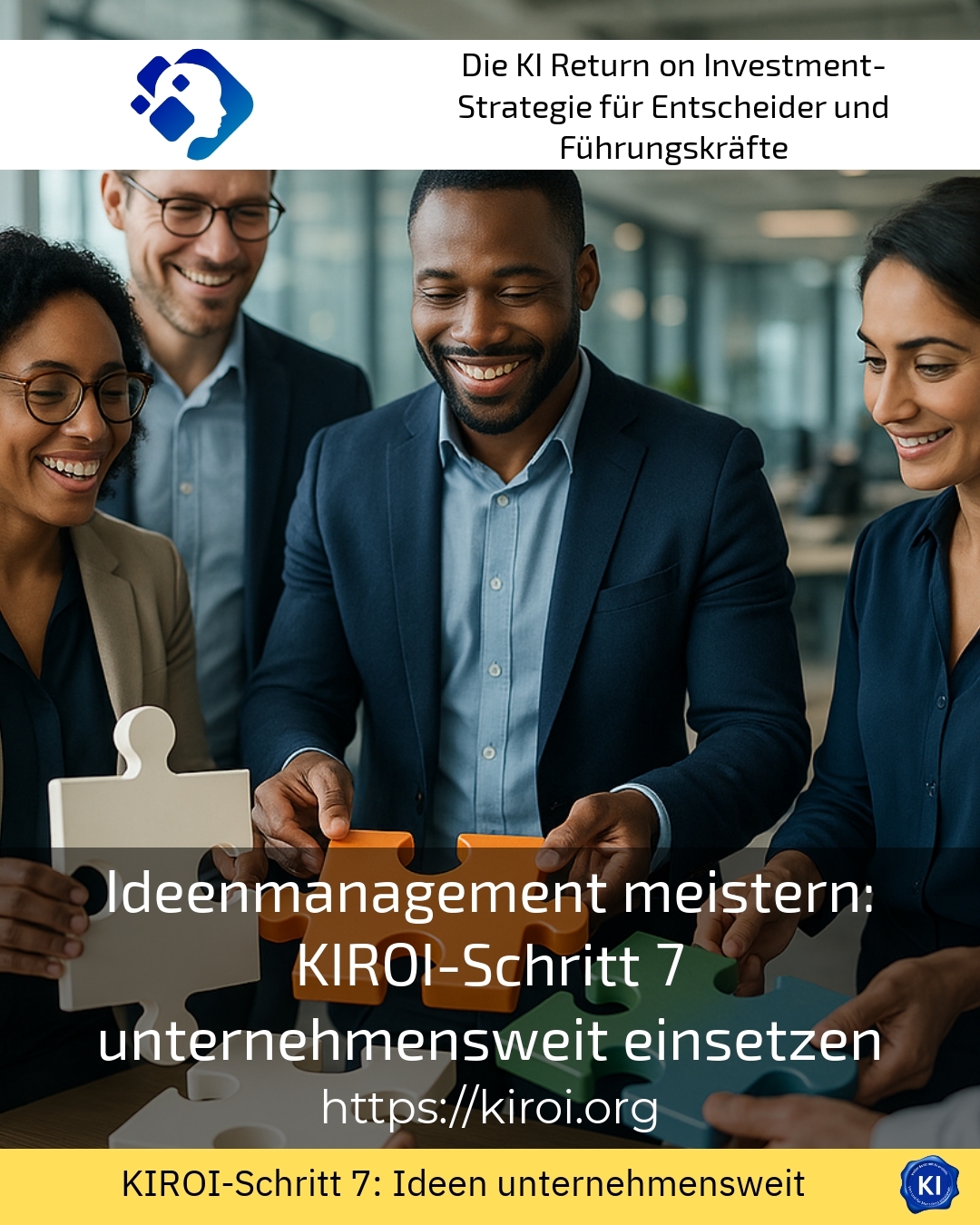
Ideation management is a crucial success factor for companies today that want to sustainably increase their innovative strength. The KIROI step 7 offers a practice-oriented approach to not only collect ideas but to effectively implement them company-wide. This makes it possible to specifically activate the creative potential of all employees and to integrate it permanently into their everyday work.
Ideation management as a holistic process
Many companies face the challenge that ideas exist, but the structures for implementation are often lacking. KIROI Step 7 addresses precisely this issue and supports ideas continuously – from submission to successful realisation. This approach understands idea management as a living, dynamic process that strengthens the innovation culture and ensures efficient workflows.
In the automotive industry, moderated workshops regularly demonstrate the added value of implementing suggestions for manufacturing optimisation with support. Teams benefit from open exchange, which breaks down barriers and opens up new perspectives. In the financial sector, agile approaches with KIROI Step 7 enable the rapid implementation of customer-oriented improvement ideas into the IT process. The retail sector also benefits from a digital platform that creates transparency, on which ideas from various branches can be evaluated and developed into innovative projects.
BEST PRACTICE with one customer (name hidden due to NDA contract) In a medium-sized manufacturing company, KIROI-Step 7 was used to accelerate the implementation of innovations. Through workshops and targeted coaching, cross-departmental obstacles were removed. The result was a culture in which employees are actively involved and product developments are realised more quickly. This significantly boosted employee motivation.
Transparency and feedback as keys to success in idea management
Transparent communication channels are a key element of KIROI Step 7. They make it possible to visualise ideas and give feedback. This makes employees feel valued and keeps them motivated to actively contribute. Regular feedback ensures that impulses are not lost, but are systematically developed further.
A well-known retailer, for example, uses digital platforms to gather ideas across locations and conduct rapid evaluations. In software development, feedback rounds have been introduced, which strengthen team communication and accelerate innovation successes. An industrial manufacturing company also benefited from moderated workshops, through which innovative solutions were created across departments.
BEST PRACTICE with one customer (name hidden due to NDA contract) A mechanical engineering company improved its communication structure with KIROI Step 7. Thanks to regular innovation workshops, practical solutions were developed that were directly incorporated into the production process. Employees were more involved, which significantly shortened the innovation cycle.
AI-powered tools help with scaling
Digital and AI-based systems help turn idea management from an individual solution into a company-wide success. They enable automated processes, prioritise suggestions, and ensure structured follow-up. This means ideas don't lose significance but are processed systematically and efficiently.
In the logistics sector, for example, an AIROI-powered digital portal was introduced, through which teams from engineering, warehousing, and dispatch can propose innovative process improvements. Coordination between departments improved measurably, and implementation rates increased significantly. In the IT sector, collaborative tools led to greater involvement of all employees in the further development of products and services.
Practical tips for company-wide implementation of idea management
In order to implement idea management successfully, culture and communication are crucial in addition to technology. The following impulses can provide support:
- Encourage an open dialogue in which ideas can be shared without judgement.
- Define clear responsibilities for processing and implementation.
- Use workshops to strengthen cross-departmental collaboration.
- Establish a continuous feedback system that activates idea providers.
- Integrate digital platforms that make the suggestion process transparent.
For example, a logistics company helped to overcome collaboration barriers with regular cross-departmental workshops. This led to the creation of a digital idea portal that ensured everyone's participation and visibly increased innovation potential. In the healthcare sector too, digital systems support the exchange of suggestions for improvement beyond traditional hierarchies.
My analysis
Idea management is gaining increasing importance in competition, as it enables companies to systematically harness the creative potential of their employees. The KIROI step 7 provides the right foundation for this by supporting ideas throughout the company and establishing a culture-promoting, transparent structure. This transforms individual suggestions into sustainable innovative strength, leading to measurable progress and motivated teams across various industries. The consistent involvement of all employees and digital support tools are crucial success factors.
Further links from the text above:
Rethinking idea management: KIROI Step 7 for your business
KIROI Step 7: Embed Company-Wide
Revolutionising Idea Management: KIROI Step 7 for Sustainable Innovation
KIROI step 7: Rethink idea management across the organisation
For more information and if you have any questions, please contact Contact us or read more blog posts on the topic Artificial intelligence here.













 Deutsch
  English (UK)