
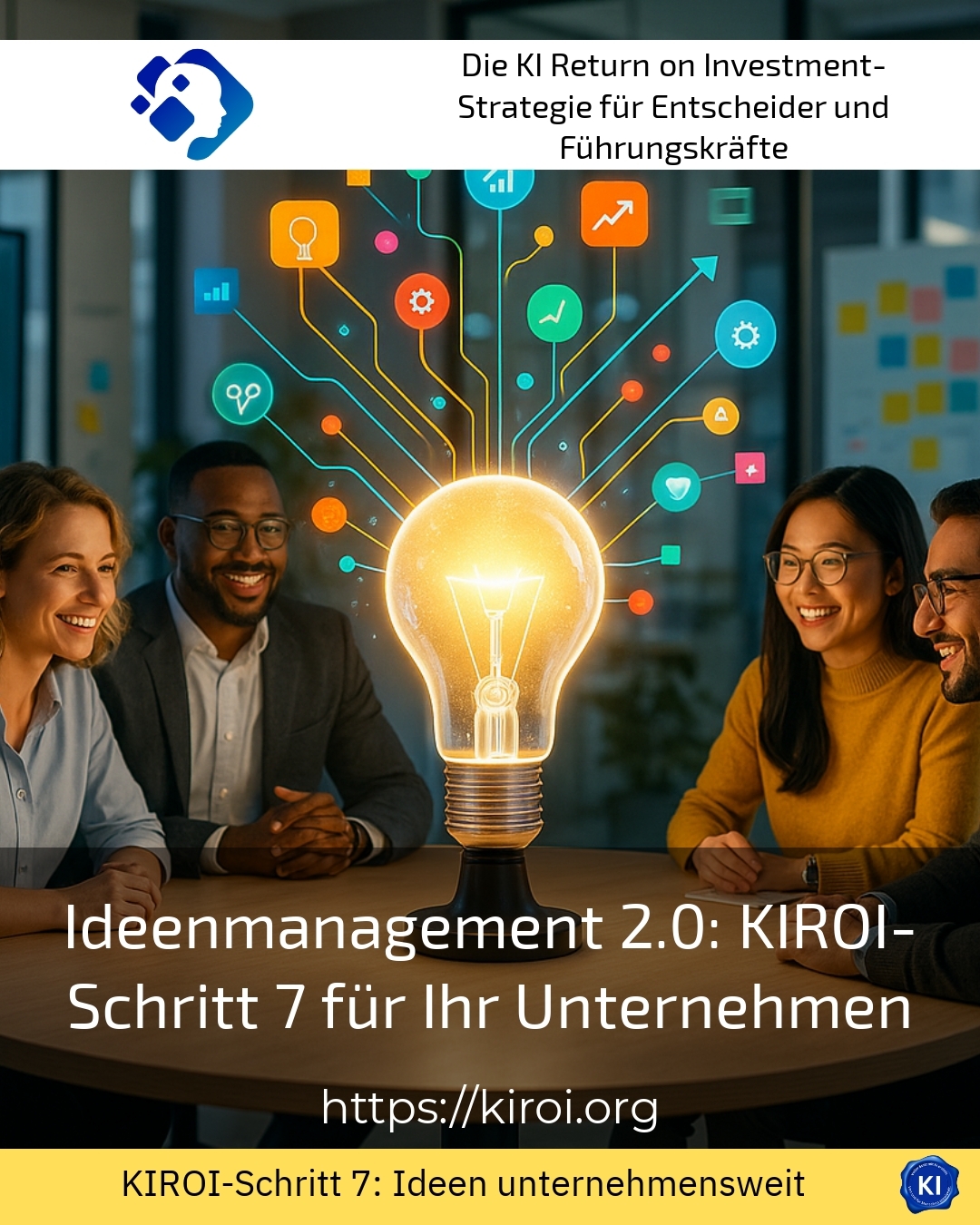
Ideas management is increasingly gaining importance in companies, as it offers a structured way to systematically capture, develop and successfully implement creative impulses. Particularly in today's world, many organisations are open to new approaches to sustainably strengthen their innovative power. The KIROI Step 7 picks up exactly here and supports companies in sustainably shaping idea processes through transparent and appreciative feedback. This way, ideas management is understood not just as a one-off process, but as a continuous, supported development process.
Ideas management as a driver for continuous innovation
At its core, idea management serves to bundle the creative potential of all employees, thereby increasing competitiveness. The process includes various phases: capturing, evaluating, developing, and implementing ideas. It is important to identify obstacles early on and overcome them through targeted measures. The KIROI Step 7 precisely supports this process with a systematic feedback and support approach.
Practical examples illustrate this: in the mechanical engineering industry, for instance, moderated workshops help to shorten development cycles. This improves the collaboration between different departments and enables faster realisation of innovations. At a software development company, transparent feedback and networked idea platforms significantly liberated the innovation flow and increased the acceptance of new solution approaches. Successes are also evident in retail through digital tools that document and systematically evaluate suggestions, making the idea process transparent for all stakeholders.
BEST PRACTICE with one customer (name hidden due to NDA contract)
BEST PRACTICE with one customer (name hidden due to NDA contract) In industrial manufacturing, a workshop format was established with KIROI Step 7 to specifically identify and remove obstacles hindering the implementation of promising ideas. The result was accelerated project implementation and enhanced cross-departmental communication, which measurably improved the innovation climate and generated new momentum.
KIROI Step 7 as innovative support in idea management
The seventh step in the KIROI concept focuses on guiding and supporting idea processes. It makes it clear: idea management requires more than just collecting suggestions. It needs transparent structures, regular feedback, and a culture where employees feel valued and involved. This way, creative initiatives won't go to waste but will be systematically advanced.
Various companies therefore rely on established digital platforms to simplify the submission and tracking of ideas. A good system allows each idea to be assessed transparently and its status to be visible at all times. Employees receive timely feedback, which strengthens motivation and trust and keeps the innovation process alive.
For instance, since the introduction of a digital tool, a manufacturing company has been using automated forwarding of ideas to the relevant specialist departments. This transparency has significantly increased the number of suggestions submitted and made many previously overlooked potential improvements visible. In the service sector, teams benefit from regular feedback cycles that help to advance problem-solving more quickly and avoid inefficiencies.
Practical tips for successfully implementing idea management
To make idea management effective in everyday life, the following approaches are recommended:
- Create clear communication channels to capture ideas easily.
- Establish regular feedback loops so that every idea provider has transparency on the status of their suggestions.
- Offer facilitated workshops or innovation sprints that bring together diverse perspectives.
- Utilising digital tools that map the entire process and enable automated workflows.
- To foster a corporate culture that embraces mistakes as learning opportunities and rewards creative engagement.
This is how companies can effectively remove obstacles and continuously motivate employees to contribute their ideas and actively participate in shaping things.
My analysis
Modern idea management requires a holistic approach that goes beyond simply collecting suggestions for improvement. KIROI step 7 particularly emphasises the importance of a sustainable accompanying process with transparent feedback and appreciation. Companies that integrate this step benefit from higher employee participation, faster innovation cycles, and better networking between departments. By combining digital tools, moderated formats, and an open culture of admitting mistakes, the potential of the entire organisation is best leveraged.
In particular, in industries with complex processes or high pressure to innovate, this methodological approach reveals significant competitive advantages. Thus, idea management becomes a central pillar of a successful innovation ecosystem.
Further links from the text above:
What is idea management? Definition, processes, and best practices
Rethinking Idea Management: KIROI Step 7 in the Company
KIROI Step 7: Unleashing Company-Wide Idea Management
For more information and if you have any questions, please contact Contact us or read more blog posts on the topic Artificial intelligence here.













 Deutsch
  English (UK)