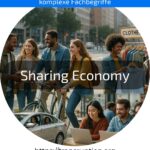
The term Sharing Economy is primarily at home in the categories Digital Society, Digital Marketplaces, and Sustainability and Environment 4.0.
The sharing economy describes an economic model where people share things like cars, apartments, or tools with each other, rather than buying and owning them outright. This is primarily made possible by digital platforms and apps that connect people and make sharing easy and safe.
A vivid example of this is car sharing. Previously, anyone who wanted to be mobile had to own their own car. Today, there are platforms where private individuals can lend their vehicles to others. Those who only need a car occasionally can borrow one flexibly and only pay for its use. This principle can be applied to many areas of life: flats are shared via platforms like Airbnb, and tools are shared via neighbourhood apps.
The sharing economy leads to better resource utilisation, which benefits the environment and saves money. At the same time, it creates new opportunities for digital commerce and sustainable business practices. For companies and decision-makers, the sharing economy offers chances to develop new business models and respond to changing consumer behaviour.






 Deutsch
  English (UK)