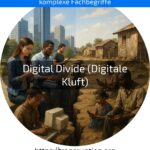
The term Digital Divide originates from the categories of Digital Society and Digital Transformation. It describes the difference between people who have access to modern information technology and fast internet, and those who are excluded from it.
The digital divide is evident, for example, in the fact that many city dwellers can easily work from home and have quick access to online educational resources. In contrast, people in rural regions or from lower-income families often do not have an internet-enabled computer or only have slow internet. This limits their opportunities in education, work, and social participation.
An everyday example: A school in the city provides all pupils with tablets and offers online lessons. A village school cannot do this because there are too few devices and poor internet. This creates inequality, which can grow over time.
Bridging the digital divide is an important goal for modern societies so that everyone can benefit from digitalisation and no one is left behind.






 Deutsch
  English (UK)