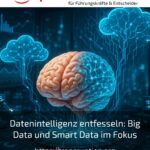
Data intelligence is a crucial factor for companies that want to use their data efficiently. It supports companies in transforming data into valuable information that can inform business decisions and drive success. In this context, Big Data and Smart Data play a central role, as they offer different approaches to data collection and analysis. Big Data describes large and complex datasets, which are often unstructured, while Smart Data focuses on the quality and utility of data by providing relevant information that is essential for business decisions.
Big Data: The Foundation of Data Intelligence
Big Data refers to a vast amount of data that is generated daily. This data can be both structured and unstructured, comprising, for example, texts, images, and videos [8][9]. Big Data is characterised by the four Vs: Volume, Variety, Velocity, and Veracity [1][3]. Companies utilise Big Data to understand customer behaviour patterns or to optimise production processes.
An example from the retail sector demonstrates how Big Data is used to increase customer satisfaction: a retail company analysed data on customer behaviour patterns in its online shop to create personalised recommendations. These measures led to a significant increase in sales and customer satisfaction.
Opportunities and Challenges of Big Data
Big Data offers many opportunities but also entails challenges. On the one hand, it enables deeper insights into customer behaviour and processes; on the other hand, it requires extensive resources for the processing and storage of gigantic data volumes [8]. Processing speed and quality are crucial factors for obtaining valuable information.
Data Intelligence and Smart Data: The Key to Efficiency
Smart Data, on the other hand, is the selectively processed and analysed version of Big Data, providing information essential for business decisions. It is often considered the „cleaned“ version of Big Data, as it is free from errors and irrelevant information [1][3]. Smart Data focuses on quality and benefit, making it easier to achieve business goals.
In Industry 4.0, smart sensors play an important role in generating smart data. These sensors capture precise data which can be immediately analysed and integrated into production to ensure more efficient processes [7].
BEST PRACTICE at the customer (name hidden due to NDA contract)An industrial company used smart data to increase production efficiency. By analysing sensor data, predictive maintenance applications were developed that prevented sudden machine failures and significantly reduced downtime.
Using Smart Data
Smart Data offers several advantages: it's more precise, cost-effective, and supports better decision-making as it contains only relevant and reliable information[3][5]. Areas of application include Customer Journey Analytics and Voice of the Customer, which help companies improve customer satisfaction and strengthen market reputation[7].
Practical Implementation of Data Intelligence
To effectively implement data intelligence, it is crucial to use the right tools and strategies. This begins with the integration of Big Data tools for data collection and storage. Subsequently, data analysis should be carried out using targeted algorithms and machine learning techniques to generate Smart Data[6].
Another example from the financial sector: a banking institution used data analytics to detect fraudulent activities and implement preventive measures. By combining Big Data and advanced analytical techniques, the number of fraudulent transactions was significantly reduced.
My analysis
Overall, the use of data intelligence is crucial for companies that want to use their data efficiently and strategically. By combining Big Data and Smart Data, companies can improve their decision-making, optimise processes, and ultimately increase business success. Support from experts in this field can help companies develop the best possible strategies and fully leverage their data.
Further links from the text above:
For further information, please visit the following links:
Differences between Big Data and Smart Data
Big Data: Definition and Benefits
For more information and if you have any questions, please contact Contact us or read more blog posts on the topic TRANSRUPTION here.






 Deutsch
  English (UK)