
„`html
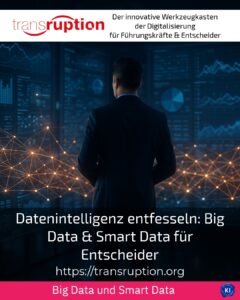
Data intelligence is no longer an add-on, but the centre of business excellence. Companies that extract smart, usable insights from vast mountains of data increase their innovative capacity and position themselves at the forefront of the competition. Decision-makers today ask themselves: How can the step from Big Data to real, targeted business impulses be achieved – and what role does data intelligence play in this? The focus is on the ability to intelligently analyse large and complex amounts of data and derive reliable bases for decision-making. Those who unleash data intelligence do not just passively use information flows, but actively shape processes, markets, and innovations [5][11].
Big Data as a raw material for data intelligence
Let's start at the beginning: Companies today collect a massive amount of data. Sensors measure machine states, digital channels continuously provide customer data, and internal systems constantly store process data. This data flood – often referred to as Big Data – is characterised by its large volume, high velocity, and immense variety [3]. However, such raw data alone rarely brings value. Only through smart analysis, targeted condensation, and process-specific filtering does Big Data become what we call Smart Data, and from that – through systematic integration into management – true data intelligence [2][5].
Classic examples can be found in manufacturing, logistics, and finance: In mechanical engineering, sensors monitor the condition of production facilities in real-time, while logistics companies globally network freight data. In the financial sector, portfolios, market movements, and customer needs are constantly changing. Big Data provides the input here, but it is only Smart Data that turns this into solution-oriented insights. This allows companies to identify bottlenecks early on, optimise supply chains, assess market risks, and react specifically to changes [11].
From raw data to intelligent decisions
Big Data is like a quarry: the volume is enormous, but it's only targeted processing that brings value. Smart Data is the result of intelligent filtering, quality control, and structuring using Data Analytics and Artificial Intelligence. This provides companies with data that can be directly used for decision-making [1][2]. Decision-makers benefit because precisely the data relevant to their questions is extracted from the flood.
Data intelligence means analysing and evaluating this information in real-time and translating it into understandable recommendations for action. For instance, a marketing agency can continuously measure customer behaviour and automatically adjust campaigns, thus minimising wastage and improving the precision of the customer journey and target group approach [7][11]. In industry, smart algorithms trigger maintenance warnings before machines actually fail, saving time and costs while increasing system availability [9]. In the financial sector, portfolio positions are dynamically managed based on current market data and AI forecasts.
Data intelligence for greater decision-making security
In coaching and projects, decision-makers frequently ask how they can minimise uncertainties in data processing. Many companies report a flood of information, but at the same time, uncertainty about which data is actually business-critical. Data intelligence is the key to creating clarity and making reliable decisions [11].
Data intelligence approaches help to filter Big Data according to business requirements: only the relevant data is analysed, evaluated and converted into clear, meaningful key performance indicators (KPIs). Dashboards and analysis tools visualise results, allowing executives to see at a glance how their processes, customers and markets are performing. This creates agility and decision-making confidence because the foundation is not guesswork, but reliable data.
How do you derive genuine value from data intelligence?
The interplay of Big Data, Smart Data, and targeted analysis ensures sustainable business success. Using the example of an international logistics company: data intelligence was used to continuously forecast and optimise delivery times and warehouse stocks. This led to reduced costs, shorter delivery routes, and a significant increase in customer satisfaction. The data foundation provided smartly filtered performance indicators, which were continuously updated and transparently displayed on dashboards.
BEST PRACTICE at the customer (name hidden due to NDA contract) The logistics company developed a data intelligence tool that extracted relevant KPIs such as inventory turnover time, delivery delays, and transport costs per route from existing systems. The analysis was carried out in real-time, allowing focal points to be identified and processes to be adjusted immediately. The result was fewer bottlenecks, shorter delivery times, and improved internal and external collaboration.
Another example from production: A mechanical engineering company introduced a predictive maintenance system that signalled impending failures early on based on sensor data. Employees received targeted recommendations for action, which significantly reduced downtime and increased productivity. In marketing too, data intelligence can be used to address target groups more precisely because customer behaviour is continuously analysed and evaluated. Increased revenue becomes measurable because wastage is minimised and the conversion rate is increased.
BEST PRACTICE at the customer (name hidden due to NDA contract) A large marketing agency relied on data intelligence to capture and evaluate customer behaviour in real-time. The analysis of interactions led to personalised content recommendations and dynamically adjusted campaigns. The result: customer loyalty increased, advertising costs decreased, and revenue demonstrably grew. The data intelligence platform became the central control instrument for the entire customer journey.
A third example from the financial sector: an asset manager used an AI-powered analysis platform to continuously adapt portfolio strategies to market changes. The platform filtered relevant market and customer data from extensive sources, filtered out noise, and fed action recommendations into the portfolio management system. Performance became more transparent, risk more controllable.
Unleash Data Intelligence: Impulses for Your Practice
The implementation of data intelligence is most successful when companies define clear objectives from the outset. What decisions should be data-supported? What questions need answering, what processes need optimising? Transruption Coaching guides decision-makers on the path to a data-intelligent organisation. Together, use cases are developed, data sources identified, and analysis processes established.
A first step is data-driven localisation. Where does your company stand regarding data and analytics? Which systems are in use, which data is already being utilised, and where do opportunities lie? In coaching, we provide impulses to shift the focus from pure data collection to intelligent utilisation. People are at the centre of this: only when teams understand how to work with data intelligence does real change emerge.
Transruptions coaching also means specifically employing methods such as Design Thinking, agile processes, and AI technologies. This is how data strategies are created that do not bypass the daily work routine but provide concrete answers. The consultancy creates space for new solutions, makes dealing with resistance easier, and supports change management.
Three concrete tips for getting started
Start with small, measurable projects that deliver quick wins. This is how teams gain experience and confidence in data intelligence. Choose a use case that directly contributes to business development, such as reducing returns, optimising delivery routes, or personalising customer offers [4]. Always begin with a clear question.
Rely on modern analysis and visualisation tools. Dashboards provide a compact overview, while AI-based analyses reveal trends and anomalies. This allows you to transition from pure data collection to intelligent control. Build transparency: Data intelligence is only truly embraced when all stakeholders understand how data generates added value.
Connect IT, management, and specialised departments. Data intelligence thrives on exchange and collective development. The best ideas emerge from cross-functional teams because diverse perspectives come together. Utilise external coaching to establish new ways of thinking and new methods – and to master the transition from Big Data to Smart Data and true data intelligence.
My analysis
Data intelligence is more than technology. It is an attitude, a culture, and a method all at once. Companies that use their data strategically gain agility, future-proofing, and a competitive advantage. Big data provides the input, smart data the targeted selection, and data intelligence turns it into robust decisions. However, the path to a data-intelligent organisation is a process – and is best achieved with clear objectives, practical projects, and open exchange.
Transruptions-Coaching accompanies decision-makers on this journey: we bring structure to data diversity, sharpen the focus on what's essential, and collectively shape the next development step. Data intelligence is not a static state but a continuous learning process. Those who unleash it actively shape the future and secure a sustainable advantage in the digital age.
Further links from the text above:
Data Intelligence: Definition and Application [5]
Unlocking Data Intelligence: Big Data & Smart Data [11]
Big data vs. smart data: is more always better? [2]
Smart Data Definition: Intelligent Data – what is it? [1]
Big Data Simply Explained: Definition and Significance [3]
Big Data: Using Large Quantities of Data as an Opportunity [4]
Smart data: definition, application and difference to big data [7]
Smart data, or the intelligent use of data [9]
For more information and if you have any questions, please contact Contact us or read more blog posts on the topic TRANSRUPTION here.
„`











 Deutsch
  English (UK)