
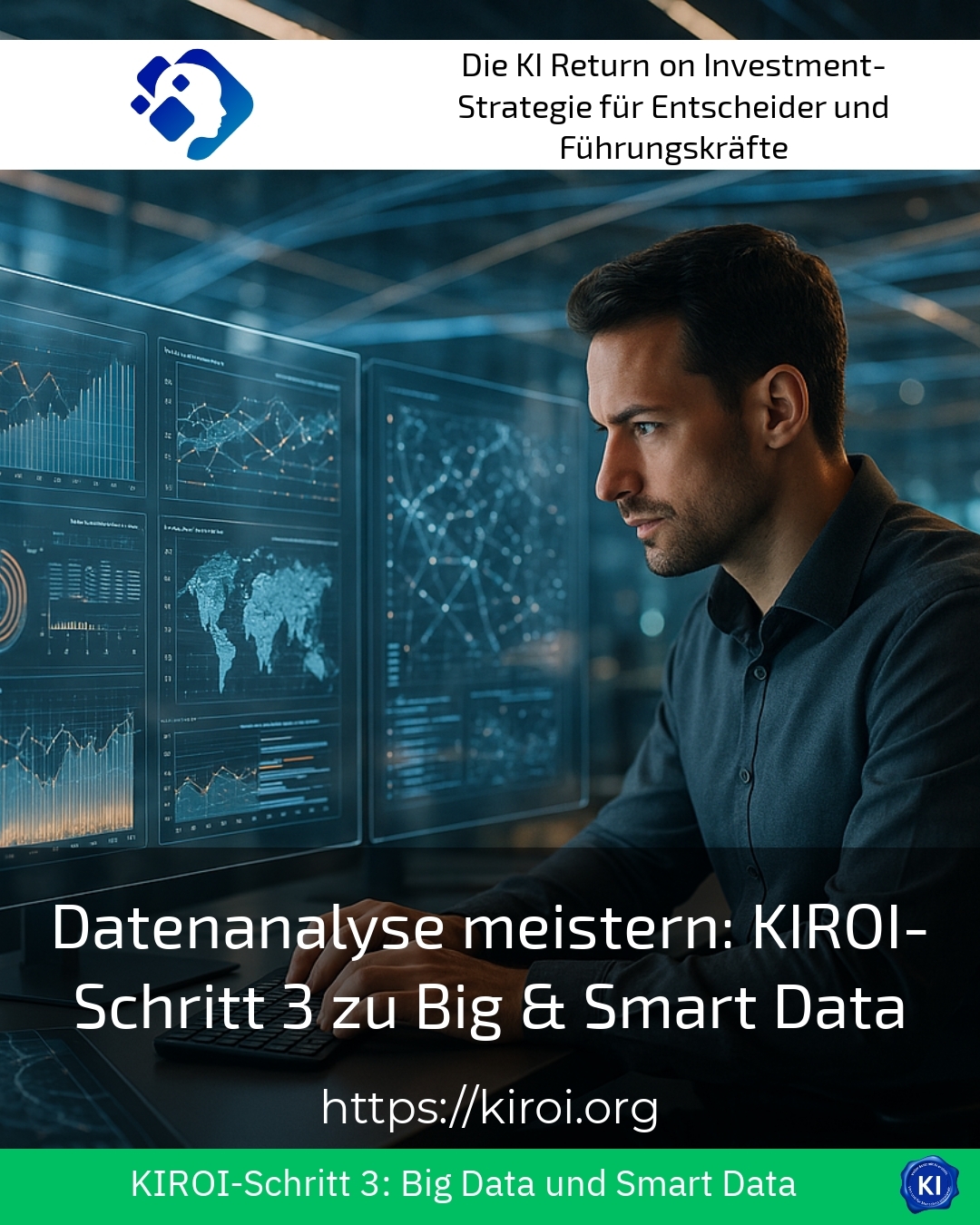
**Data analysis** plays a central role in extracting targeted, essential insights from ever-increasing volumes of data. Particularly when handling large and complex datasets, it supports companies in optimising their processes and making well-informed decisions. Within the scope of KIROI Step 3, which focuses on Big and Smart Data, **data analysis** unfolds its full potential by extracting relevant information from extensive raw data, thereby creating added value.
What does data analysis mean for Big & Smart Data?
Big Data refers to the massive volumes of data that accumulate daily within companies and organisations. This data originates from a wide range of sources, such as sensors in industry, customer interactions in retail, or movement data in the transport sector. The challenge lies in processing this flood of data in such a way that actionable insights can be derived from the sheer volume. This is where data analysis comes in: it employs various methods like data mining, machine learning, and statistical procedures to uncover patterns, correlations, and trends.
Smart Data builds on Big Data and stands for intelligently filtered, quality-assured information. This means that not all data is considered equally, but specifically data that offers added value. This creates a focused database that supports companies in making faster and more precise decisions.
Practical examples of data analysis in industrial and technical environments
In industry, data analysis methods help to detect machine malfunctions early, for example. Sensors continuously collect data on the condition of the equipment. By analysing this information, risks of failure can be identified early and maintenance can be planned effectively. This reduces unplanned downtime and saves costs for companies.
Data analysis is also used in manufacturing to ensure production quality. Process data can be used to detect and immediately control deviations. This enables reproducible quality and strengthens customer satisfaction.
In the field of logistics, intelligent data analysis optimises supply chains. By evaluating inventory and transport data, stock levels can be kept to a minimum and delivery times improved. This allows companies to benefit from increased efficiency and flexibility.
BEST PRACTICE with one customer (name hidden due to NDA contract) The implementation of a smart monitoring system enabled real-time analysis of machine data. This allowed for dynamic adjustment of the maintenance cycle, leading to a significant reduction in downtime while simultaneously extending the lifespan of the equipment.
Important methods and tools for data analysis
Modern data analysis in Big & Smart Data projects encompasses various methods. Descriptive analyses show what has happened, while predictive analyses enable forecasts for future developments. Prescriptive analyses go a step further and provide recommendations for action.
Data visualisations such as heatmaps, scatter plots, and box plots help to understand complex relationships. This allows stakeholders to better grasp which factors particularly influence business processes.
Machine learning also plays a crucial role. In anomaly detection or fraud prevention projects, algorithms are trained to automatically recognise unusual patterns and initiate appropriate measures.
BEST PRACTICE with one customer (name hidden due to NDA contract) A manufacturing company used predictive data analytics to forecast failures of critical components early on. By precisely adjusting maintenance intervals, production stoppages were minimised and operating costs were significantly reduced.
How does transruptive coaching accompany data analysis projects?
Many companies face the challenge of extracting the right added value from complex data volumes. This is where coaching can help, providing practical support through all phases of data analysis. This allows analysis questions to be clearly defined, suitable methods to be selected and results to be communicated effectively.
One focus is on empowering teams to deal with big and smart data. Topics such as data preparation, quality checks and visualisation are covered. In practice in particular, many clients report that structured support provides impetus for better utilisation of their data sets and gives them confidence when making decisions.
For example, coaching can help to clarify questions regarding data quality and data protection, which is particularly important with sensitive data. It also supports the development of competences to sustainably integrate data projects into the company.
BEST PRACTICE with one customer (name hidden due to NDA contract) The disruptive coaching helped a medium-sized company develop a data strategy that purposefully organised the data flood, thereby significantly increasing information quality. This led to more efficient decision-making processes and better alignment between IT and business departments.
My analysis
Data analysis is at the heart of dealing with today's data volumes. Particularly in the context of Big & Smart Data, it demonstrates how valuable insights can be specifically gained from large, often confusing datasets. Companies benefit from improved transparency of their processes, optimisation of workflows and well-founded support for strategic decisions.
A holistic approach, ranging from data preparation and intelligent analytical methods to practical support through coaching, facilitates successful data management. This ensures that data is not only collected but also used effectively and purposefully. The ability to analyse data is therefore increasingly becoming a competitive advantage and sustainably supports digital transformation.
Further links from the text above:
Smart + Big Data | Artificial Intelligence
Intelligent data analysis methods for engineers
Big and smart data - from statistics to data analysis
Big Data explained simply
Smart data: definition, application and difference to big data
Make decisions with smart data
Big and Smart Data – DLR Research
Mastering Data Analysis: KIROI Step 3 with Big & Smart Data
Data Analytics: Data and Methods – Fraunhofer SCS
For more information and if you have any questions, please contact Contact us or read more blog posts on the topic Artificial intelligence here.











 Deutsch
  English (UK)