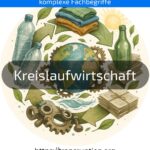
The term circular economy is particularly relevant in the categories of sustainability and Environment 4.0 as well as Industry and Factory 4.0. Circular economy describes an economic system in which resources are used, reused, and recycled for as long as possible. The aim is to avoid waste and spoilage and to close material loops.
Instead of simply discarding products after use, in a circular economy, they are repaired, refurbished, or broken down into individual raw materials so that new products can be made from them. This conserves natural resources and reduces CO₂ emissions.
A vivid example: Imagine a company that manufactures mobile phones. In the circular economy, old mobile phones are taken back after use, the working parts are reused, and valuable raw materials like gold and copper are recovered to make new devices. This creates a closed loop.
The circular economy is an important approach for companies to operate more sustainably. With digital technologies such as the Internet of Things or automation, the cycle can be efficiently controlled and monitored, which in the long term benefits not only the environment but also a company's own competitiveness.






 Deutsch
  English (UK)