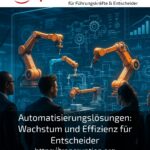
Automation solutions are essential companions for decision-makers who want to promote growth and efficiency in their companies. They offer the opportunity to optimise recurring processes, save time and deploy resources more strategically. At the same time, they help to reduce errors, thereby increasing both product quality and customer satisfaction. Many executives from various industries report that automation solutions effectively support their projects and provide sustainable impetus for business success.
How automation solutions sustainably increase efficiency
In practice, automation solutions enable a significant increase in productivity. For example, in the manufacturing industry, machines are automatically controlled and used efficiently around the clock. Production lines operate without breaks, which shortens throughput times and increases output. At the same time, manual intervention is greatly reduced, which minimises human errors and leads to consistent quality.
Positive effects are also evident in the finance and controlling departments: routine tasks such as data entry and report generation are being automated, allowing teams to focus on more complex analyses. According to research, this shift to automated workflows leads to efficiency gains of up to 60% and a significant reduction in errors[2][6].
A typical example of successful automation solutions can be found in logistics: automated order processing can shorten delivery times while increasing the accuracy of processes. This allows short-term customer requirements to be met more quickly and precisely.
BEST PRACTICE at the customer (name hidden due to NDA contract)
A medium-sized industrial company implemented automation solutions to manage its production lines more flexibly. The integration of real-time data monitoring has made it possible to utilise plant capacity more efficiently and significantly reduce downtime. As a result, lead times were cut by 25 per cent whilst product quality was improved.
Optimising cost-efficiency and resource utilisation through automation
Automation solutions help to permanently reduce costs by minimising the need for manual tasks and optimising resources. For example, energy consumption and material usage can be precisely controlled, leading to significant savings, particularly in the manufacturing industry.
Furthermore, automated processes enable continuous operation without breaks, which significantly increases profitability in areas such as manufacturing or IT administration. This also reduces personnel costs for repetitive tasks, freeing up capacity for strategic activities.
In the service sector, companies benefit from automation solutions through accelerated workflow processes, for example in document management or customer relationship management. This leads to better service levels and higher customer satisfaction.
BEST PRACTICE at the customer (name hidden due to NDA contract)
A financial services provider implemented automation solutions to optimise data processing. By reducing the need for manual intervention, the error rate fell significantly and reporting cycles were shortened by 40%. This freed up more time for staff to focus on advisory work and complex analyses.
Flexibility and scalability through well-thought-out automation solutions
Another advantage of automation solutions lies in their adaptability. Modern systems are modular in design and can be quickly adapted to new market requirements or business models. This allows companies to react flexibly to changes in demand and introduce innovative products.
For example, production lines in the automotive industry can be designed to handle both large-scale and small-scale production with minimal changeover times. In IT, automated workflows allow for efficient scaling with increasing data volumes and user numbers.
This supports managers in making their projects around automation solutions agile and contributing sustainably to company success.
BEST PRACTICE at the customer (name hidden due to NDA contract)
A technology company used flexible automation solutions to double its production capacity at short notice. Modular control systems enabled them to efficiently integrate new product variants without disrupting existing workflows.
Automation solutions as strategic support for decision-makers
Decision-makers using automation solutions often require support during the planning, selection, and implementation of suitable systems. It's important to align the technology with the specific needs of the company in a targeted manner and to involve employees accordingly.
Automation projects can be successfully managed through close collaboration between management, IT, and specialist departments. At the same time, accompanying consulting supports the constructive addressing of challenges such as fears of digitalisation or a shortage of skilled workers.
Many managers report positive experiences with such support, which helps to shape change and establish automation solutions as sustainable growth engines.
My analysis
Automation solutions are indispensable tools today for fostering growth and efficiency in companies. They create clear competitive advantages through cost savings, quality improvements, and flexibility. Decision-makers who rely on strategic guidance can successfully manage the transformation process and set sustainable impulses for their organisation. As a result, automation solutions are developing into a strong driver for innovation and competitiveness.
Further links from the text above:
What are IT automation solutions?
How process automation reduces errors and increases efficiency
Automation explained - definition, examples and advantages
Automating Business Processes – Efficiency & More
Automation solutions & success factors
For more information and if you have any questions, please contact Contact us or read more blog posts on the topic TRANSRUPTION here.






 Deutsch
  English (UK)