
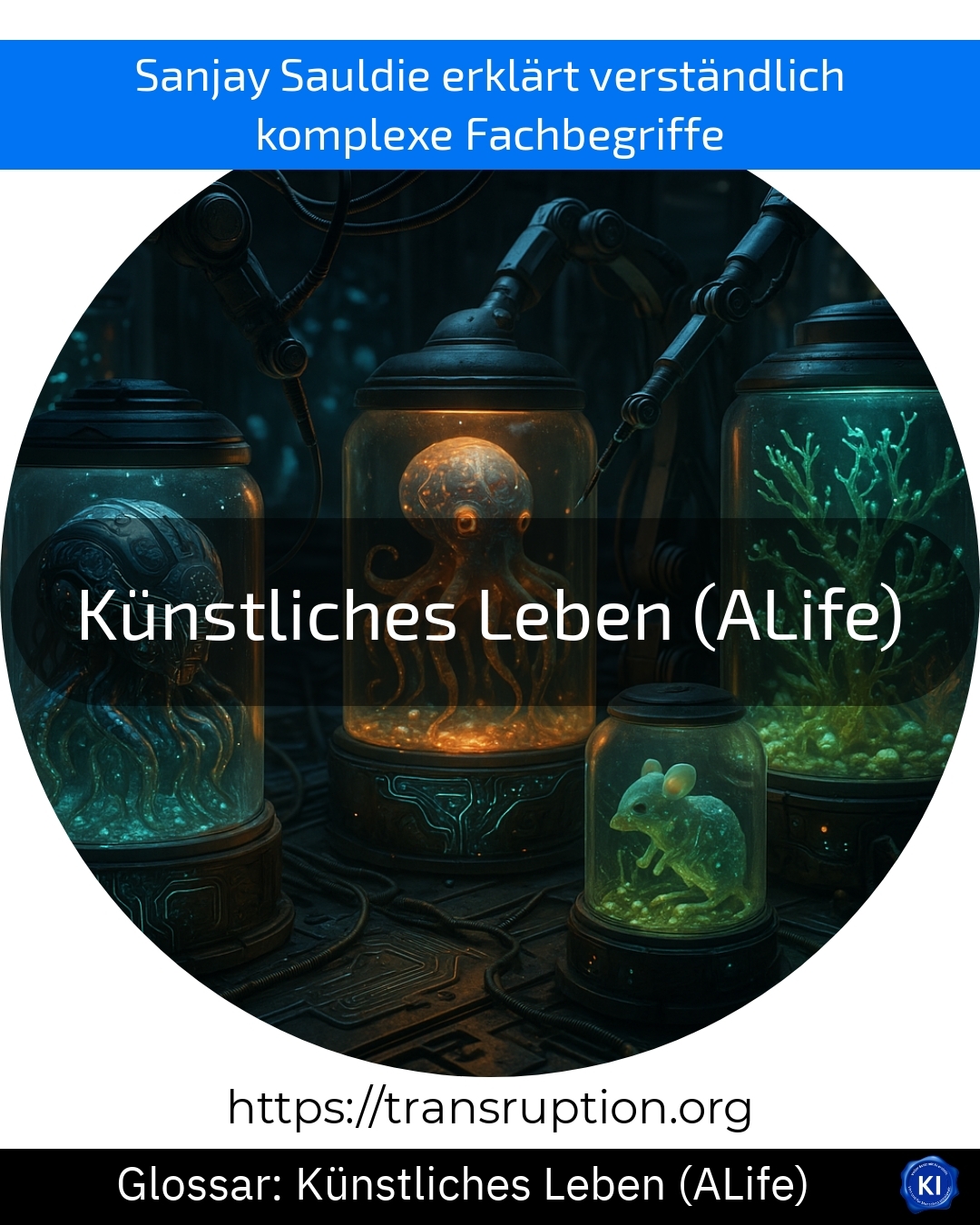
Artificial Life (ALife) falls into the categories of Artificial Intelligence, Sustainability and Environment 4.0, and Industry and Factory 4.0. The term describes digital or mechanical systems that mimic the behaviour of living organisms. The aim is to artificially generate processes such as learning, growing, or reacting to the environment.
For example, „artificial organisms“ are being developed in industry that can recognise their environment and adapt themselves. They can save energy, report errors, or even independently find solutions to work more sustainably. This can lead to machines in factories optimally adjusting their energy consumption depending on how much is being produced – similar to how animals are only active when they need to find food.
Artificial life therefore helps to better understand complex ecological or technical systems and to design them more sustainably. It finds application in research, the automation of production processes, or the development of new, environmentally friendly technologies. In this way, Artificial Life (ALife) contributes to mastering future challenges in society and industry.










 Deutsch
  English (UK)