
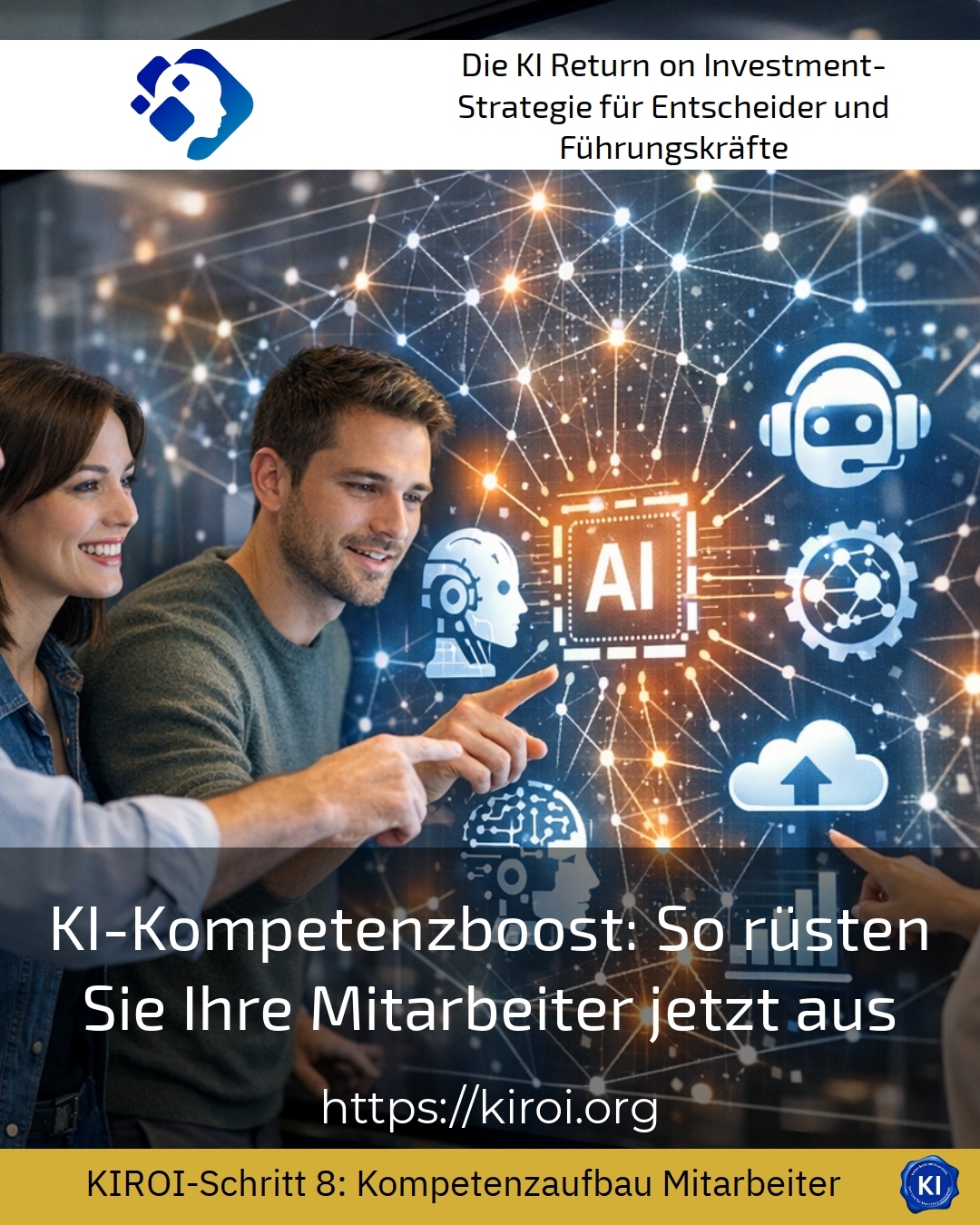
Have you ever wondered why some companies succeed with intelligent technologies while others fail? The crucial difference lies rarely in the technology itself, but rather in the people who use and understand these tools. A targeted approach AI Skills Boost For your workforce, it can make the difference between digital stagnation and a real competitive advantage. After all, modern systems for data analysis, process automation, and intelligent decision support only reach their full potential when employees know how to use them in a meaningful way. In this article, you will learn how to systematically empower your team and what concrete steps really count along the way.
Why the AI skills boost is becoming indispensable now
The working world is changing rapidly and profoundly. Intelligent algorithms are taking over routine tasks in almost all sectors. Today, the spectrum already extends from automated accounting to predictive maintenance in production. At the same time, completely new fields of activity are emerging that require specific knowledge. In healthcare, imaging procedures with learning systems support doctors in diagnosis [1]. Logistic companies optimize their routes using predictive analytics. Financial service providers rely on automated risk assessments when granting credit. These developments affect not only large corporations but also medium-sized businesses. Therefore, executives now need to act and prepare their teams.
The challenge lies in the fact that technological understanding alone is not enough. Employees need to learn to handle algorithmic recommendations critically. They should understand where the limits of automated systems lie. Furthermore, they need the ability to combine human judgment with machine precision. In retail, for example, algorithms analyze purchasing behavior and generate forecasts. But the final decision on assortment design requires human intuition for local peculiarities. In personnel recruitment, learning systems filter applications. However, the final selection is still in the hands of humans. This collaboration between human and machine aims to be learned.
Best practice with a AIROI customer
A medium-sized manufacturing company with about three hundred employees faced a special situation because the management had invested in modern analytical tools, but the utilization remained far behind expectations. As part of our transruptive coaching support, we jointly identified the causes of this discrepancy between investment and actual benefits. It turned out that many employees had touch-point fears and avoided the new systems. Others, on the other hand, used the tools without really understanding their results or making meaningful connections to them. We subsequently developed a multi-stage training program that began with basic concepts and gradually introduced more sophisticated applications. Particularly important was the involvement of multipliers from different departments. After their training, these internal ambassadors assumed the role of the first point of contact for their colleagues. After six months of intensive support, the active use of the implemented systems increased by over seventy percent. The employees often reported an increased confidence in using data-based decision-making tools.
Strategies for a sustainable AI competence boost in various industries
The qualification of employees requires a well-thought-out concept that takes into account different learning levels. Not everyone needs to become a data expert. Rather, it is about role-specific competencies that enrich the respective work routine. In the banking sector, for example, customer advisors need a fundamental understanding of how automated credit checks work [2]. They must be able to explain the decisions to customers in a comprehensible way. IT specialists in the same bank, however, need deeper technical knowledge about model validation and bias detection. In hospitals, nursing staff should understand how early warning systems for patient deterioration work. Doctors, in turn, must be able to critically evaluate imaging analysis methods.
The insurance industry offers illustrative examples of successful qualification approaches. Underwriters learn there how automated claims assessments work and when human review becomes mandatory. Underwriters understand the basics of predictive risk models and their limitations. Field agents use mobile applications with intelligent recommendations for customer consultations. In the automotive industry, the situation looks similarly diverse. Production workers work with predictive maintenance systems that detect potential machine damage early. Development engineers use generative design tools and evaluate their suggestions. Quality inspectors use image-based error detection as a supporting tool.
A well-thought-out training program begins with an assessment of existing competencies. Subsequently, companies define target profiles for different groups of employees. The actual qualification ideally takes place in blended formats. In-person workshops are suitable for interactive exercises and discussions. Online modules allow for flexible self-study at one’s own pace. Practical projects solidify the learned knowledge through direct application. In retail, teams can, for example, conduct small pilot projects to optimize inventory levels. In law firms, lawyers practice using document analysis systems on real cases. In architectural firms, architects experiment with generative design tools on internal projects.
The right framework for sustainable competence development
Sustainable training requires more than individual training events. It needs a supportive organizational framework. Leaders play a key role in this, as they must provide and demand learning time. In progressive companies in the pharmaceutical industry, employees receive dedicated hours for further education [3]. Media companies establish regular experimental spaces for new tools. Energy providers create cross-departmental learning groups for the exchange of experiences. These structural measures signal that competence development is taken seriously.
Another important factor is psychological safety in the learning process. Employees must be allowed to make mistakes without having to fear negative consequences. In consulting firms, protected spaces are created for experimenting with new analysis tools. Advertising agencies encourage playful exploration of creative assistance systems. Mechanical engineering companies establish testing environments for production data without real-time pressure. This atmosphere of openness significantly accelerates the learning process. Because those who are afraid of mistakes avoid new things and stick with what they know.
Best practice with a AIROI customer
A multi-location, transregional tax advisory firm sought ways to empower its professionals for automated accounting and auditing processes while maintaining high quality advice. The transruptive coaching approach initially focused on identifying concrete use cases with high potential for relief and quality improvement. Together with the employees, we developed tailored learning paths that addressed both technical fundamentals and ethical issues. Particular emphasis was placed on integrating machine suggestions into the existing audit process without undermining the professional judgment of the tax advisors. The firm hosted weekly learning sessions where teams exchanged experiences and learned from each other. In addition, guides were developed for typical situations that documented when algorithmic recommendations are particularly reliable and when increased caution is warranted. After about eight months, employees often reported significant time savings in routine tasks that they were able to use for more demanding advisory services.
Overcoming typical challenges in AI competence building
When training employees, companies face various obstacles. Transruptive coaching helps teams systematically overcome these hurdles. A common challenge is the heterogeneous starting point within a workforce. Younger employees often bring digital basic skills, while experienced professionals bring their deep domain knowledge. In the trade, this situation is particularly evident. Masters with decades of experience know their materials and procedures inside and out. Trainees, on the other hand, are familiar with digital tools and mobile applications. Successful training programs leverage this diversity as a strength.
Another common theme is resistance to change. Some employees fear being replaced by automated systems. Others doubt the usefulness of new tools for their work. In public administration, we regularly encounter such concerns. Administrative staff worry about the future of their positions. Executives question the reliability of algorithmic decision-making tools. Transparent communication helps address these concerns. Companies should clearly define which tasks still require human judgment. They should demonstrate how new tools facilitate work rather than replacing it.
Time constraints are another practical obstacle. In day-to-day operations, there is often little room for further training. Hotels and restaurants are particularly familiar with this problem. Seasonal peaks strain all available capacities. Training then quickly falls behind. Microlearning offerings with short, focused units help here. Fifteen-minute modules are easier to integrate into the workday than full-day workshops. Learning apps enable qualification during waiting times or while commuting. These low-threshold formats complement more intensive training measures in a meaningful way.
Success measurement and continuous adjustment
Qualification programs should regularly review and adapt their effectiveness. In the field of competence development for intelligent systems, new requirements are constantly emerging [4]. For example, market research companies are observing rapid developments in analysis tools. What was once specialized knowledge is tomorrow’s standard repertoire. Therefore, training programs need built-in updating mechanisms. Regular needs assessments identify new qualification gaps. Feedback from participants improves the didactic preparation. Pilot groups test new modules before broad rollout.
The measurement of success ideally takes place on several levels. In the short term, knowledge growth can be documented through tests. In the medium term, the practical application of new competencies in everyday work shows the transfer. In the long term, qualification successes are reflected in business metrics. In call centers, for example, the resolution rate during the initial contact increases due to better use of supporting systems. In engineering offices, project lead times are shortened through more effective use of tools. In editorial departments, the quality of research improves through competent use of analytical applications. Such concrete improvements justify investments in continuous qualification.
My AIROI Analysis
Systematic training of employees to handle intelligent systems is no longer an optional measure, but a strategic necessity for any future-oriented organization. Based on my experience in transruptive coaching, it is repeatedly shown that technical implementations alone rarely yield the desired results. The real leverage lies in the qualification and motivation of the people who are to use these tools. Companies that have a targeted AI Skills Boost Prioritizing them creates the foundation for sustainable competitive advantages.
The goal is not to turn every employee into a data scientist. Rather, different roles require different skill profiles. A well-thought-out qualification concept takes this differentiation into account and offers appropriate learning paths. The integration of practical exercises and real-world applications significantly accelerates the transfer of knowledge. Leaders bear a special responsibility by allowing time for further training and fostering a learning culture that is error-prone. Organizations that adhere to these principles often report increased employee satisfaction and more innovative solutions. The path to achieving this requires patience and consistent commitment, but the investment pays off through higher productivity and better decision quality.
Further links from the text above:
[1] Federal Ministry of Economics – Artificial Intelligence in the Economy
[2] BaFin – Publications on digital transformation in the financial sector
[3] Bitkom – Studies on digitalization in German companies
[4] Platform for Learning Systems – Skills Development for AI
For more information and if you have any questions, please contact Contact us or read more blog posts on the topic Artificial intelligence here.







 Deutsch
 English (UK)