
Why do so many companies fail to adopt new technologies despite using the most modern tools and investing significant budgets?
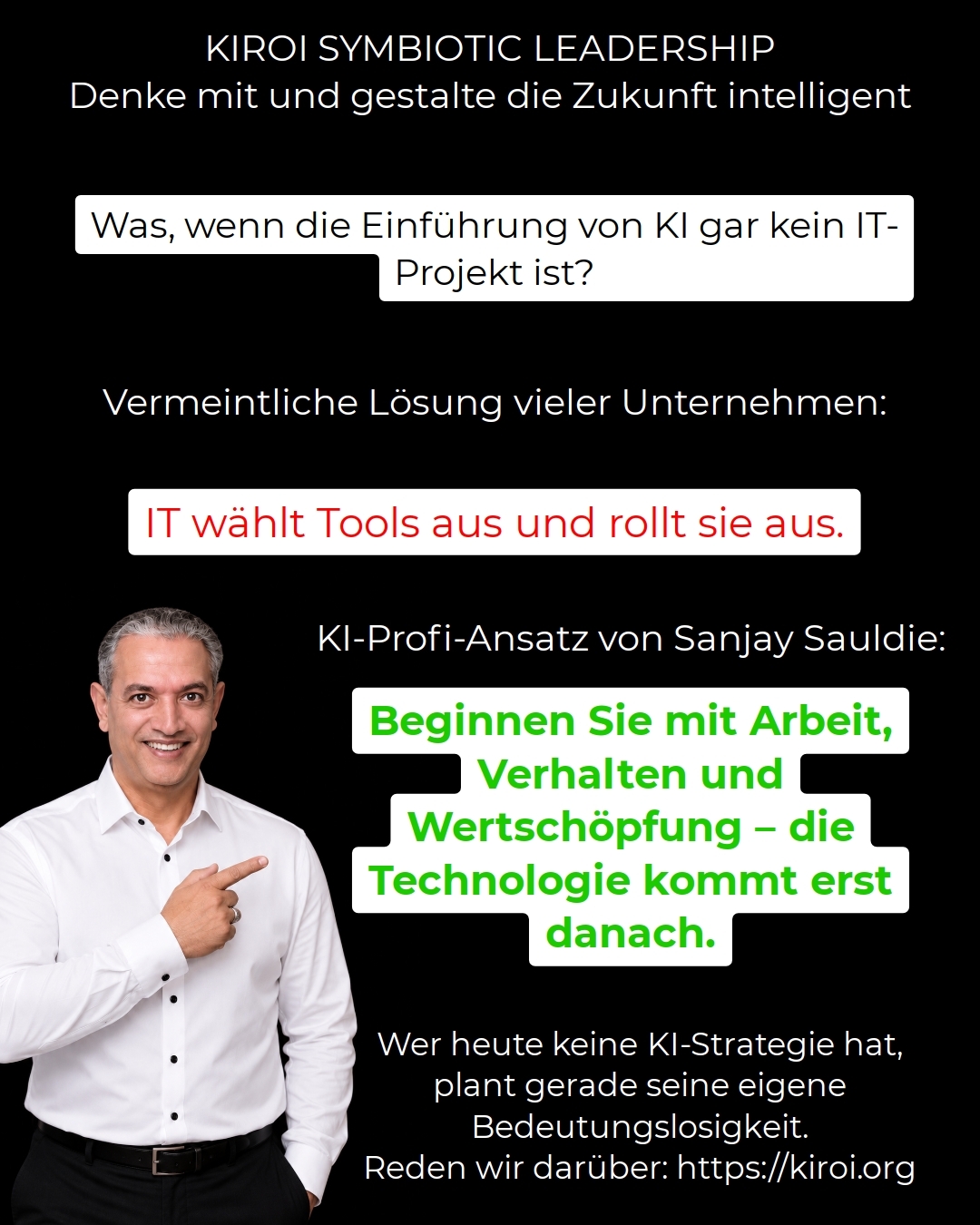
This question concerns executives in almost all industries because it reveals a fundamental thinking error that runs like a red thread through countless failed transformation projects. Introduction of AI In most organizations, it is treated as a classic IT project in which technical departments take the lead and functional departments are merely considered users. However, this approach regularly leads to disappointing results because it completely ignores the actual success factors. In this article, you will learn why a radical change in perspective is necessary and how the AIROI-method takes a fundamentally different approach that focuses on sustainable value creation.
The traditional approach: IT departments decide alone
In average companies, the Introduction of AI Following an established pattern. The IT department is tasked with evaluating and selecting suitable tools. Subsequently, a technical implementation is carried out, which is controlled by the IT department. Then, specialist departments receive training on how to use the new systems. This process appears logical and structured at first glance.
Nevertheless, practice shows that this approach is often problematic. Employees do not use the new systems as intended. Processes are not adapted, but merely digitized. The hoped-for efficiency gains remain elusive. Frustration arises on all sides of the organization.
A classic example can be found in the logistics industry. A medium-sized company invested in an intelligent warehouse management system. The IT department chose a state-of-the-art solution. However, after the technical installation, it became apparent that the warehouse workers still preferred their tried-and-tested methods. The system became a costly data dump.
We regularly observe similar situations in retail. Smart checkout systems are being introduced, but employees ignore them. Predictive maintenance solutions in production provide data, but no one uses it for decision-making. Chatbots in customer service are rejected by customers because they do not fit the service culture.
Why the IT-centric approach is too short-sighted
The cause lies in a fundamental misunderstanding. Technology is never an end in itself, but always a tool. A tool only becomes valuable through the way it is used. If people do not understand why they should use a tool, they will avoid it.
Furthermore, the technology-centric approach ignores human factors. Fears of change are not addressed. Habits are not taken into account. Cultural aspects remain unaddressed. This leads to resistance that even the best technology fails to overcome.
For example, a manufacturing company implemented AI-based quality control. The technology worked flawlessly. However, the experienced quality inspectors felt they were being bypassed and sabotaged the system subtly. Only after months of conflict did the real problem become apparent.
Best practice with a AIROI customer
A long-established retail company with several hundred stores faced the challenge of optimizing its inventory planning and making meaningful use of artificial intelligence. The first attempt followed the classic model, in which the IT department evaluated and technically implemented a leading software solution. After six months, a disappointing picture emerged, as store managers ignored the system’s recommendations and continued to order based on gut instinct. The management then approached us and requested guidance in reorienting the project. Together, we first analyzed the actual work processes in the stores and conducted detailed discussions with employees at all levels. It turned out that store managers perceived the system as a threat to their expertise rather than as a support. We developed a workshop approach where store managers could define for themselves which information they needed and how it should be presented. This involvement fundamentally changed the attitude, so that acceptance within a few weeks increased significantly. Today the company reports a noticeable improvement in inventory accuracy and higher satisfaction among employees, because they see themselves as designers and not as those affected by the change.
AIROI The solution: Work, behavior, and value creation first
The AIROI-method is based on a fundamentally different philosophy. It does not focus on the technology, but on the people and their work. This change of perspective may sound simple, but it requires a profound rethinking within the organization.
The first step is to understand the actual work. What do people actually do when they work? What decisions do they make? What information do they need for that? These questions are not answered theoretically, but explored through observation and dialogue.
An example from the insurance industry illustrates this approach. Instead of immediately introducing AI for damage assessment, it was first analyzed how claims handlers actually make decisions. It was found that they rely heavily on collegial exchange. The later technology solution therefore integrated functions for knowledge sharing.
Behavioral change as the key to Introduction of AI
In the second step AIROI, human behavior is addressed. Technology can only create value if people adapt their behavior. However, this adaptation does not occur automatically. It must be consciously designed and accompanied.
It is not about manipulation or coercion. Rather, it is about creating the conditions that enable and encourage new behaviors. People need to understand the personal benefits of the change. They need time to experiment and space to make mistakes.
In healthcare, this is particularly evident. Doctors and nurses accept new systems only if they make their work easier. One clinic introduced an AI-based documentation system. The success came only when the employees themselves were able to determine how to use the system.
In banking, we observe similar patterns. Customer advisors only use intelligent recommendation systems when they support their advisory expertise and do not replace it. Successful implementation therefore requires intensive dialogues with the advisors about their role.
Define value creation before selecting technology
The third component of the AIROI-method is the precise definition of the intended value creation. Before talking about technology, it must be clear what specific added value the change is intended to bring. This added value must be measurable and understandable.
It distinguishes AIROI between different dimensions of value creation. Efficiency improvement is just one of them. Quality improvement, customer satisfaction, employee satisfaction, and innovation are other important aspects. The organization must decide which dimensions are prioritized.
An automotive supplier originally only wanted to reduce production costs. Through the AIROI process, the company realized that quality improvement was more strategically important. The later technology selection was oriented towards this goal and led to better results.
In tourism, another example emerges. A travel agency initially defined personalized customer interaction as the most important value lever. Only then was search for suitable technologies that could support this goal initiated.
Best practice with a AIROI customer
An energy provider focused on renewable energy faced the challenge of optimizing its grid control and using modern analytical methods in the process. The project team did not start with a technology selection but with a comprehensive analysis of the work processes at the grid control stations. The employees were intensively involved in this process and were able to articulate their experiences and concerns, which led to a deep understanding of the actual challenges. It was revealed that the greatest value creation was not in automation but in better supporting human decisions in the event of disruptions. Based on this, a requirement profile was developed that the employees themselves had co-created and that valued their expertise. The subsequent technology selection was consistently oriented towards these requirements and not towards the promises of software providers. The result was a system that was perceived as helpful by the employees and significantly shortened the response times in case of incidents. The management emphasizes that the success is largely due to the early involvement of the employees.
The Introduction of AI understand as a cultural project
AIROI views technological transformation primarily as a cultural project. Corporate culture determines whether new tools are adopted or rejected. Leaders play a central role in this because their behavior sends signals.
When leaders themselves use the new tools, employees are more likely to follow suit. When leaders reward experimentation and tolerate mistakes, learning spaces are created. When leaders communicate goals and challenges transparently, trust grows.
In the pharmaceutical industry, this is particularly relevant. Regulatory requirements require high precision. Nevertheless, companies that use the AIROI-approach report higher acceptance of new systems. The reason lies in the organizational cultural preparation.
A media company transformed its editorial processes with the support of intelligent systems. The success was not due to the technology itself, but to intensive cultural work. Editors were valued as creative experts, not as labor to be replaced.
Practical steps for executives
For executives who want to implement the AIROI-approach, there are concrete recommendations for action. Start with honest self-reflection on the goals of the change. Question whether it is really about value creation or about technology enthusiasm.
Invest time in understanding the actual work processes. Leave your office and observe how employees work. Conduct conversations without an agenda and really listen. This investment will pay off many times over.
In mechanical engineering, a manager successfully used this method. He spent a week in the production facility and got to know the perspectives of the employees. The insights gained fundamentally changed the entire transformation strategy.
One logistics service provider went even further and had employees develop their own improvement suggestions. The results exceeded all expectations, as the employees were able to bring their expert knowledge to bear and felt that they were being taken seriously [1].
My AIROI Analysis
The experiences from numerous transformation projects clearly show that the traditional IT-centric approach when it comes to Introduction of AI It often leads to unsatisfactory results because it systematically underestimates human and cultural factors. Companies that view technology as a solution without first understanding the actual problems invest significant resources with limited returns. The AIROI-approach offers a well-founded alternative that enables sustainable value creation because it consistently puts people at the center.
The three pillars of this approach – understanding work, shaping behavior, defining value creation – form a coherent framework that can guide leaders through complex transformations. It is important to emphasize that this approach offers no guarantees and promises no easy solutions. It requires time, commitment, and the willingness to question established mindsets. However, companies that take this path report higher acceptance, more sustainable changes, and ultimately better business results.
As an accompanying coaching offering, transruptions coaching supports leaders in making this change in perspective and in developing their organizations accordingly. The coaching provides guidance, asks questions, and helps identify blind spots. Often, clients report that only through this external support did the real challenges become visible and new solutions emerged that had previously seemed unimaginable [2].
Further links from the text above:
[1] AIROI-Strategy: Value-oriented transformation
[2] Leadership Transruptions Coaching
Are you a leader and would you like to learn how you can genuinely introduce AI into your company in a valuable and sustainable way, away from the hype? Take part Contact us or read more blog posts on the topic Artificial intelligence here.







 Deutsch
 English (UK)