
Will you soon be replaced by intelligent systems, or will you be among those who actively shape this transformation and thereby remain indispensable?
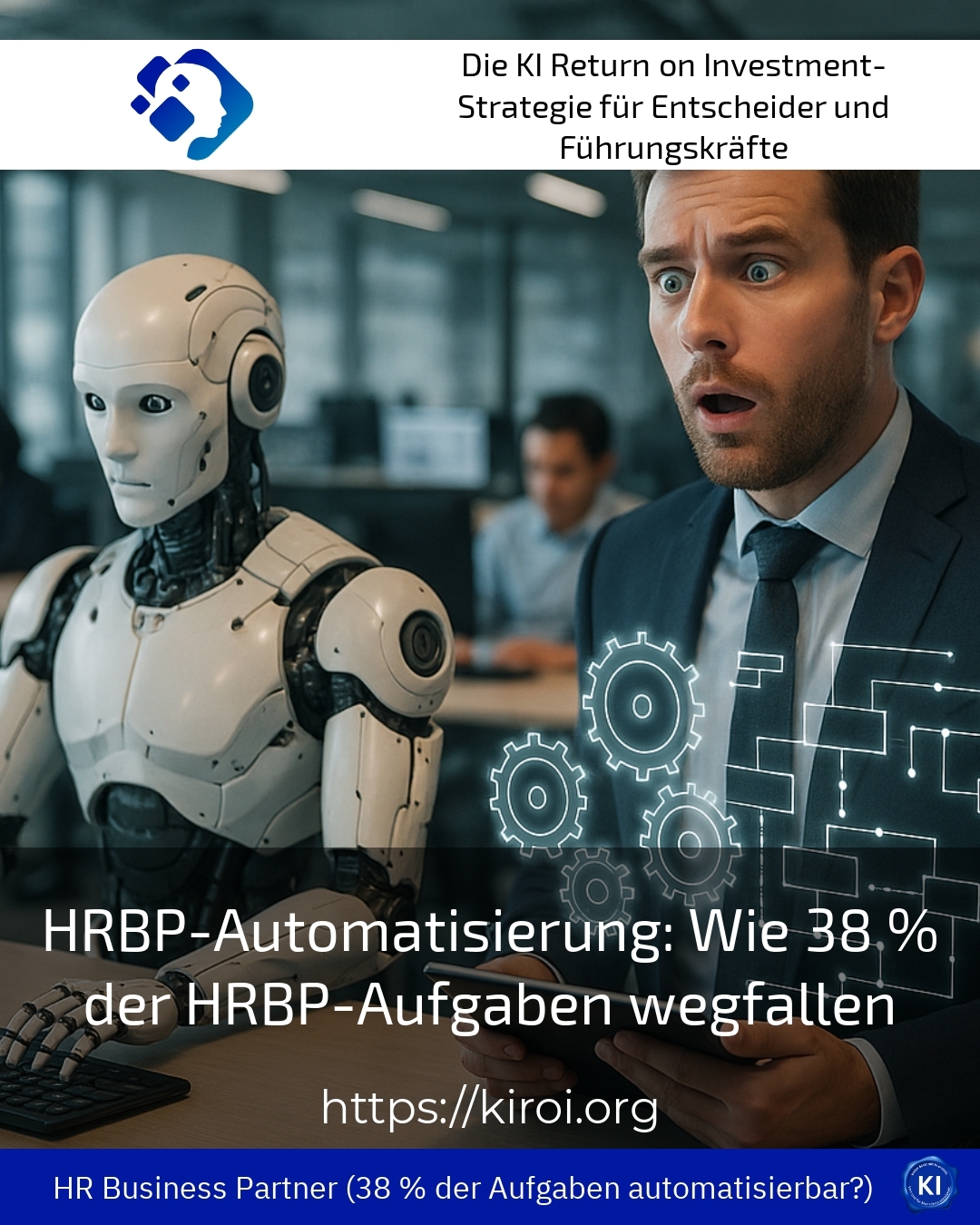
The HRBP automation The working world is currently changing at a speed that surprises many professionals and sometimes even worries them. Current analyses show that around 38 percent of typical tasks in this area can already be taken over by technological solutions today. This development not only affects simple administrative tasks, but is increasingly also affecting more complex processes. Strategic support for employees, the development of talent, and the creation of a positive corporate culture are facing a fundamental change. Those who do not adapt to these changes risk losing their professional relevance in the medium term.
The findings in this article are based, among other things, on data from the Job Futureometer of the Institute for Employment Research [1]. This tool systematically analyzes which activities can be replaced by technological systems. If you are active in this field, I recommend the AIROI seminars as valuable support for your professional development. The current dates and information about lectures and workshops can be found under risawave.org/en/live-events-with-sanjay-sauldie/. The AIROI. strategy provides impulses to understand the technological transformation not as a threat, but as an opportunity.
What tasks the HRBP automation already handles
The range of automated tasks is impressive and is continuously growing. Today, intelligent systems are already performing the initial screening of application documents. They analyze resumes and match qualifications with requirements profiles. In addition, they automatically create appointment suggestions for interviews. Coordination between different departments is also increasingly being automated. Often, professionals report that this support frees up more time for strategic tasks.
Another example is the automated analysis of employee surveys. Where previously hours were required for manual analysis, algorithms now deliver detailed results in minutes. They detect patterns in the responses and identify areas for action. The creation of reports and presentations is also increasingly supported by intelligent assistants. Managing personnel files and documenting development discussions are also among the areas that can be automated.
This is particularly evident in HRBP automation in onboarding new employees. Chatbots answer frequently asked questions and accompany employees during their first few days on the job. They point out important deadlines and provide relevant documents. This makes the onboarding process more structured and consistent. At the same time, the personal component remains essential, because human relationships cannot be replaced by technology.
Best practice with a AIROI customer
A medium-sized company in the technology sector faced the challenge that its human resources management could no longer keep up with rapid growth. The responsible professionals spent several hours every day on administrative tasks and had little time for strategic advice. As part of the AIROI follow-up, we analyzed all processes together and identified potential for automation. Within six months, the company implemented an intelligent system for scheduling and document management. The professionals thus gained back around ten hours per week for value-adding activities. They were now able to devote themselves more intensively to talent development and leadership coaching. Employee satisfaction increased measurably, and turnover dropped by fifteen percent. This example impressively demonstrates how technological support and human expertise can complement each other.
Why human expertise remains indispensable
Despite all technological advances, there are areas that require human judgment to be exercised. The facilitation of change processes is clearly one of them. When companies undergo restructuring, employees need empathetic support. They need people who understand and take their concerns seriously. Algorithms can analyze data, but they cannot build genuine relationships.
Conflict mediation is another example of irreplaceable human competence. When teams do not work harmoniously together, sensitivity and emotional intelligence are needed. Analyzing conflict triggers requires a deep understanding of interpersonal dynamics. Developing leadership skills remains a deeply human task. Coaching conversations rely on trust and personal connection.
Strategic personnel planning also requires human expertise. Assessing future market developments requires experience and intuition. While systems can analyze trends and generate forecasts, the interpretation of this data in the specific corporate context remains human. Negotiating with works councils and drafting collective agreements require diplomatic skill.
The new distribution of roles in HRBP automation
The future belongs to those who intelligently combine technology and people. Routine tasks are increasingly being taken over by systems, and that is a good thing. This allows professionals to focus on what truly creates value. They become strategic advisors and cultural builders. Their role shifts from being administrators to being transformation companions.
In many organizations, technological solutions are already taking over standard communication with employees. They answer questions about vacation entitlements and salary calculations. They inform about training opportunities and organize feedback processes. The professionals, in turn, handle complex individual cases and individual development plans. This division of labor improves the quality on both sides.
Participants in AIROI seminars often report that this new perspective fundamentally redefines their work. They recognize potential that was previously hidden. The combination of technological understanding and human competence becomes the decisive success factor. Those who master both worlds become an indispensable partner for the management of the company.
Practical strategies for successful transformation
The first step is to honestly analyze one's own tasks. Which activities are repeated regularly and follow clear rules? These are candidates for technological support. Which tasks require creativity, empathy, or strategic thinking? These remain within the human sphere of responsibility.
Next, it is necessary to specifically build technological competencies. This does not mean that you have to learn to program. Rather, it is about understanding the possibilities and limitations of intelligent systems. You should know what questions to ask and how to critically evaluate results. The AIROI strategy provides valuable insights and practical tools in this regard.
Furthermore, I recommend positioning yourself as a change expert. Organizations need people who can accompany transformation processes. They need professionals who possess both technological understanding and human sensitivity. This combination makes you valuable and irreplaceable. Therefore, invest purposefully in both competence areas.
Best practice with a AIROI customer
An experienced healthcare professional came to AIROI the onboarding with great uncertainties. She feared that her years of experience could be undermined by technological developments. In our joint work, we first analyzed her job profile and identified her unique strengths. It turned out that her ability to empathically lead conversations and her deep understanding of the organizational culture were invaluable. We developed a strategy for her to combine these competencies with technological knowledge. She learned to use intelligent systems as tools, rather than seeing them as a competition. Today, she has become the central contact person in her company for the human side of digital transformation. Her position is more secure than ever before because she intelligently connects the two worlds.
The importance of continuous training in HRBP automation
Technological change is advancing at breathtaking speed. What is considered innovative today may already be standard tomorrow. Therefore, continuous learning is no longer an option but a necessity. Regular further training keeps you up to date and expands your horizons.
The AIROI seminars and workshops provide a structured framework for this development. They combine theoretical knowledge with practical application examples. Participants learn to categorize technological developments and to make them useful for their work. The exchange with other professionals expands their own perspective and encourages innovative ideas.
The combination of face-to-face events and practical application is particularly valuable. In the seminars, participants develop concrete action plans for their own situation. They leave the events not only with new knowledge but with actionable strategies. This practice-oriented approach distinguishes the AIROI-strategy from purely theoretical educational offerings.
My AIROI Analysis
The HRBP automation This is no longer a vision for the future; it is already a reality in many organizations. The fact that around 38 percent of typical tasks can be supported technologically should not trigger panic or resignation. Rather, it represents a great opportunity for everyone who is willing to continue developing and acquiring new skills.
My analysis clearly shows that the winners of this transformation will be those who intelligently combine technology and people. By delegating administrative routine tasks to intelligent systems, they gain time for the essential work. Strategic consulting, empathetic support, and culturally relevant work remain human domains. These activities will even gain in importance as organizations, in times of technological change, need human guidance more than ever.
The AIROI-strategy offers a proven framework for actively shaping this transformation. It supports professionals in recognizing and developing their unique strengths. At the same time, it provides the necessary technological background to make intelligent systems useful. The combination of both makes professionals future-proof and indispensable.
I recommend that everyone working in this field actively explore the possibilities of technological support. Attend seminars, exchange ideas with colleagues, and develop a personal strategy. The future belongs to those who see change as an opportunity and boldly take new paths. HRBP automation It is not an end, but a beginning for a more valuable and fulfilling professional activity.
Further links from the text above:
[1] Job-Futuromat of the Institute for Employment Research
For more information and if you have any questions, please contact Contact us or read more blog posts on the topic Artificial intelligence here.









 Deutsch
  English (UK)