
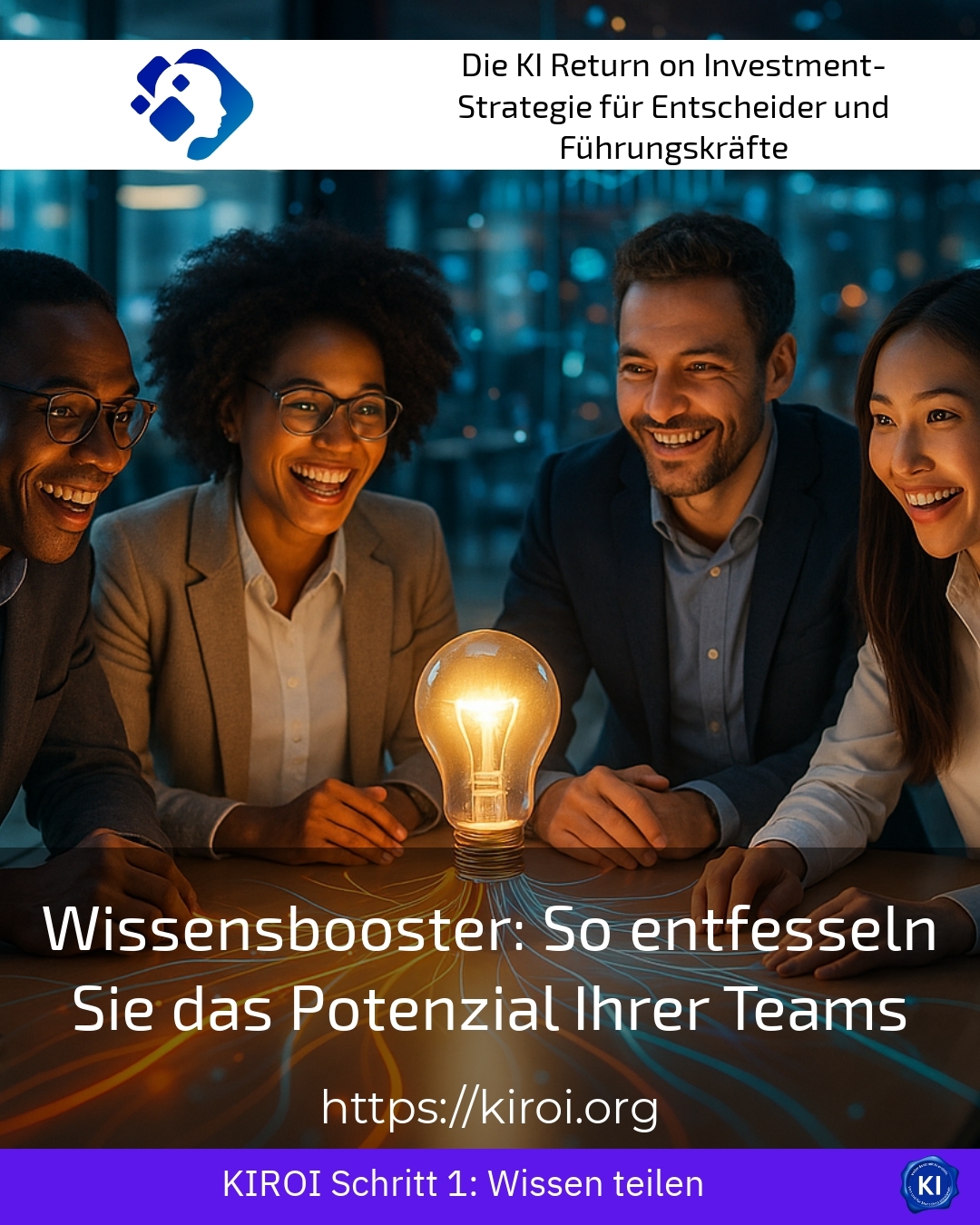
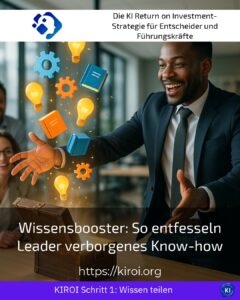
Imagine your team suddenly developing solutions that previously seemed unthinkable. This knowledge booster transforms how companies train and support their employees. Many leaders come to me with exactly this concern: they sense untapped potential. They observe valuable knowledge stagnating in silos. And they are looking for ways to unearth these hidden treasures. The good news is encouraging. There are proven methods that can often deliver surprising results. In this post, you will discover which impulses make the difference.
Why traditional further education often reaches its limits
The classic classroom training has had its day. At least in its current form. Many organisations invest considerable budgets in continuing education programmes. They book renowned trainers and rent fancy conference rooms. Nevertheless, a large part of the knowledge imparted disappears within a few weeks. The reason for this is the lack of connection to everyday work. Theoretical knowledge without practical application remains abstract and fleeting. This is why many clients report frustration after expensive training measures.
For example, a medium-sized logistics company had trained its entire management level. The participants praised the inspiring presentations. However, three months later, hardly anything had changed in daily operations. A financial services provider experienced something similar after an elaborate change management programme. The employees returned to their workplaces motivated. But old patterns quickly reasserted themselves. A manufacturing company invested in digital learning platforms. However, usage rates remained disappointingly low. These examples clearly highlight a recurring pattern.
The knowledge booster as an alternative to traditional training
A true knowledge booster works fundamentally differently. It starts where people actually work and make decisions. It connects learning with concrete challenges of everyday work. And it considers that every person learns and understands differently. Transruption coaching supports companies in designing such individual learning paths. It provides impulses without dictating how the path must look.
Best practice with a KIROI customer
An internationally operating trading company approached us with a specific concern. Teams were working increasingly in isolation from each other. Valuable experience and knowledge were being lost with every staff change. New employees took disproportionately long to get up to speed. The management team wished for a sustainable change to this situation. Together, we developed a concept for internal knowledge-sharing circles. These met regularly in short, focused sessions of a maximum of ninety minutes. Experienced colleagues shared their knowledge with others in structured formats. New team members brought fresh perspectives and critical questions. After six months, the company reported noticeably reduced onboarding times. Fluctuations in critical areas declined significantly. Particularly noteworthy was the improved collaboration between departments. Employees developed a stronger sense of belonging and shared learning.
The role of managers in the knowledge booster
Leaders often underestimate their influence on their teams' learning culture. Their behaviour determines whether knowledge sharing is rewarded or penalised. They decide whether mistakes are viewed as learning opportunities or failures. And they set the tone for how new ideas are handled. A knowledge booster can only be effective if leaders actively support it.
In a technology company, a single executive initially blocked all change. She hoarded knowledge as power and was reluctant to share her own insights. Only after intensive coaching did her behaviour gradually change. A healthcare provider experienced the opposite in a positive way. The management consistently modelled open knowledge sharing. They admitted their own mistakes and actively sought feedback from employees. This role model had a contagious effect on all levels of the organisation. A consulting firm implemented so-called knowledge sponsorships between experienced and new consultants. The senior partners were remunerated not only for project work but also for knowledge transfer.
Psychological safety as a foundation for the unfolding of knowledge
People are only willing to share their knowledge in safe environments. They need to be able to trust that questions are not seen as a weakness. They need the assurance that unusual ideas are welcome. Psychological safety forms the indispensable foundation for any knowledge booster [1]. Without this foundation, all other measures remain superficial and ineffective.
A pharmaceutical company conducted regular, anonymous surveys on psychological safety. The results initially came as a considerable shock to management. Many employees did not feel safe expressing dissenting opinions. A mechanical engineering company established the principle of constructive dissent in meetings. Each team member was allowed and expected to formulate at least one critical objection. This practice fundamentally and lastingly changed the quality of discussions. A media company created so-called "experimentation spaces" for risky ideas. There, teams could try out new concepts without fear of consequences.
Technology as support, not as a replacement
Digital tools can significantly accelerate and simplify knowledge transfer [2]. They enable asynchronous learning and cross-location exchange. However, technology alone does not solve cultural challenges within a company. It can reinforce existing structures but cannot fundamentally change them. Transruption coaching assists organisations in finding the right balance.
A global consumer goods manufacturer implemented a cutting-edge knowledge management platform. The software offered impressive features for documentation and search. However, employees barely used it for actual knowledge sharing. Only the addition of moderated community formats brought the system to life. An insurance company skillfully combined digital learning modules with in-person coaching sessions. This hybrid approach proved particularly effective for complex topics. An automotive supplier used Artificial intelligence for the networking of experts. The system automatically suggested suitable contact persons for specific questions.
Best practice with a KIROI customer
An energy provider was facing a significant challenge with knowledge transfer. Many experienced specialists were nearing retirement. Their expert knowledge of complex technical facilities had hardly been documented. The company feared considerable skill gaps in the near future. We supported the establishment of a systematic knowledge transfer program over several months. Experienced employees were trained and mentored as internal knowledge ambassadors. They learned methods for making their implicit knowledge accessible to others. At the same time, younger colleagues developed skills in structured knowledge management. Collaboration between the generations improved noticeably and sustainably. The company was able to secure and further develop critical knowledge. The older employees experienced appreciation for their expertise. The younger ones gained access to valuable experiential knowledge.
Knowledge booster through peer consultation and peer learning
Some of the most effective learning methods are low-cost and high-impact. Peer coaching systematically harnesses the collective intelligence of existing teams. Peer learning facilitates knowledge exchange on an equal footing, free from hierarchical barriers. These formats are particularly suited to complex, context-dependent challenges in everyday working life.
A hotel chain introduced regular exchange formats between its locations. General Managers shared best practices and current challenges with one another. Participants reported valuable impulses for their own work. A retail company systematically established learning partnerships between store managers from different regions. These pairs continuously supported each other in difficult situations. An IT service provider organised monthly case discussions for project managers across the company. The anonymised practical cases offered rich learning material for all involved.
Learning to recognise and overcome obstacles
The path to becoming a learning organisation is rarely straightforward and simple. Resistance can emerge from various directions and take you by surprise. Some employees fear being replaced through knowledge sharing. Others have had bad experiences with previous change initiatives. Transruptional coaching helps to understand and address these resistances.
A financial institution struggled with a pronounced culture of competition between departments. Knowledge sharing was considered a competitive disadvantage for one's own career there. Only the change in evaluation criteria and incentive systems brought about movement. An industrial company initially experienced significant passive resistance to new knowledge formats. Employees participated but hardly engaged actively in the process. Intensive discussions revealed fears of additional workload as the cause. A service company considerably underestimated the time required for knowledge activities. The packed schedules left little room for reflection and exchange.
My KIROI Analysis
After many projects on knowledge development in organisations, a clear pattern emerges. Successful companies do not view learning as an isolated activity, but as an integral component. They create structures that enable and reward knowledge sharing. They invest in psychological safety as an indispensable foundation. And they understand that technological solutions can only support what is culturally embedded.
The KIROI methodology [3] provides a structured framework for this transformation. It combines strategic planning with practical implementation support over time. Throughout this process, the human element remains at the centre of all considerations and actions. Ultimately, it is people who create, share, and apply knowledge.
The realization that there are no standard solutions seems particularly important to me. Every organisation brings its own prerequisites, challenges, and potential. What works for one company can fail for another. That's why I consistently work with individual analyses and tailored recommendations. The knowledge booster must fit the respective context in order to develop sustainable impact.
The future belongs to organisations that can systematically harness collective intelligence. They will be able to react faster to changes and act more innovatively. They will attract talent seeking and valuing development opportunities. And they will remain resilient in a world of increasing complexity and uncertainty.
Further links from the text above:
[1] Harvard Business Review – Psychological Safety
[2] McKinsey – People and Organisational Performance
[3] KIROI Method – Overview and Application
For more information and if you have any questions, please contact Contact us or read more blog posts on the topic Artificial intelligence here.






 Deutsch
  English (UK)