
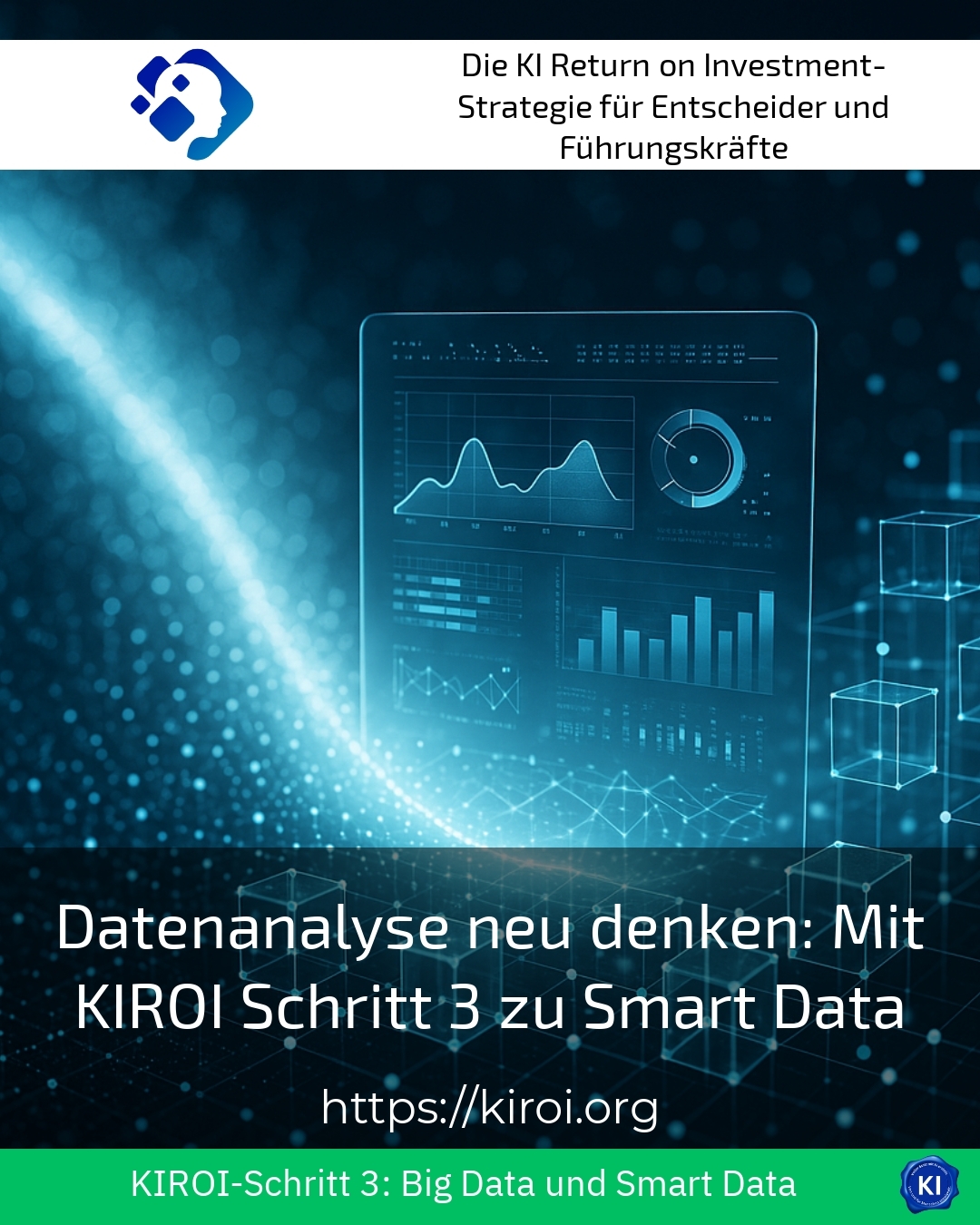
The modern business world is changing rapidly. Data analysis is increasingly at the centre of it all. However, many organisations collect vast amounts of information but do not utilise it optimally. The challenge lies in extracting truly valuable insights from this data. This is precisely where a new approach comes in: rethinking data analysis. With KIROI Step 3, the journey to Smart Data is systematically and practically supported.
Why data analysis must be rethought today
In the past, it was often enough to collect data and store it in tables. Today, that is no longer sufficient. Companies need clear, relevant, and immediately usable information. Classic data analysis quickly reaches its limits here. Modern solutions focus on intelligent filtering, targeted preparation, and context-specific evaluation. This is how raw data is transformed into valuable insights that support decisions.
Example: A manufacturing company collects data daily from machines, sensors, and employees. With classical data analysis, this data is often merely stored. With a new approach, it is specifically filtered, contextualised, and analysed. This enables the prediction of maintenance needs, the identification of bottlenecks, and the automation of quality control.
Another example: In traffic management, data from cameras, GPS systems and social media is analysed. This makes it possible to optimise traffic flows, reduce congestion and adaptively control traffic lights. Here, too, it is clear that classic data analysis is not enough. Intelligent methods are needed to derive real added value from the data.
A third example: In marketing, data is collected from various channels. Classical data analysis often only evaluates individual campaigns. With a new approach, customer behaviour can be understood across touchpoints and personalised campaigns can be developed.
Data Analysis and Smart Data: The Next Level
Data analysis as the basis for Smart Data
Smart Data isn't created by mere data collection. It is the result of targeted data analysis. Large volumes of data are filtered, prepared, and contextualised. This creates clear, relevant, and immediately usable information.
For example, an e-commerce company collects data on orders, clicks, and customer feedback. With traditional data analysis, this is often only aggregated. With a new approach, it is analysed specifically to understand customer behaviour and develop personalised offers.
Another example: In logistics, data on deliveries, routes, and vehicles are collected. With classic data analysis, often only individual key figures are considered. With a new approach, routes can be optimized, delivery times shortened, and costs reduced.
A third example: In the healthcare industry, data on patients, treatments, and outcomes is collected. Traditional data analysis often only looks at individual cases. A new approach allows treatment outcomes to be compared, risks to be identified, and processes to be optimised.
BEST PRACTICE with one customer (name hidden due to NDA contract) and then the example with at least 50 words.
A medium-sized manufacturing company faced the challenge of using its machinery more efficiently. With traditional data analysis, only individual key figures were considered. By introducing a new approach, data could be specifically filtered and contextualised. This allowed for the prediction of maintenance requirements, the identification of bottlenecks, and the automation of quality controls. Productivity increased significantly, and downtime was reduced.
Practical steps for new data analysis
Rethinking data analysis: The three steps
1. Data Collection: Collect data from various sources such as sensors, IoT devices, CRM systems, and web tracking.
2. Data Integration: Connect the data through ETL processes, APIs, and middleware. This creates a unified data picture.
3. Data Analysis: Utilise modern tools and methods such as machine learning, data mining, and statistical analysis to gain valuable insights.
For example: A retail company gathers data on orders, clicks, and customer feedback. By integrating the data into a unified system and applying modern analytical methods, customer behaviour can be understood and personalised offers developed.
Another example: In logistics, data on deliveries, routes, and vehicles is collected. By integrating the data into a unified system and applying modern analysis methods, routes can be optimised, delivery times shortened, and costs reduced.
A third example: In the healthcare sector, data on patients, treatments, and outcomes are collected. By integrating the data into a unified system and applying modern analytical methods, treatment outcomes can be compared, risks identified, and processes optimised.
My analysis
Modern data analysis is a crucial factor for business success. It enables valuable insights to be extracted from large volumes of data and supports decision-making. With a new approach, data can be specifically filtered, processed, and contextualised. This creates Smart Data that delivers real added value. Practice shows that companies rethinking data analysis achieve significantly better results.
Further links from the text above:
What does smart data mean and what are the application scenarios?
Smart data: How intelligent data is shaping our future
Smart Data Analytics | DE | TÜV Rheinland
Smart data: How companies make better decisions
Big and smart data - from statistics to data analysis
Make decisions with smart data
Smart data: definition, application and difference to big data
What is smart data and how does it work?
For more information and if you have any questions, please contact Contact us or read more blog posts on the topic Artificial intelligence here.











 Deutsch
  English (UK)