
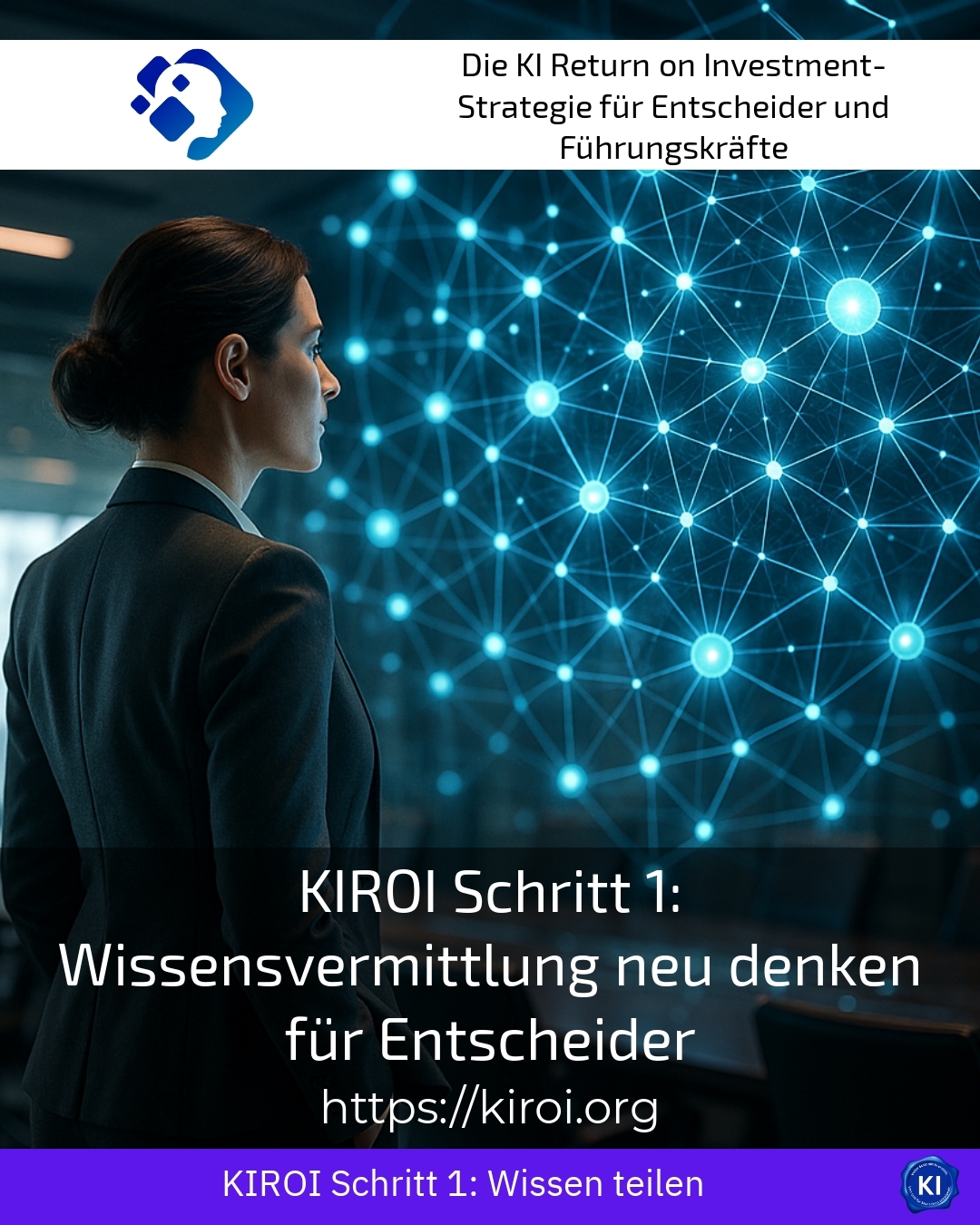
The modern business landscape presents decision-makers with entirely new challenges. Knowledge has become the most valuable resource. But how is knowledge effectively imparted today? Classical knowledge transfer no longer works in the digital age. Companies need new approaches. They must fundamentally rethink knowledge transfer. This is precisely where transruption coaching comes in. We support decision-makers with projects related to innovative knowledge transfer.
Warum traditionelle Wissensvermittlung ihre Grenzen erreicht
Many organisations still rely on outdated methods. Frontal teaching, long presentations and static documents dominate daily life. Yet, reality has changed. Employees learn faster today. They expect individual learning paths. They want interactive formats. Traditional knowledge transfer ignores these expectations.
The result is often frustrating. Knowledge is passed on, but not understood. Or it is forgotten because the format isn't right. Companies invest in training that doesn't yield sustainable results. The time is ripe for a paradigm shift. Decision-makers must recognise: knowledge transfer is not simply information transfer.
Knowledge transfer as a strategic success factor
Effective knowledge transfer is a strategic tool. It creates a competitive advantage. It strengthens innovative capacity. It retains talented employees. Companies like Google, Amazon and Microsoft understood this early on. They invest heavily in modern learning formats. They use storytelling, visualisation and interactive methods.
A software company in Munich is a prime example of this. The company completely changed its knowledge transfer methods. Instead of training videos, they now use digital learning platforms. Employees learn at their own pace. The success was measurable. Productivity rose by 35 percent. Employee satisfaction climbed significantly.
But why does that work? Because modern knowledge transfer takes learners seriously. It considers different learning styles. It creates space for questions. It connects theory with practice.
The opportunities of modern knowledge transfer for your business
Modern knowledge transfer opens doors. Employees develop faster. They feel valued. They stay with the company. This saves costs associated with staff turnover. At the same time, a culture of continuous learning emerges. Innovation becomes a matter of course.
Three concrete opportunities arise:
Firstly: Higher competence development. Through adaptive learning paths, each employee can build on their individual strengths. Chunking methods break down complex topics into digestible bites. Understanding becomes deeper. Knowledge is retained for longer.
Secondly: Better knowledge retention. If knowledge is properly transferred, the company protects itself against knowledge loss. A sales manager with 20 years of experience retires. His knowledge is gone. Unless the knowledge transfer has systematically documented and passed it on to others.
Thirdly: Faster problem-solving. When employees learn faster, they can act faster. They make better decisions. They innovate more quickly. This is crucial in the digital age.
Practical methods for better knowledge transfer
What does modern knowledge transfer look like in practice? There are tried and tested methods that work.
Storytelling: Conveying knowledge through stories
People remember stories. This is scientifically proven. A dry lecture on customer service will be quickly forgotten. But a story about a satisfied customer whose problem was solved will stick in the mind.
A telecommunications company systematically uses storytelling. It tells its customer service employees stories of real customer cases. Not as criticism, but as learning stories. The effect: The employees better understand the principles. They apply them more quickly. Customer satisfaction increased by 28 percent.
Storytelling brings dry information to life. It connects knowledge with emotion. This ensures that knowledge transfer is sustainably retained in memory.
Visualisation: Images instead of a desert of words
The human brain processes images 60,000 times faster than text. A good graphic replaces hundreds of words. However, many companies don't leverage this.
A financial services provider worked with columns of numbers in Excel spreadsheets for a long time. Imparting knowledge about complex financial products was laborious. Then visualisations were introduced. Interactive diagrams now show how money flows. Employees understand connections immediately. The error rate dropped by 42 percent.
Visualisation makes knowledge transfer more efficient. It works with the natural way the brain functions. It saves time. It improves understanding.
Interactivity: Learners become creators
One-sided learning is ineffective. People learn by doing. They learn through exchange. They learn through feedback.
A mechanical engineering company opted for interactive workshops instead of training videos. Technicians discuss problem-solving live. They experiment with simulations. They give each other feedback. The result: knowledge transfer is more intensive. Employees feel more valued as partners.
Interactive knowledge transfer also creates a different culture. It signals: your opinion counts. Your input is valuable. This is motivating.
Customers come to transruptions-Coaching with topics related to disruption.
In our practice, we experience diverse challenges. Organisations come to us with specific problems.
First, there are the companies that want to digitalise their knowledge transfer. They have recognised that old methods are no longer sufficient. They need modern e-learning platforms. They are looking for help with the conceptualisation. They want to ensure that the new knowledge transfer really works.
Then there are organisations that have to manage knowledge transfer between generations. Experienced employees are retiring. There is a risk of know-how being lost. We help to systematically document and impart this knowledge.
The third group consists of companies that want to strengthen their innovative capabilities. They know that without better knowledge transfer, there can be no real innovation. We support them in creating learning cultures that foster innovation.
Fourthly come organisations that want to develop their leaders. Leaders are central to knowledge transfer. They must embody knowledge transfer. They must motivate employees to learn.
And finally: Businesses that want to improve their customer training. Customers should understand products. They should be able to use them independently. This requires professional knowledge transfer.
BEST PRACTICE with one customer (name hidden due to NDA contract)A retail group with over 5,000 employees had a central problem. Knowledge transfer between the different locations was not working. Each branch did things differently. There were no standards. This led to quality problems and customer complaints. Together with Transruptions Coaching, we developed an integrated knowledge transfer system. We combined storytelling, visualisation, and online modules. Each employee could learn at their own pace. After six months, the results were measurable: customer complaints decreased by 51 percent. Employee satisfaction increased significantly. Knowledge transfer became a competitive advantage.
Knowledge transfer in the context of artificial intelligence
The future of knowledge transfer is shaped by artificial intelligence. AI systems can personalise learning paths. They can recognise individual learning paces. They can generate adaptive content.
This does not mean that human knowledge transfer becomes redundant. On the contrary. AI is a tool. An important tool. But the emotional component remains crucial. People want to learn from people. They want to be in a relationship. They want to feel understood.
The best knowledge transfer of the future combines both. AI takes over the routine tasks. Humans take over the relational and reflective aspects. Together, something powerful emerges.
Action steps for decision-makers
What exactly can you do? Here are four steps to improve knowledge sharing in your organisation.
Step one: Honestly analyse your current knowledge transfer. How do you transfer knowledge today? What methods do you use? Which ones work? Which ones don't? This inventory is essential. Without it, you'll end up with modern formats that don't fit your culture.
Step two: Define clear objectives. What should improved knowledge transfer achieve? Higher competence? Better customer satisfaction? More innovation? Lower staff turnover? Without clear objectives, initiatives will get nowhere.
Step three: pilot new formats. Start small. Test a new method with one department. Learn from it. Then scale gradually. This reduces risk and resistance.
Step four: Measure success. What gets measured gets improved. Use key performance indicators. Skill progression, customer satisfaction, employee satisfaction, innovation success. The transfer of knowledge is a central tool in this process.
Common hurdles in modernising knowledge transfer
The transition to modern knowledge transfer is not easy. There are typical hurdles that many organisations experience.
The first hurdle is often the question of resources. Modern knowledge transfer costs money. Money for tools. Money for training. Money for design. But there is a misunderstanding here. It's not about costs. It's about investment. And the ROI is often higher than expected. Better knowledge transfer saves costs through higher productivity, fewer errors, and lower staff turnover.
The second hurdle is resistance. Employees like routines. Managers are sceptical. „We've been doing it this way for 20 years. Why change?“ The key here is: show small successes first. Create positive experiences. Then acceptance will follow.
The third hurdle is quality. There are many tools for knowledge transfer. But not all of them are good. A bad e-learning platform is worse than none at all. Therefore: Work with experts. Ensure that the quality is right.
Why Transruption Coaching should be your partner
The modernisation of knowledge transfer is complex. It requires experience. It requires methods. It requires an external perspective.
transruptions-Coaching offers both. Firstly, experience. We've worked with hundreds of organisations on knowledge transfer. We know the stumbling blocks. We know what works.
On the other hand, methods. We use tried-and-tested approaches. We combine theory with practice. We are guided by real-world challenges. We create solutions that work.
And we bring an external perspective. Sometimes organisations are too close to things. They don't see their own blind spots. An external consultant can help to recognise these.






 Deutsch
  English (UK)