
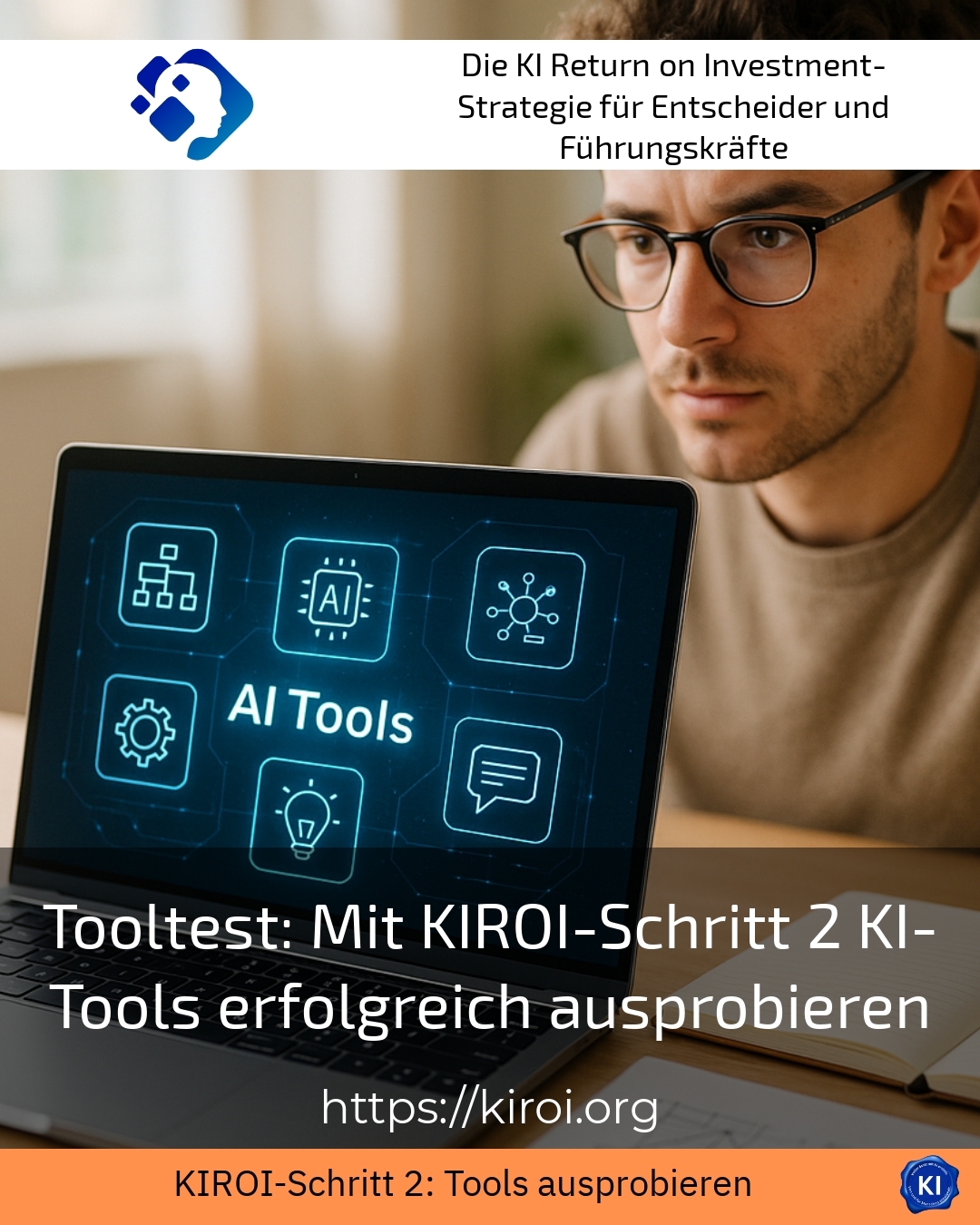
Im digitalen Wandel stellt der Tooltest represents a significant step, enabling companies to specifically try out and evaluate new technologies. Especially within the framework of the KIROI methodology, Step 2 offers a structured approach to testing AI tools meaningfully and in a results-oriented manner. This allows managers and project leads to gain important insights for precisely tailoring software solutions to their requirements.
Why the tool test is essential in KIROI step 2
The Tooltest follows a detailed analysis of individual company requirements in the KIROI process. Instead of choosing tools based on gut feeling, teams develop clear use cases that cover all important functions and features during the testing phase. For example, in the manufacturing industry, tests check how reliably visual systems detect quality defects. In healthcare, user-friendly and secure documentation solutions are the focus of testing. And in financial services, AI applications for risk analysis are meticulously checked for their integration suitability.
This precise preparation avoids costly misjudgments due to unbalanced features or a lack of compatibility. Because when dealing with AI systems in particular, the following applies: only those who test the tools realistically can create a sound basis for decisions.
How the tool test supports practical business processes
In trade, for example, it enables Tooltest the review of AI-powered forecasting systems for inventory management. Improved sales planning reduces warehousing costs and minimises stockouts. In logistics, various software solutions for route optimisation are evaluated through testing, which leads to a noticeable increase in delivery performance. Educational institutions are trialling supporting programmes that adapt curricula to individual learning needs.
These examples show: The practical relevance is for the Tooltest indispensable. Only in realistic application scenarios do the strengths and weaknesses of the solutions become apparent.
BEST PRACTICE with one customer (name hidden due to NDA contract)
A media company used the Tooltest In KIROI Step 2, to evaluate different AI-based text creation solutions. The focus was on text quality, customisability, and workflow integration. This structured approach led to successful implementation and a high level of acceptance within the team.
What matters when carrying out tool testing
Successful tool testing follows a clear process: first, the specific need is identified with the involvement of the specialist departments. Building on this, the team selects potential tools, which are then tested against defined criteria. It's not just technical functions that are important here, but also usability, security, and compatibility with existing systems.
For example, a manufacturer in the automotive sector tested AI-powered diagnostic tools to better plan maintenance processes. In the marketing sector, a service provider evaluated SEO tools to specifically analyse competitors and improve visibility. A financial services provider used automation solutions to take over routine tasks in contract management, thereby freeing up time resources.
Tips for effective tool testing
Companies should create a realistic testing environment that accurately reflects day-to-day work. It is advisable to actively involve users so that their feedback is incorporated into the evaluation. Iterative testing and documentation ensure that all findings remain transparent and weaknesses are identified early on. Furthermore, the Tooltest a spectrum from functional testing to sustainable integration into the organisation.
This frequently succeeds in successfully embedding technological innovations and strengthening innovative power.
A further advantage of structured tool testing is the support it provides in prioritising criteria and making better investment decisions. Linking with coaching services, such as transruption coaching, can help clients fully realise the potential of the tools.
BEST PRACTICE with one customer (name hidden due to NDA contract)
A technical service company carried out a Tooltest through with a focus on an SEO analysis tool. The systematic support in the KIROI process helped to evaluate usability and adaptability. The insights gained sustainably improve digital competitiveness.
My analysis
The Tooltest KIROI Step 2 is a structured and proven method for evaluating AI tools and digital solutions in a practical way. It supports companies in selecting suitable tools for the long term that meet individual requirements. Robust decision-making foundations are created through real application scenarios and the incorporation of user feedback. The variety of industry examples shows that the tool test can provide impetus for more efficient processes and better results. At the same time, it promotes the acceptance of new technologies within the company.
Companies that specifically use this method and have it accompanied by coaching foster sustainable project success and strengthen their innovation capability.
Further links from the text above:
Tool Testing: How to Succeed with Step 2 of the KIROI Methodology – SAULDIE
Focus on tool testing: How to succeed in step 2 of the KIROI process
Tooltest: Successfully testing AI innovations with KIROI Step 2
Tool testing for decision-makers: successfully utilising KIROI step 2
Focus on tool testing: KIROI step 2 for AI success – SAULDIE
For more information and if you have any questions, please contact Contact us or read more blog posts on the topic Artificial intelligence here.











 Deutsch
  English (UK)