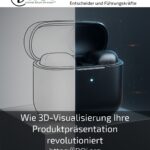
How 3D Visualisation is Permanently Changing Your Product Presentation
Every company today faces the challenge of presenting products clearly, attractively, and convincingly. 3D visualisation has established itself as a key technology here because it makes complex relationships easy to understand while remaining flexible. This allows you to convey your message precisely, even if a physical product does not yet exist. Especially in times of agile development cycles and increased demands for sustainability, 3D visualisation is a powerful tool for product development, marketing, and sales.
Flexibility and variety of options through modern 3D visualisation
A digital 3D model offers enormous freedom: you can adjust colour, material, shape and perspective at any time, without requiring complex redesigns or new shoots [1]. This is particularly advantageous if your product is offered in different versions or is still under development. This way, you save time, reduce costs, and keep all presentation channels consistent.
For customers, this means more transparency and better comparability, as they can directly see how different features look. iROI Coaching will guide you through the creation and integration of such 3D configurators into your sales and marketing process, allowing you to fully exploit their potential.
BEST PRACTICE with one customer (name hidden due to NDA contract) A medium-sized furniture manufacturer uses photorealistic 3D visualisation to allow customers to interactively select different upholstery fabrics and types of wood. As soon as a combination is changed, the image updates instantly. Customers describe it as a fascinating, modern shopping experience. At the same time, the company has been able to reduce the time spent on photo shoots by more than 60% and increase online conversion rates.
The same principle applies in the automotive industry: virtual showrooms display vehicles in real-time, for example with different paint colours or interior options [4]. Customers can immediately see what their favourite model would look like without a prototype needing to be built. 3D visualisation is also used in the packaging industry – for example, for interactive 360-degree views of packaging designs, which are presented online or at trade fairs [4].
BEST PRACTICE with one customer (name hidden due to NDA contract) A manufacturer of cosmetic packaging visualises new designs as a 3D model before printing moulds are produced. Customers can test various decorations, shapes, and closures with a mouse click. This shortens the development process from weeks to days, and customer satisfaction increases through early involvement in the design process.
Interactive experiences build trust and shorten purchasing decisions
The strength of 3D visualisation lies in its interactivity: users can rotate, zoom, and sometimes even look inside products. This builds trust because customers can see what they are getting and engage more deeply with the product. Studies show that such interactive presentations can significantly increase customer loyalty and boost conversion rates[1][5].
An example from the electronics industry: For innovative tech products, 3D animations are often created that demonstrate functional processes and explain operation. This makes complexity tangible without the need for a device to be present on-site. The integration of Augmented Reality (AR) – for example, for virtual trial functions – also sets new standards for the customer experience[3][4].
BEST PRACTICE with one customer (name hidden due to NDA contract) An online shop for technical measuring instruments offers, in addition to classic product photos, a 360-degree rotation animation and short 3D videos that clearly demonstrate how the products work. The additional option to virtually place products in one's own work environment doubles the time spent on the website and significantly increases enquiries for in-house demos.
Time and cost savings: Plan efficiently with 3D visualisation
3D visualisation is not only innovative but also practical: it saves time and resources, as physical prototypes are often only needed for final testing[3][9]. Changes or new variants can be implemented directly on the computer. This accelerates development and brings products to market faster.
In industry, technical 3D CAD animations are highly valued for making complex machinery and processes understandable [2] [6]. Instead of lengthy explanations, a short video showing how something works step-by-step is sufficient. Companies also benefit internally because different departments can work on the same digital model, minimising misunderstandings [9].
An example from the construction industry: Architectural firms use 3D visualisation to visualise construction projects even before the first spade has broken ground. This ensures optimal use of potential areas and gives clients a realistic picture of the final product, which reduces uncertainty and increases acceptance [6].
iROI-Coaching supports your 3D visualisation projects
Many companies seek guidance when they want to explore new avenues in product presentation. Typical questions include: How do we integrate 3D visualisation into our sales process? Which tools are suitable? How do we measure success? iROI-Coaching helps answer these questions, develops use cases together with you, and focuses on a high return on investment – not just in design, but also in marketing, lead management, and sales.
Real added value is created when 3D visualisation is not viewed in isolation, but is embedded within the entire customer journey. This results in seamless, exciting user experiences – from the initial inspiration to the concrete purchase. This is often a crucial advantage over competitors, especially in the B2B environment.
My analysis
3D visualisation transforms product presentations from static advertising materials into interactive brand experiences. It offers high flexibility, strengthens the trust of your target audience, and measurably reduces effort and costs. Those who integrate this technology into marketing, sales, and development benefit from more interaction, higher conversion rates, and innovative communication possibilities.
Experience shows that companies which use 3D visualisation often achieve a 27% higher conversion rate and see a rise of up to 65% in customer engagement[1]. This clearly demonstrates just how much 3D visualisation can boost the success of your product presentation.
Further links from the text above:
3D Product Visualisation – Examples, Costs & Benefits (film-wote.de) [1]
30 terrific 3D product presentation and visualisation videos (thinkmedia.de) [2]
Why 3D visualisation is a must for product presentations (werbefilm.de) [3]
3D Visualisations – 8 Strong Industry Examples (commalive.io) [4]
Interactive 3D Visualisation: Benefits and Technologies (canvaslogic.de) [5]
Examples of 3D Visualisation | Virtual Factory [6]
For more information and if you have any questions, please contact Contact us or read more blog posts on the topic internet Return on Investment - Marketing here.






 Deutsch
  English (UK)