
Idea development and implementation within the department
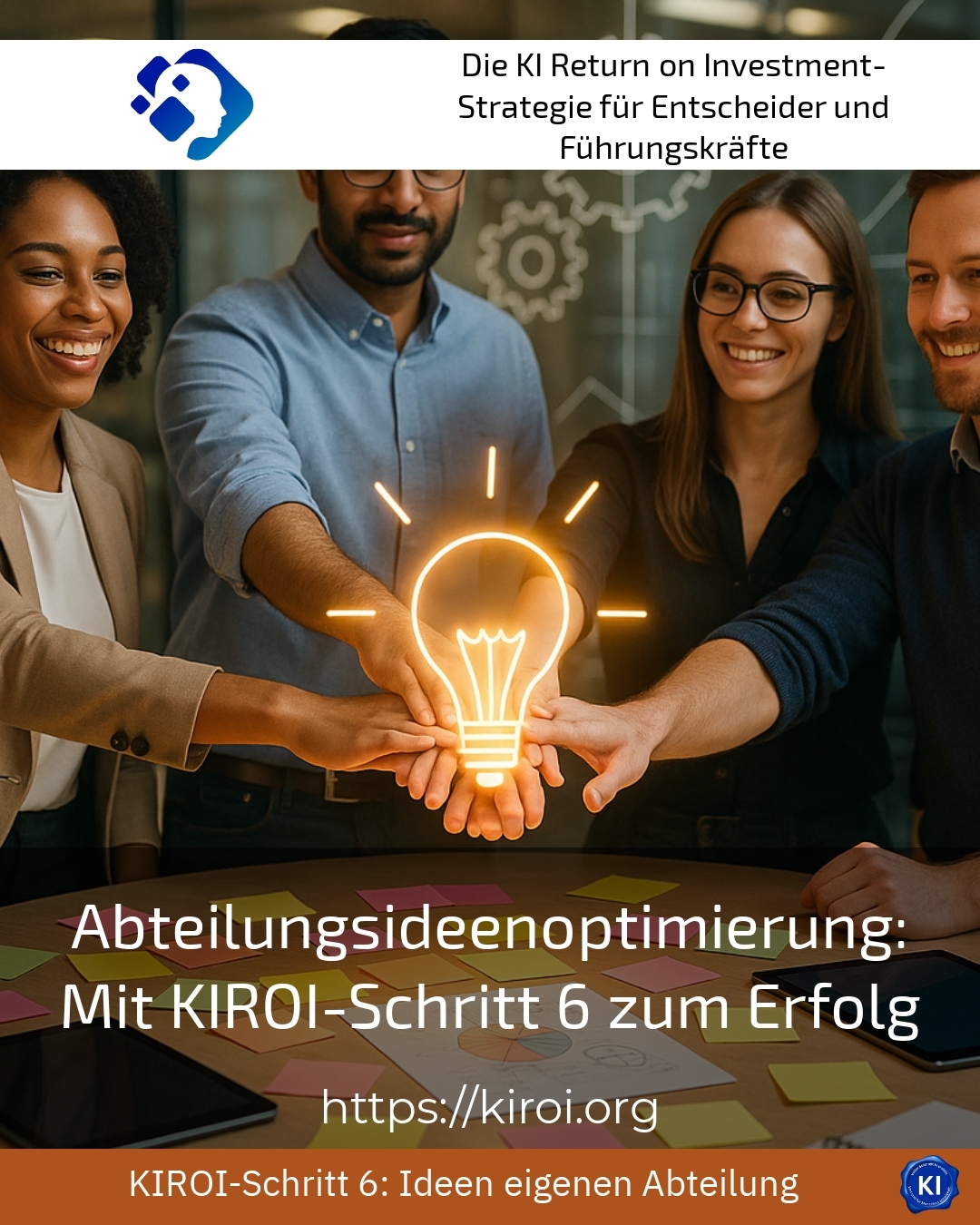
Departmental Idea Optimisation is an essential process that can increase an organisation's efficiency and innovative capacity. The core of this process is to specifically develop ideas within the department and then to implement them in a structured manner. The KIROI Step 6 provides valuable impetus on how teams can foster creative solutions while simultaneously designing realistic implementation strategies. Companies often face the challenge of integrating new approaches without disrupting ongoing operations. With systematic support from KIROI, this exact balance can be found.
Catalyst for creative solutions and teamwork
The path to success in department idea optimisation often begins with the question of how to permanently integrate innovative impulses into the daily workflow. KIROI step 6 supports this by not only activating teams but also making them more receptive to new perspectives. Creativity is not left to individuals but is fostered as a collective result through exchanges between employees. This generates ideas that are both practical and inspiring, and that immediately advance the department.
KIROI BEST PRACTICE at company XYZ (name changed due to NDA contract) Within the product development department, KIROI Step 6 provided a structured framework for developing ideas with interdisciplinary teams. Existing processes were questioned, and digital collaboration tools were partly introduced. The result was a multitude of suggestions for rapid prototypes, which were immediately tested. This open, yet methodically guided approach made it possible to identify and purposefully implement realistic innovations.
Departmental Idea Optimisation through Diverse Structured Methods
The variety of methods plays a crucial role in optimising departmental ideas, as it allows for flexible responses to different requirements. For example, Design Thinking can be used to initiate creative processes, while agile principles guarantee iterative implementation. Lean Management complements these approaches by focusing on process optimisation and efficient resource utilisation. KIROI helps to combine the most suitable methods for each department, without overlooking the individual needs of the teams.
KIROI BEST PRACTICE at company XYZ (name changed due to NDA contract) As part of the departmental optimisation of a sales department, agile methods were linked with traditional approaches. This allowed new sales campaigns to be designed and tested in parallel in smaller teams before they were rolled out on a large scale. The structured support avoids a rigid process and leaves room for spontaneous ideas that utilise the employees' creative potential.
Technological Support for Sustainable Innovations
The integration of modern technologies, particularly in the field of artificial intelligence, opens up entirely new possibilities in the optimisation of departmental ideas. For example, AI can automate repetitive tasks, giving employees more time for creative and strategic activities. Furthermore, AI-powered analyses can evaluate the department's current performance data, thereby identifying specific starting points for improvements and innovations. The combination of methodological diversity and technological application creates a productive innovation culture in the long term.
KIROI BEST PRACTICE at company XYZ (name changed due to NDA contract) A marketing department has analysed customer behaviour using AI tools and developed personalised campaign concepts based on the findings. Close guidance throughout the process enabled colleagues to quickly implement concrete ideas with clear objective orientation. The coaching helped to integrate technological support purposefully into everyday work and strengthen acceptance of the new methods.
From impulse to sustainable change
Optimising sustainable departmental ideas only succeeds if impulses are not seen as short-term measures, but as an ongoing process. This is why support from experienced coaches like KIROI is so valuable: they help to utilise team dynamics, systematically tackle urgent problems, and meaningfully integrate the new possibilities of digitalisation. Clients often report positive changes in collaboration and motivation as a result. This development is sensitively picked up by the accompanying dialogue, shaping the path to effective results.
My analysis
Departmental idea optimisation offers companies an opportunity to specifically unlock their teams' potential and effectively utilise modern technologies. KIROI Step 6 supports this process by creating a structured framework that fosters creativity while simultaneously checking implementation feasibility. The combination of methodological diversity, technological advancement, and continuous support forms the basis for changes to be experienced as opportunities rather than burdens. This allows the department to grow sustainably and adapt to changing requirements.
Further links from the text above:
[1] Step 6 of the KIROI strategy: Practical examples for developing your own departmental ideas
[2] Department optimisation: With KIROI Step 6 to innovative ideas
[4] Fostering Departmental Innovation: Strategies and Examples
For more information and if you have any questions, please contact Contact us on or read further blog posts on the topic Artificial Intelligence Blog here.













 Deutsch
  English (UK)