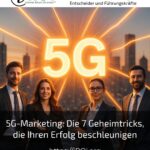
The digital transformation is advancing, dramatically changing the daily lives of companies and customers. Anyone who dares to take the step into digital marketing today cannot avoid the topic of 5G marketing, as the new mobile communications standard offers far more than just faster internet connections. It opens up completely new possibilities for addressing target groups, creating experiences, and precisely controlling results.
What is 5G marketing – and why is it worth looking at the state of the art?
5G marketing stands for the strategic use of cutting-edge network technology to make marketing measures even more precise, faster, and interactive. The foundation for this is the high speed, low latency, and large capacity of the 5G network – and these are also the core arguments for companies that want to forge a closer, more direct, and more effective digital connection with their customers[1]. The classic advertising touchpoint thus becomes an immersive, individual, and emotional user experience.
But how can 5G marketing be implemented successfully? Are there any secret tricks that noticeably accelerate success? And what are some practical examples from the industry? This article presents the answers – clearly, practically, and with many tips from daily agency work.
The 7 Secret Tricks: How to Achieve Real Competitive Advantages with 5G Marketing
1. Optimise content technologically – for convincing speed and quality
With 5G marketing, optimising content for fast networks is the key to success. Ultra-HD videos, augmented reality experiences or interactive landing pages now load without delay, forming the basis for a unique user experience. The tourism industry, for example, proves this by achieving significantly higher conversion rates with 5G-optimised booking sites, as loading times are minimised [1]. At the same time, adaptive streaming technology ensures the best possible quality at all times – whether on a smartphone, tablet or laptop.
Another example: Streaming providers are focusing on 4K content that starts immediately without stuttering. This keeps their users on the platform for longer and increases the advertising impact. Anyone investing in 5G marketing today, therefore, is thinking not least about bandwidth – and about the appropriate end-user device within the target group[4].
2. Real-time analysis - design individual, dynamic campaigns
The true strength of 5G marketing lies in the utilisation of real-time data. Companies can analyse customer behaviour second by second and adjust their outreach immediately. This increases the relevance of every advertising message and ensures better targeting of the audience.
Retailers use this technique to implement multi-channel campaigns: those who are currently in the store receive suitable push notifications or personalised coupons on their smartphones, in addition to POS promotions. The conversion rate increases noticeably because the shopping experience is designed to be seamless and individual[1]. In online retail too, product recommendations are dynamically adjusted as soon as user behaviour changes.
The logistics industry demonstrates how 5G marketing can even optimise supply chains: sensors transmit real-time data, allowing marketing to react flexibly and deliver pinpoint campaigns. This improves customer satisfaction and strengthens brand loyalty[2].
BEST PRACTICE with one customer (name hidden due to NDA contract) A major retail chain launched an interactive live shopping series featuring influencers. The streams were broadcast in 4K quality, directly linked to purchasing options, and achieved significantly higher conversion rates than traditional online campaigns. Brand awareness increased sustainably because the target audience enthusiastically embraced the new format and shared it on social media. Simultaneously, the technology provided precise data for audience analysis. [1]
3. Multi-channel strategy without breaks – experience a consistent customer journey
With 5G marketing, the lines between the online and offline worlds are blurring. Today, customers expect a consistent, seamless customer journey – whether they are in a shop, on a laptop, or on a smartphone[2]. This only works if communication is coordinated across all channels, data is linked, and real-time reactions are possible.
This is particularly evident in the telecommunications sector: Telekom launched a three-phase campaign for the introduction of 5G, communicating the technology to target groups both emotionally and rationally. At the same time, new tariffs and suitable end devices such as the iPhone 12 with 5G functionality were advertised – and positioned with the best network as a unique selling proposition[4]. The campaign was so successful that contract signings increased by 100 percent.
Companies are also benefiting in the automotive sector: Connected vehicles can inform about current promotions, book workshop appointments directly, or display local offers on the screen – all based on a stable 5G connection[2].
4. New formats and creativity – the key to attention
5G marketing thrives on innovation. Companies that try out new formats stand out from the crowd. Interactive videos, AR applications, or virtual showrooms leave a lasting impression and increase user engagement[1].
A telecommunications provider opted for a spectacular public LED installation controlled by 5G technology. The campaign attracted considerable attention, was shared on social media, and significantly increased local brand presence[1].
In the entertainment industry, 5G enables the streaming of VR content and gamification elements. Customers become fully immersed in digital worlds, while brand messages are subtly placed.
5. Personalisation: Real-time engagement for every touchpoint
Fast data transmission makes true personalisation possible. Companies are adapting their messages not only to segments but also to individual behaviour. Latency is decreasing, interaction is becoming smoother – and the target audience experiences companies as empathetic, flexible, and close[3].
Retailers use geolocation to directly address nearby customers. Automated push notifications inform them about current offers, even when the target audience is out shopping. Conversions increase because customers feel they are being addressed individually.
6. Regular Optimisation and Team Focus
5G marketing is a dynamic process that requires regular analysis, adaptation, and close teamwork. The digital world is changing rapidly, so it's important to clearly define goals, measure KPIs, and be open to new things[5].
Teams that work agilely react more flexibly to changes and benefit from a positive error culture. A willingness to engage in dialogue and network are key success factors, as they help to recognise and implement new opportunities early on[5].
BEST PRACTICE with one customer (name hidden due to NDA contract) A company in the logistics sector optimised its supply chains using 5G-enabled sensors. The live data was not only used internally but also fed directly into marketing. This resulted in campaigns that responded to current delivery times and customer wishes. Customer satisfaction increased significantly because the company always made the right offer at the right time.
7. Let yourself be accompanied from the start – reach your goal with iROI coaching
Entering the 5G marketing space is complex and requires expertise in technology, strategy, and operational implementation. Many companies therefore rely on guidance from experienced partners like iROI-Coaching, to maintain an overview and develop tailor-made solutions. Clients often report that this collaboration helps them to recognise potential early on and strengthen their own positioning.
iROI-Coaching supports you with strategic alignment, selecting the right technologies, and successful campaign planning. The guidance always begins with an analysis of your target audience, your resources, and your digital infrastructure.
BEST PRACTICE with one customer (name hidden due to NDA contract) A medium-sized industrial company ventured into 5G marketing in collaboration with iROI-Coaching. The project received comprehensive support, from employee training and the integration of real-time data to the implementation of interactive campaigns. The result: increased visibility, satisfied customers, and a clear competitive advantage.
My analysis
5G marketing isn't a short-term trend but a central driver of innovation for businesses of all sizes. Those who embrace the possibilities of 5G today will benefit from increased speed, greater precision, and new opportunities for customisation. Practice shows that successful 5G marketing strategies always require technological and content optimisation, data-based agile control, and the integration of creative formats.
At the same time, it's worth investing in support from experts like iROI-Coaching – because digital transformation is also an opportunity for new business models and stronger customer loyalty. Exchanging ideas with like-minded people, trying out new technologies, and a willingness to learn are crucial. Those who invest in 5G marketing today are shaping the future – and sustainably increasing their company's success.
Further links from the text above:
5G Marketing: These strategies will move your business forward [1]
5G Strategy Marketing: The Secret Levers for Your Success [2]
The impact of 5G on online marketing strategies [3]
9 success factors for your digital marketing strategies [5]
For more information and if you have any questions, please contact Contact us or read more blog posts on the topic internet Return on Investment - Marketing here.






 Deutsch
  English (UK)