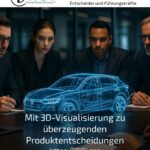
3D visualisation has established itself as a crucial tool for making product decisions more secure and convincing. It helps companies present their products realistically, even during the development phase. This generates valuable momentum for design improvements, marketing strategies, and sales activities.
The role of 3D visualisation in product development
In product development, 3D visualisation allows for an exact representation of materials, shapes, and colours. This saves companies the cost of physical prototypes and allows for rapid testing of variations. Design changes can therefore be identified and implemented early on. For example, a manufacturer of technical devices uses 3D models to simulate functionalities while simultaneously creating a compelling image for internal stakeholders.
Another example comes from the furniture industry: here, different types of fabric, surfaces and colour variations are displayed digitally thanks to 3D visualisation. Customers and designers benefit from the ease of comparison without the need to produce a physical sample. This saves time and costs, but also increases the quality of the final product.
In the automotive sector, manufacturers are using 3D visualisation to realistically represent interior and exterior designs. This allows features to be reviewed under different lighting conditions and decisions to be made more quickly. Virtual reality enables employees and customers to interactively explore the vehicle before production.
How 3D visualisation supports compelling product decisions
Visualisation promotes clear communication between designers, marketing, and product management. Complex ideas become understandable, and misunderstandings decrease. Furthermore, photorealistic renderings help increase the emotional connection of potential customers. This can noticeably accelerate purchasing decisions.
BEST PRACTICE with a client (name redacted due to NDA): A technology company was able to incorporate numerous feedback loops prior to the market launch of its new product through detailed 3D visualisation – which significantly increased the satisfaction and trust of all stakeholders. In particular, risky design assumptions could be reviewed early on.
Similarly, a startup from the consumer goods sector was able to significantly improve the conversion rate in online shops thanks to interactive 3D representations. Customers had the opportunity to view products virtually from all perspectives and customise them individually. This led to increased engagement and faster purchasing decisions.
Another practical case demonstrates how a manufacturer of industrial plants made internal processes transparent with the help of 3D sectional models. Complex components and their interplay were visualised, enabling technical teams to make informed decisions about potential optimisations.
Flexibility and increased efficiency through 3D visualisation
Using digital models allows for the easy depiction of product variability - without new photos or physical samples. This enables quicker responses to customer requests. An example from the fashion industry illustrates this: different fabric colours and cuts are visualised in 3D representation in the shortest possible time. This supports lean development cycles and shortens time-to-market.
3D visualisations are also an important aid in medical technology. They clearly explain complex devices or processes, thereby enabling informed decisions by both medical professionals and patients. This often improves the acceptance of new technologies and contributes to increased quality.
In the realm of consumer electronics, 3D models not only allow for the presentation of technical details but also for interactive use. This means customers can experience features and usability even before purchasing. This intensive product perception is a strong competitive advantage.
Practical tips for integrating 3D visualisation into business processes
To fully leverage the benefits of 3D visualisation, the following approaches are recommended:
Firstly, 3D visualisation should be integrated into the development process early on, allowing design decisions to be supported by concrete images and adjusted if necessary.
Secondly, close cooperation between design, marketing and sales is helpful to include all perspectives in the visualisations and to optimise the market launch.
Thirdly, investing in professional software and service providers like iROI-Coaching, who act as experienced companions to support 3D visualisation projects, is worthwhile, thereby creating real added value.
Fourthly, the creation of interactive 3D models can help to increase customer loyalty by making products tangible – whether in the webshop, at trade fairs or in virtual showrooms.
My analysis
A powerful 3D visualisation opens up comprehensive opportunities for companies to compellingly shape product decisions. It enables realistic representations, improves internal and external communication, and shortens development cycles. Due to its flexibility and emotional impact, it helps to reach target groups more effectively and accelerate purchasing processes. The cross-industry examples show how diverse the fields of application are and that the integration of professional support such as iROI coaching is sensible for effective project implementation and sustainable results.
Further links from the text above:
The most important advantages of 3D visualisation for businesses
3D Product Visualisation – Examples, Costs & Benefits
3D product visualisation in marketing: these advantages will convince customers
Why 3D product visualisation is so effective
3D product visualisation instead of product photography
Advantages in marketing with 3D visualisation
6 benefits of 3D animations in product visualisations
Product Visualisation – 3D Design – Render Vision
The meaning of 3D product visualisation for modern marketing
Get 3D Product Visualisations Created | Expert Tips
For more information and if you have any questions, please contact Contact us or read more blog posts on the topic internet Return on Investment - Marketing here.






 Deutsch
  English (UK)