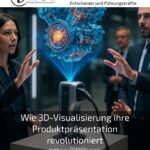
Introduction: How 3D Visualisation is a Game-Changer
More and more companies are opting for 3D visualisation, as it allows products to be experienced even before they are actually manufactured. This technology makes product presentations flexible, illustrative, and interactive – and this is regardless of whether the product physically exists or is still under development [1]. Customers who come to me often report challenges in communicating complex product features, a lack of variant diversity, or high costs for prototype development. This is where 3D visualisation comes in and fundamentally changes product marketing.
Flexibility and variety of options through 3D visualisation
Once created digitally, a 3D model can be adapted as required – in colour, material, shape or perspective[1]. This not only saves time but also opens up new possibilities for product representation. For example, in the furniture sector, customers can try out different fabrics, wood types or design variations in real-time without each model having to be physically built[3]. Manufacturers of technical devices also benefit because they can visualise equipment variants or material options with a single click. Instead of expensive photoshoots, digital renderings are now sufficient, which can be flexibly adapted to new requirements[1].
Imagine a company from the packaging industry wants to show its customers different design options. With 3D visualisation, packaging can be displayed in different colours, shapes and styles, and customers can view them online from any angle – even a 360-degree view[4]. This builds trust and makes the purchasing decision easier.
Or take the automotive industry, for example: here, 3D visualisation allows customers to virtually explore their desired car with individual features – from the paint colour to the interior design [3]. This makes the variety of options tangible without every model needing to be built.
BEST PRACTICE with one customer (name hidden due to NDA contract) An international mechanical engineering company used 3D visualisation to involve customers in the development process early on. Customers could digitally review various designs and provide direct feedback. This resulted in shorter development cycles, reduced sources of error, and significantly increased customer satisfaction. In parallel, the costs for physical prototypes decreased, as many changes and optimisations were implemented directly in the virtual model.
Resource savings and faster market launch
3D visualisation not only accelerates alignment with clients, but also internal development. Forgoing physical prototypes saves materials, time, and costs – and allows for a faster market launch of your product[3]. Particularly in the fashion industry, new collections can initially be displayed digitally to optimise cuts and fabrics before production begins. This reduces manufacturing defects and makes production more sustainable.
Companies also benefit from the technology in the consumer electronics sector. Market leaders are already offering augmented reality applications that allow customers to virtually place devices in their own homes [4]. This creates a realistic impression that surpasses traditional product photos and increases the likelihood of purchase.
Another example comes from medical technology: Complex devices can be displayed with 3D visualisation so that their functions and innovations become immediately understandable – without lengthy explanations or expensive training.
Interactive experiences and higher customer loyalty
The strength of 3D visualisation lies not only in the presentation, but also in the interaction. Customers can rotate and zoom in on products and view them from every angle – both online and at trade fairs and events[4]. Studies show that interaction with 3D configurators increases customer loyalty and boosts conversion rates[1]. Companies that use 3D visualisation report up to 27% more conversions and a 65% increase in customer interaction[1].
The automotive industry is focusing on virtual test drives, where customers can experience different models without getting into a car. In retail, the technology is used to allow customers to virtually place furniture in their own living rooms – and in real time. This creates an immersive experience that significantly surpasses traditional advertising[7].
Brands also benefit from packaging design: Interactive 3D presentations allow customers to virtually open, rotate, and even simulate the contents of packaging. This builds trust and reduces purchasing uncertainties [4].
The role of iROI coaching in your 3D project
If you're considering implementing 3D visualisation within your company, iROI Coaching is here to support you. Many of my clients approach me with questions about the optimal implementation, selecting suitable tools, or integrating them into existing marketing processes. Together, we'll develop a clear strategy to get the most value from your product presentation. I focus on practical integration, ensuring you don't just get attractive visuals, but also generate real competitive advantages.
My analysis
3D visualisation is more than a modern gimmick – it's revolutionising product presentation for good. This technology allows companies to showcase products flexibly, realistically and interactively, thus supporting purchasing decisions, accelerating development processes and increasing customer loyalty. Those who embrace 3D visualisation today benefit from higher communication quality, greater variety of options and more efficient resource utilisation. Especially in times of digital transformation, investing in this innovative presentation format is a clear step forward.
Further links from the text above:
3D Product Visualisation – Examples, Costs & Benefits [1]
How 3D visualisation revolutionises your product presentation [3]
3D Visualisations – 8 Strong Industry Examples [4]
30 Great 3D Product Showcase & Visualisation Videos [2]
For more information and if you have any questions, please contact Contact us or read more blog posts on the topic Internet Return on Investment – Marketing here.






 Deutsch
  English (UK)