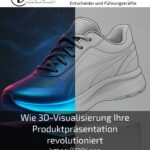
Modern 3D visualisation is revolutionising how companies present their products. It allows products to be displayed realistically and attractively even before their physical manufacture. Through detailed three-dimensional representations, customers experience a new dimension of engagement – this sustainably promotes understanding and purchase intent.
The advantages of 3D visualisation for product presentations
3D visualisation offers numerous practical advantages that complement and often significantly surpass traditional product presentations. One of the key benefits is flexibility: digital models can be easily adapted in colour, shape, and surface without requiring elaborate photoshoots. This saves both time and money.
For example, furniture manufacturers can use 3D models to display various fabric and wood options, making it easier for customers to choose. Electrical appliances can be presented interactively in terms of their design and how they work. In the automotive industry, vehicle variants or interior fittings are shown realistically, giving potential buyers a comprehensive picture.
In addition, photorealistic 3D visualisations significantly increase the willingness to buy, as products can be viewed from all angles. This builds trust and minimises queries or incorrect purchases.
Practical applications and real-world examples
Another advantage of 3D visualisation lies in its interactive use, which enhances the customer experience. In online retail, users can rotate products 360 degrees, zoom in on details, and try out different configurations. This increases dwell time on the website and boosts the conversion rate.
3D visualisation also opens up new possibilities at trade fairs and in showrooms: manufacturers of technical devices can make complex functions understandable through animation. Packaging companies present different designs and shapes in virtual 3D models, which is particularly helpful for large orders, allowing them to show customers tailor-made solutions.
In the outdoor area, landscape or garden furniture can be visualised in realistic 3D environments. This gives customers an immediate feel for the product in its context of use.
BEST PRACTICE with one customer (name hidden due to NDA contract) A manufacturer of high-quality kitchen worktops uses 3D visualisation to show customers the diverse design possibilities. The models can be configured in real-time with different surfaces and colours, and simulated under various lighting conditions. This has significantly reduced sales time per customer and increased customer satisfaction.
Tips for the successful use of 3D visualization
For visualisation to effectively support product presentation, quality is crucial. High-resolution models with photorealistic materials and convincing lighting create the desired WOW effect. Interactive functions such as zoom, rotation and variant changes invite users to linger.
Accompanying consultation is also valuable so that companies know how to integrate 3D visualisations efficiently into marketing and sales. This allows for tailored solutions to be found that are individually adapted to the industry and target group.
In practice, companies often report that 3D visualisation helps to make complex technical products understandable. The technology acts as a powerful communication tool, particularly in areas with functions that require explanation or numerous variants.
BEST PRACTICE with one customer (name hidden due to NDA contract) An industrial machinery supplier uses 3D visualisation to illustrate the individual process steps of its systems in detail. Customers benefit from being able to explore the systems virtually and view their desired configurations in advance. The accompanying coaching provided by iROI-Coaching has helped the team to effectively integrate the visualisation into sales meetings.
Interactive 3D Models as Sales Boosters
The integration of interactive elements such as configurators or virtual tours increases customer loyalty. This allows potential buyers to implement their own ideas directly and experience the product virtually. This transforms a passive presentation into an active experience.
A typical example is the automotive industry, which offers 3D configurators that allow vehicles to be individually assembled. The fashion industry is also increasingly experimenting with digital try-ons based on 3D models.
BEST PRACTICE with one customer (name hidden due to NDA contract) A designer lighting manufacturer uses 3D visualisation to simulate lighting moods in various room environments. Customers can adjust lamp colours, brightness, and position via a digital tool, which simplifies the purchasing decision and increases sales.
My analysis
3D visualisation opens up diverse opportunities to improve product presentation and resonate more strongly with customers on an emotional level. Companies not only save time and costs, but can also realistically display and make a wide range of variations directly tangible. Especially in the digital age, visual communication is becoming increasingly important, which is effectively supported by 3D technology.
iROI-Coaching specifically supports companies with projects involving 3D visualisation to achieve optimal results in sales and marketing. With professional guidance, the potential of this technology can be fully exploited.
Further links from the text above:
[1] 3D Product Visualisation – Examples, Costs & Benefits
[2] 30 Great 3D Product Showcase & Visualisation Videos
[3] Why 3D visualisation is a must for product presentations
[4] 3D Visualisations - 8 Strong Industry Examples
[5] Interactive 3D Visualisation: Benefits and Technologies
[7] 3D Product Visualisation – 4 Benefits for Product Presentation
[9] The most important advantages of 3D visualisation for businesses
For more information and if you have any questions, please contact Contact us or read more blog posts on the topic internet Return on Investment - Marketing here.






 Deutsch
  English (UK)