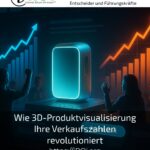
In digital marketing, 3D product visualisation has become a key success factor. Companies are using this innovative technology to present products more vividly, understandably, and attractively. 3D product visualisation brings complex products, technical details, and yet-to-be-realised prototypes to the screen – which impresses customers and demonstrably increases sales.
Customers today want an immersive, interactive experience when shopping online. They want to see products from all angles, zoom in on details, and try out different variations – and that's exactly what 3D product visualisation enables [4]. The technology is no longer an exclusive tool for the automotive industry or the high-tech sector, but is used by many companies, from furniture retailers to industrial firms.
Advantages of 3D product visualisation for success and growth
3D product visualisation offers a multitude of advantages that classic product photography cannot achieve. It significantly increases the conversion rate, as studies show: up to 40 % higher sales success is possible when companies use 3D visualisations[3].
Flexibility and rapid adaptation
Once created, a digital 3D model can be altered almost indefinitely. Colour, material, perspective – everything can be adjusted without new production costs, and the changes are visible in real time. This provides a clear competitive advantage because product variations, individual customer requests or seasonal offers can be visualised quickly and affordably.
BEST PRACTICE with one customer (name hidden due to NDA contract) A furniture manufacturer is embracing 3D product visualisation because it allows sofas in different colours, sizes, and fabrics to be configured directly in the online shop. The company saves on costly photoshoots, delivers faster, and delights customers with an immersive selection. The switch to 3D visualisations has noticeably reduced the return rate and increased product loyalty, as customers know what they're getting. The system also allows furniture to be placed directly in their own living rooms using Augmented Reality – a level of transparency that traditional images could never achieve.
Real insights, trust, and interaction
3D product visualisation can also be used to showcase products that don't exist yet – for example, prototypes or individual configurations that are specifically tailored to customer wishes. Interactive 3D views, exploded drawings or virtual test scenarios inform potential buyers in an understandable and transparent way[7]. This builds more trust because customers can truly „get to grips“ with the product before ordering.
BEST PRACTICE with one customer (name hidden due to NDA contract) A household appliance manufacturer showcases its products with detailed 3D renderings and animated features. Customers can see the internal structure of an oven or which functions are hidden behind a shiny surface. This visualisation reduces uncertainty, clearly explains the technology, and has reduced the return rate by over 30 %, as misunderstandings are cleared up in advance. Additionally, the 3D product visualisation can be flexibly used on marketplaces, social media, and in advertising films.
Cost-effectiveness and resource conservation
Compared to traditional photoshoots, companies save time, logistical effort, and costs once the 3D model has been created [5]. New versions, additional colours, or materials can be realised digitally – without new production runs or expensive photo appointments. Especially for products that do not yet exist, 3D product visualisation is often the only way to present them in an appealing and market-ready manner.
BEST PRACTICE with one customer (name hidden due to NDA contract) A manufacturer of luminaires and lighting systems uses 3D renderings to present its collections to international customers without needing to have every product physically on hand. The visualisations are photorealistic, show different colours and materials, and can be individually integrated on partner retailers' websites. Development cycles have been shortened and global distribution accelerated, as sample productions are only necessary after a purchase decision has been made.
Why 3D Product Visualisation Is Essential Today
Digital transformation is radically changing customer and business expectations. Visual content dominates online marketing and determines how sustainably a brand is perceived. 3D product visualisation makes it possible to explain complex products and their functions in an understandable way – this is particularly well-received in technical or niche industries, such as mechanical engineering, electronics or special tools.
Furthermore, high-quality 3D visualisations increase engagement rates on social media because they generate attention and encourage sharing[2]. The effect: greater reach, more interaction, and ultimately more sales. Companies that opt for 3D product visualisation are often perceived as innovative and professional. This strengthens the brand image and ensures sustainable differentiation from the competition.
3D Product Visualisation in Daily Practice
Many companies use 3D product visualisation as a central tool in e-commerce, social media marketing, at trade fairs or in customer service chats. The visualisation can be used in online shops, on marketplaces like Amazon, in presentations, and even on their own social media channels [7]. The biggest advantage: once created, the assets can be used flexibly and incur no ongoing costs.
Another important aspect is the integration of Augmented Reality (AR). With AR, customers can project products, such as a piece of furniture, directly into their own living room or a machine into a company building. This immersive experience creates an immediate connection to the product and significantly simplifies the decision-making process[4].
Getting started with 3D product visualisation: implementation tips
Businesses starting to integrate 3D product visualisation into their marketing should pay attention to the following points:
- Clear Briefings: Formulate objectives and requirements clearly, so that the visualisations are a perfect fit.
- Quality of 3D models: Opt for photorealistic and interactive renderings to build trust.
- Utilise flexibility: Offer various versions and configurations to appeal to different customer groups.
- Create immersive experiences – for instance, with 360° views, exploded drawings or AR integration.
iROI-Coaching specifically supports companies with the introduction and optimisation of 3D product visualisation. Together, we analyse application possibilities, assist with the selection of the appropriate technology, and help to exploit the full revenue potential.
My analysis
3D product visualisation is now an indispensable part of modern product presentation. It creates experiences that classic product images cannot offer, and is a powerful tool for companies to increase sales, retain customers, and sustainably strengthen their brand image. The technology is flexible, cost-effective, and directly contributes to increasing conversion rates and customer loyalty – regardless of industry or company size[1][2][3]. Those who get involved now will benefit from the advantages and set new standards in digital marketing.
Further links from the text above:
3D Product Visualisation – Examples, Costs & Benefits [1]
Effective 3D product visualisation for your marketing [2]
How modern 3D product visualisation can boost your sales figures [3]
What is 3D product visualisation software? [4]
3D Product Visualisation ▷ Boost Your Sales Figures [5]
We create photorealistic 3D product visualisations [7]
For more information and if you have any questions, please contact Contact us or read more blog posts on the topic internet Return on Investment - Marketing here.






 Deutsch
  English (UK)