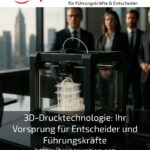
3D printing technology opens up crucial new opportunities for leaders and decision-makers to design more efficient processes and tap into innovation potential. It offers advantages that extend far beyond conventional manufacturing methods, enabling not only significant cost savings but also great flexibility in production.
3D Printing Technology as a Driver of Innovation and Efficiency
Companies working with 3D printing technology immediately benefit from improved production flexibility. They can manufacture individual components or small batches quickly and on demand, without the need for elaborate toolmaking. This saves time and money because development cycles are significantly shortened. For example, car manufacturers are optimising their spare parts inventory through on-demand production, considerably reducing storage costs.
In medical technology, the use of 3D printing technology leads to perfectly fitting implants and instruments that are tailored entirely to the individual needs of patients. In the aerospace industry, companies are also using the process to manufacture very lightweight components with complex geometries that would be difficult to produce using conventional methods.
Additive manufacturing helps to relieve supply chains. Digital models can be shared worldwide and produced on-site, thereby reducing long transport routes and the risk of bottlenecks. This is a tremendous advantage, especially in times of global uncertainty.
Diverse Practical Applications
A renowned car manufacturer is using the technology to test and validate complex prototypes faster than ever before. This has resulted in development times being reduced by up to 70 %.
In plant engineering, 3D printing enables precise and flexible production of spare parts directly on-site. This allows companies to avoid expensive production downtimes and better control maintenance costs.
Even in the consumer goods industry, companies are opting for individualised product lines that can be realised through additive manufacturing processes. This results in tailor-made design pieces that offer customers clear added value.
Opportunities for Decision-Makers: Competitive Advantages through 3D Printing Technology
Managers often encounter challenges such as long lead times or high inventory costs. 3D printing technology supports this by enabling quick and cost-effective responses to market changes. This allows companies to make their supply chains more robust and reduce dependencies on individual suppliers.
In addition, the technology offers enormous potential for customisation. Customers increasingly expect tailor-made solutions, and while mass production can barely meet all needs any longer, 3D printing also makes it economically viable to produce small batches. This is how you gain customer satisfaction and loyalty.
In research and development, additive manufacturing supports rapid prototyping. Product ideas can be quickly visualised and tested. This reduces the cost of failures and shortens innovation cycles.
BEST PRACTICE at the customer (name hidden due to NDA contract)
A medium-sized mechanical engineering company used 3D printing technology to ensure spare parts supply in remote markets. This allowed the company to reduce the delivery cycle from several weeks to just a few days and significantly increase customer satisfaction.
Another focus is on sustainable production. 3D printing leads to less material waste as the material is applied precisely where needed. Energy-intensive processes such as milling are therefore partially eliminated.
Practical tips for integrating 3D printing technology
Before companies invest in their own 3D printers, it is recommended to work with external service providers. This allows them to gain experience and better assess the potential for their own use cases.
Close collaboration between design, development, and manufacturing is important to fully exploit the special capabilities of 3D printing. For example, unique lightweight structures and complex geometries allow for competitive differentiation that conventional methods cannot offer.
Crucially, employees must also be trained and change processes must be managed openly, so that the technology is integrated seamlessly into existing workflows.
BEST PRACTICE at the customer (name hidden due to NDA contract)
A leading company in the consumer goods sector conducted a pilot project with 3D-printed packaging components. The iterative design development was significantly faster and more cost-effective than usual. At the same time, the team gained valuable experience that can be used in scaling the process.
My analysis
3D printing technology offers executives a real competitive advantage by bringing flexibility, speed, and cost-efficiency to the production process. It helps in meeting complex requirements while simultaneously reducing supply chain risks. Companies that proactively adopt this technology enhance their innovative capacity and sustainably strengthen their position in dynamic markets.
Further links from the text above:
[1] 6 underestimated benefits of 3D printing for your supply chain
[2] What are the advantages of 3D printing?
[3] Advantages of 3D printing for small businesses
[4] The pros and cons of 3D printing
[5] Advantages of 3D printing
For more information and if you have any questions, please contact Contact us or read more blog posts on the topic TRANSRUPTION here.






 Deutsch
  English (UK)