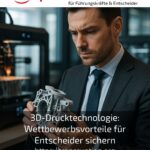
3D printing technology is changing the way businesses develop, produce, and distribute products. Many decision-makers are wondering how they can purposefully use this technology to secure competitive advantages. 3D printing technology offers not only new possibilities for product development but also for process optimisation and adaptation to individual customer needs. In this article, you will learn how companies from various industries benefit from 3D printing technology and what concrete advantages it can offer.
Flexibility and Customisation as the Brand Core
Using 3D printing technology, products and components can be manufactured precisely to customer specifications. This flexibility overcomes traditional manufacturing limitations and allows for direct adaptation to specific requirements. For instance, medical technology companies produce custom-fit prosthetics or implants that are precisely tailored to patient needs. In the consumer goods sector, personalised jewellery or design objects are increasingly being offered. In the transport and logistics sector, spare parts are also printed directly on-site, which reduces storage costs and shortens delivery times. Even in crafts, new revenue streams are emerging through limited editions or seasonal products.
3D printing technology allows companies to react quickly to market changes and offer individual solutions. This strengthens customer loyalty and opens up new business models. Many clients report that they can improve their market position and differentiate themselves from the competition through 3D printing technology.
Rapid Prototyping and shorter time-to-market
Prototypes and sample parts in record time
Prototypes and sample parts can be manufactured in record time with 3D printing technology. This significantly speeds up product development and allows for a faster response to market changes. Start-ups and SMEs in particular benefit from this, as it enables them to develop innovative products even with limited resources. Additive manufacturing not only saves time but also costs, as complex tools such as injection moulds are completely eliminated for small production runs. This allows companies to respond quickly to customer feedback, implement design changes, and test new ideas without making high investments.
A medium-sized mechanical engineering company used 3D printing technology to create functional prototypes within a few days. This allowed errors to be identified and rectified early on, while competitors were still waiting for traditional manufacturing steps. The result was a market launch time shortened by several weeks.
Examples from practice
An automobile manufacturer is using 3D printing technology to produce replacement parts for older vehicle models on demand. This reduces storage costs and ensures the availability of spare parts. A medical device manufacturer is printing custom components for clinical trials to accelerate the development of new products. A jewellery designer is offering personalised jewellery that is made exactly to the customer's specifications.
Cost savings and sustainability
Toolmaking and small-batch production
Traditional manufacturing methods like injection moulding often require expensive tooling and moulds, particularly for small-batch production. With 3D printing, no tooling is necessary, which reduces upfront costs and makes the process more cost-effective for producing small batches or specialised parts. This flexibility allows industries such as medical and aerospace to experiment with prototypes and custom-made parts without incurring significant expense.
Another advantage of 3D printing technology is its ability to produce parts on demand, which reduces the need for extensive inventories. This is particularly helpful for older parts or those with low demand, as it lowers stocking costs and allows for more flexible supply chains. Engineers and supply chain experts can use platforms like MakerVerse to manage production based on real-time demand, rather than holding large stocks of spare parts.
Sustainability and waste prevention
3D printing is an additive manufacturing process, meaning only the material needed to create the part is used, thereby significantly reducing waste. In metal 3D printing processes like Laser Powder Bed Fusion, any unused metal powder can be recycled. Unlike traditional subtractive methods such as CNC machining, additive manufacturing is more resource-efficient than cutting away and discarding material. This is a major benefit for companies looking to enhance their sustainability efforts by minimising waste and reducing energy consumption during production.
3D printing technology: securing competitive advantages for decision-makers
3D printing technology offers diverse competitive advantages, from manufacturing flexibility to sustainable resource utilisation. Companies can achieve customised solutions that were previously limited by conventional manufacturing methods. Particularly in the field of prosthetics, but also in the consumer goods industry, 3D printing technology is opening up new business models and sustainably strengthening customer loyalty.
With 3D printing technology, individual customisation is not only possible, it's becoming the standard. From personalised jewellery to precisely fitting machine components: the technology makes it possible to respond directly to special requests. This flexibility is a clear competitive advantage in dynamic markets.
Another example can be found in the transport and logistics sector. Here, spare parts are produced directly at the point of use in order to save on storage costs and shorten delivery times. In craftsmanship, too, 3D printing processes are proving to be a stepping stone for new services, such as the production of limited collector’s items or seasonal products.
BEST PRACTICE at the customer (name hidden due to NDA contract) A medium-sized mechanical engineering company used 3D printing technology to realise functional prototypes within a few days. This allowed errors to be identified and rectified early on, while competitors were still waiting for classic manufacturing steps. As a result, the time to market was reduced by several weeks. 3D printing technology enabled the company to react more quickly to customer feedback and improve product quality.
My analysis
3D printing technology offers companies from various sectors the opportunity to optimise their processes, provide individual solutions, and produce sustainably. Decision-makers who strategically utilise 3D printing technology can accelerate processes, reduce costs, and respond individually to customer needs. 3D printing technology represents a real competitive advantage that helps companies establish themselves in the market long-term. Transruption Coaching accompanies projects involving 3D printing technology and supports companies in strategically leveraging the advantages of this technology.
Further links from the text above:
The main advantages of 3D printing for small businesses
3D printing technology: How decision-makers can now compete…
6 underestimated benefits of 3D printing for your supply chain
5 Advantages (and Disadvantages) of 3D Printing
For more information and if you have any questions, please contact Contact us or read more blog posts on the topic TRANSRUPTION here.






 Deutsch
  English (UK)