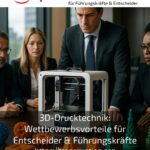
The 3D printing technique offers decision-makers and executives diverse competitive advantages – particularly in the flexible design of production processes and the rapid implementation of innovative ideas. The use of this technology can both reduce costs and significantly shorten development cycles, which decisively supports companies in dynamic markets.
3D printing technique: Flexibility and innovation for modern businesses
Companies from various sectors frequently report that they are reaching the limits of traditional manufacturing methods when it comes to quickly adapting to customer requirements. This is where 3D printing technology creates valuable flexibility. For example, a mechanical engineering company can produce and test complex prototypes within a few days, while competitors are still going through classic processes[2].
In the consumer goods sector, 3D printing is also gaining increasing importance. Manufacturers can produce small batches or unique items more quickly and cost-effectively. This opens up opportunities for limited editions in craftsmanship or seasonal special products, which allow customers to make individual choices[2][3].
The automotive industry also uses the technology to produce components with a particularly lightweight design. The result: lower weight and at the same time higher stability for complex component structures – which also reduces material and assembly costs[1][9].
Practical examples and applications in 3D printing technology
An electrical engineering company illustrates how highly stable prototypes and components can be manufactured using 3D printing. The shorter development times crucially support the product team in getting products to market more quickly.
In the medical field, technology is successfully used for custom-made shoe insoles. Different Shore hardnesses are even combined here, which can increase functionality and comfort for patients[4].
In aerospace, 3D printing makes it possible to create intricate structures that would be difficult to achieve with conventional methods. One major manufacturer, for instance, used this approach to develop significantly lighter components, resulting in substantial savings in material consumption and assembly times[4].
BEST PRACTICE at the customer (name hidden due to NDA contract) A medium-sized electrical engineering company used 3D printing for the manufacture of complex components. By flexibly adapting prototypes, they successfully minimised development times and accelerated market launch. This led to a sustainably improved competitive advantage.
Strategic impulses for managers through 3D printing technology
Managers can make their business processes more agile through 3D printing. The ability to print spare parts on demand and on-site reduces storage costs and shortens delivery times. This creates leaner logistics and higher customer satisfaction[4].
In addition, opportunities arise to produce individual products in small batch sizes, which represents a competitive advantage, particularly in times of growing customer demands for individualisation.
A further advantage is the saving of material and energy: Since 3D printing works additively, only the material that is actually needed is used. This means less waste and lower costs compared to subtractive processes such as milling or turning[1][5].
BEST PRACTICE at the customer (name hidden due to NDA contract) In a vehicle manufacturing company, tools and spare parts could be produced in-house thanks to 3D printing. The resulting shorter lead times and reduced costs led to a noticeable increase in production efficiency.
Optimising development cycles and time-to-market
Decision-makers report that 3D printing technology significantly contributes to accelerating innovation processes. Prototypes are created faster, allowing products to reach the market sooner. This is a strong advantage, particularly in highly competitive industries[1][2].
The ability to produce complex and previously scarcely feasible geometries also enables new design approaches. This allows components with improved functions or fewer parts to be realised, which in turn reduces production steps and increases quality[5][7].
My analysis
3D printing complements traditional manufacturing methods and helps executives position their companies to be more flexible and sustainable. Faster development times, lower costs, and new design options create a tangible competitive advantage. This makes the technology an important component of future-oriented corporate strategies.
Further links from the text above:
Shape the future: 3D printing in companies [1]
3D Printing: Crucial Advantages for Leaders [2]
Advantages of 3D printing for small businesses [3]
3D Printing: The Innovation Opportunity for Decision-Makers [4]
The pros and cons of 3D printing [5]
3D Printing in Business: Benefits, Integration and Innovation [7]
25 unexpected applications for 3D printing [9]
For more information and if you have any questions, please contact Contact us or read more blog posts on the topic TRANSRUPTION here.






 Deutsch
  English (UK)