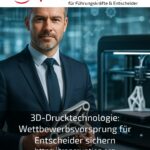
**3D printing technology** is increasingly revolutionising industrial manufacturing and is long past being just a trend. It enables companies to significantly increase their competitiveness by optimising processes, making supply chains more flexible and realising innovative product designs. Key executives today recognise **3D printing technology** as the key to securing an advantage in the dynamic market environment and consolidating their position sustainably.
Flexibility and cost control through additive manufacturing
The ability to manufacture components on demand and directly on-site elevates traditional production to a new level. Companies not only reduce storage and transport costs but also circumvent risks arising from global export restrictions and supply bottlenecks. For example, manufacturers from the automotive sector report that thanks to **3D printing technology**, they can quickly reproduce spare parts and reduce expensive inventory. Mechanical engineers are also leveraging the advantage of being able to manufacture small batches quickly and cost-effectively, without having to produce expensive tools or meet minimum order quantities. A significant advantage is the reduction of lead times in prototyping, thereby accelerating development cycles and enabling rapid adjustments.
For example, this enables a medium-sized company in the medical technology sector, which manufactures complex and individually tailored implants, to develop new solutions more quickly and to react to market demands. Manufacturers of consumer goods also combine designs and functionalities in new ways to ensure their products remain unique and better meet customer needs.
BEST PRACTICE at the customer (name hidden due to NDA contract) A leading automotive supplier has reconfigured its spare parts supply for rarely requested components using 3D printing technology. This allows them to forgo warehousing and save on expensive storage space, while ensuring parts are available at all times.
Innovative product design as a competitive advantage
**3D printing technology** opens up entirely new design possibilities that are barely achievable with traditional methods. Complex geometries, lightweight constructions, and individually customisable products can now be manufactured easily thanks to modern software and high-performance printing processes. For example, components are being created in aircraft construction that are not only lighter but also more stable at the same time – thereby reducing fuel consumption. In jewellery and fashion design, the trend towards personalised, one-off pieces that individually reflect customer needs is gaining traction.
Electrical engineering companies benefit from combining complete components into ready-to-use functional units and achieving reduced assembly times. This not only increases productivity but also enhances innovation capacity.
BEST PRACTICE at the customer (name hidden due to NDA contract) A manufacturer of innovative consumer electronics is utilising 3D printing technology to produce casings with integrated cooling systems. These designs would have been difficult to manufacture using conventional methods but enable significant performance gains and market differentiation.
3D printing technology for agile development and customisation
By eliminating complex tools and moulds, additive manufacturing offers unprecedented flexibility in small-batch production. This allows companies to easily produce prototypes, test new products, and experiment with variations without risking large investments. This is particularly attractive for innovative start-ups and small and medium-sized enterprises.
In the dental sector, practice networks are using 3D printing technology to rapidly produce individual dental prosthetics with the highest requirements for precision fit and aesthetics. Likewise, manufacturers of durable consumer goods are benefiting from the ability to print spare parts on demand, thereby significantly increasing customer satisfaction.
BEST PRACTICE at the customer (name hidden due to NDA contract) An agency for bespoke orthopaedic technology has halved the production times for its custom shoe insoles by introducing 3D printing processes, significantly increasing patient retention.
Key tips for decision-makers during implementation
For the introduction of **3D printing technology** to be a success for companies, a step-by-step strategy is recommended. Firstly, different 3D printing processes and material properties should be tested to identify the optimal area of application. External service providers can help with initial projects to gain practical experience without requiring large investments.
It is also important to integrate with existing digital processes, for example, by connecting to CAD systems or ERP software. Furthermore, it is worthwhile to involve and train employees early on so that the technology's potential can be fully exploited.
Specialised consulting services provide support and guidance during the transition, aiming to minimise risks and ensure that technical, economic, and organisational aspects are well-aligned. Clients often report that this approach also leads to the successful completion of challenging projects involving the introduction and scaling of 3D printing solutions.
My analysis
**3D printing technology** is no longer a concept purely of the future, but is firmly established as a means of increasing efficiency and flexibility in production. With its diverse advantages, from rapid customisation to material efficiency, it offers decision-makers a valuable competitive edge. The technology not only supports innovative product development, but also noticeably relieves supply chains and reduces storage costs. Companies that embrace and strategically shape this transformation strengthen their market position and secure long-term success in an increasingly complex environment.
Further links from the text above:
[1] 6 underestimated benefits of 3D printing for your supply chain
[2] What are the advantages of 3D printing?
[3] Advantages of 3D printing for small businesses
[4] The pros and cons of 3D printing
[5] Advantages of 3D printing
[6] 3D printing for businesses: What's more worthwhile?
[7] 25 (unexpected) applications for 3D printing
[8] Advantages of 3D printing
[9] 3D printing in industry: advantages and areas of application
[10] Industrial 3D Printing: The Major Expert Survey
For more information and if you have any questions, please contact Contact us or read more blog posts on the topic TRANSRUPTION here.






 Deutsch
  English (UK)