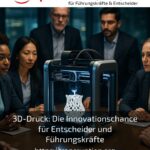
3D printing offers decision-makers and executives a remarkable opportunity to actively shape innovation processes and take corporate strategies to a new level. This technology supports the rapid implementation of product ideas and enables new business models through customised manufacturing. Especially in dynamic markets, flexibility and efficiency become crucial competitive advantages, which 3D printing can significantly promote.
Why 3D printing is a strategic advantage today
Across numerous sectors, 3D printing is significantly accelerating product development. For example, additive manufacturing in mechanical engineering allows for the rapid production of prototypes, which are traditionally time-consuming and expensive to create using conventional methods[1]. This enables medium-sized companies to respond more quickly to customer requirements and adapt their product portfolios agilely.
In the automotive industry, manufacturers use 3D printing to produce spare parts just-in-time or to completely redesign complex components. This reduces storage costs and minimises downtime of production lines. Tool manufacturers also benefit by creating custom-fit aids that would otherwise be difficult or impossible to produce using conventional methods.
In healthcare, 3D printing technologies enable the development of custom-made prosthetics or implants. These individualised solutions noticeably improve patient care and simultaneously open up new business areas for innovative companies[6].
3D printing as a driver of innovation for leaders
Decision-makers often face the challenge of efficiently supporting innovation projects. This is where 3D printing offers concrete impulses that are partly immediately implementable. Iterative development cycles lead to results that can be used more quickly, tested in practice, and improved. This approach reduces risks and increases planning certainty for new products or processes.
Furthermore, custom-made product components foster new customer loyalty. By expanding personalised services, it's possible to better address target group requirements and differentiate from the competition. For management, this means a strategic lever for strengthening market position.
Companies often report that challenges surrounding material selection, design optimisation, and process integration can be more easily overcome through accompanying coaching in 3D printing projects. This support helps to build internal expertise and sustainably embed the technology within the company's operations.
BEST PRACTICE at the customer (name hidden due to NDA contract) A medium-sized manufacturing company, with professional support in the area of 3D printing, enabled a rapid transition from prototype development to near-series production of spare parts. This ensured short-term supply capability and significantly increased customer satisfaction, particularly during times of pandemic-related supply bottlenecks.
Practical examples from various industries
In mechanical engineering, complex housings with tight tolerances can be printed precisely and cost-effectively. This results in robust components that can withstand high loads during operation and simultaneously increase efficiency.
In the aerospace sector, lightweight construction thanks to 3D printing is now a reality. Fuel tanks and engine components are optimised in terms of weight and stability, which reduces operating costs while increasing performance.
In architecture too, 3D printing is leading to innovative models and entire building components. This results in faster planning, cost savings, and the implementation of complex designs that are often impossible with traditional methods.
How leaders can harness the innovative power of 3D printing
Successful decision-makers invest in training teams to build expertise in 3D printing. This allows for more sustainable internal processes and better management of innovation. It is worthwhile to initiate pilot projects to evaluate the added value of the technology within one's own company.
Furthermore, networking with specialised partners and service providers should be sought. Transruption coaching forms a valuable bridge here to support challenges in the integration of 3D printing and to lead projects to success.
Through an integrative approach that considers technology, organisation, and market needs, executives have diverse opportunities to systematically strengthen their own innovative capacity.
BEST PRACTICE at the customer (name hidden due to NDA contract) Within a year, a leading automotive supplier established a 3D printing-based manufacturing process for small series and spare parts. Guidance from experienced coaches helped overcome technological hurdles and significantly shorten time-to-market.
BEST PRACTICE at the customer (name hidden due to NDA contract) In an innovative medical technology start-up, 3D printing was used to respond quickly to new regulatory requirements and manufacture individual implant solutions. The accompanying coaching facilitated the smooth development of manufacturing expertise and the improvement of product quality.
My analysis
3D printing offers decision-makers and executives significant potential to drive innovation processes flexibly and efficiently. By combining rapid prototyping, customised product design, and cost savings, 3D printing supports companies in successfully asserting themselves in dynamic markets. Structured guidance during implementation helps to minimise technological risks and sustainably increase innovative capacity. Therefore, it is worthwhile to consciously integrate 3D printing as a strategic tool into corporate development.
Further links from the text above:
How companies are leveraging the power of FDM 3D printing
Applications of 3D Printing | Blog Post
25 (unexpected) applications for 3D printing
30 applications with 3D printing - simple examples
Five industries that benefit most from 3D printing
For more information and if you have any questions, please contact Contact us or read more blog posts on the topic TRANSRUPTION here.






 Deutsch
  English (UK)