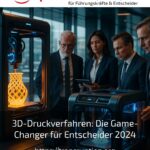
The diverse possibilities of modern manufacturing technologies are gaining increasing importance for decision-makers in companies across various industries. Innovative processes such as 3D printing processes remarkable game-changers. They open up new potential in prototyping, series production and product customisation. Additive manufacturing supports agile development processes and promotes sustainable production.
3D Printing Processes: More Than Just Prototyping
For many companies, 3D printing processes no longer purely prototype technology. They enable the fast and cost-effective production of functional components. For example, the automotive industry manufactures complex, lightweight components that optimise fuel consumption. Or aviation and aerospace benefit from robust, yet weight-saving components that can only be produced using additive manufacturing processes. Likewise, medical technology enables individual implants and prostheses that can be perfectly adapted to the patient.
In mechanical engineering, precise tools and machine parts with geometrical structures are created, which would be considerably more complex or even impossible to manufacture using conventional methods. And in the jewellery sector, the design freedom offered by 3D printing processes heralds a new era of creative, individual products.
Ein Beispiel aus der Praxis verdeutlicht dies: Ein mittelständisches Unternehmen im Maschinenbau reduzierte durch den Einsatz von 3D-gedruckten Gehäusen seine Herstellungskosten um rund 80 %, da auf konventionelle Formenbauteile verzichtet werden konnte. Diese Flexibilität ist ein Pluspunkt für viele Entscheider, die sich in dynamischen Märkten behaupten wollen.
Innovation and efficiency thanks to modern 3D printing methods
The decisive strength of 3D printing processes lies in the freedom of design. Complex internal structures, hollow spaces, or undercuts that are technically or economically difficult to achieve with classical manufacturing can be realised unproblematically with additive processes. This allows for new ways of thinking and design approaches in product development. This results in functional lightweight components that reduce the carbon footprint in the automotive industry.
In manufacturing, 3D printing processes significantly accelerate time-to-market. A simulation model is printed directly, tested, and modified promptly as needed. This allows changes to be implemented without costly tooling or long setup times. This offers SMEs in particular the opportunity to respond quickly to customer requests and provide individual solutions.
Practical examples in medical technology also demonstrate the benefits: with selective laser sintering, precisely fitting shoe insoles are produced in small batches, which not only saves costs but also increases patient satisfaction. Such applications illustrate how versatile the use of 3D printing is and how the technology is increasingly becoming part of the everyday lives of many industries.
Adaptability in production – another key to success
The ability to adapt products quickly and flexibly is crucial for many industries. 3D printing processes offer a clear advantage over traditional methods. In the aerospace industry, spare parts can be printed directly on-site, which reduces storage costs and downtime. Similarly, automotive interior design allows for personalised components, such as tailor-made controls or accessories.
In the fields of art and design, increasingly individual small runs and unique pieces are being realised. Artists and designers are relying on 3D technology to create complex structures or delicate objects without the use of tools. This also offers limitless design possibilities in jewellery making, which can very precisely reflect customer wishes.
BEST PRACTICE at the customer (name hidden due to NDA contract) The client from the mechanical engineering sector utilised 3D printing processes to manufacture spare parts for older equipment. The rapid availability of the components significantly improved equipment uptime and significantly reduced downtime. Alongside cost savings, this also led to increased customer satisfaction.
3D Printing Methods as Project Companions: Transruption Coaching for Decision-Makers
Many decision-makers face the challenge of making the right strategic and technology choices in the field of additive manufacturing. Transruption coaching supports projects related to the introduction or optimisation of 3D printing processes. This form of support helps with the analysis of individual requirements, the planning of manufacturing processes and the selection of suitable technologies.
In conversations, clients often report uncertainties regarding material selection or the integration of 3D printing into existing production chains. This is where coaching comes in, providing impetus for the creation of effective, sustainable production structures. Furthermore, it fosters acceptance among the workforce and helps to optimise the use of internal resources.
BEST PRACTICE at the customer (name hidden due to NDA contract) A manufacturer from the automotive supply industry received support in the introduction of 3D-printed prototypes through transruption coaching. The support enabled a smooth transition from conventional processes to innovative manufacturing methods with minimal disruption to day-to-day operations.
My analysis
The 3D printing processes are a crucial catalyst for modern decision-making in companies across all industries. They enable faster development cycles, greater flexibility, and often more sustainable production processes. Decision-makers benefit from the wide range of application possibilities – from prototype construction and small-batch production to customised end products. The design freedom offered by 3D printing supports both innovation and competitiveness.
The integration of specialised coaching, such as transruption coaching, primarily helps to implement these technologies in existing processes in a targeted and effective manner. Especially in dynamic markets, this allows companies to continuously improve their product development and adapt more quickly to changing customer requirements. The investment in 3D printing processes therefore frequently represents a sustainable competitive advantage.
Further links from the text above:
Areas of application for 3D printing – 3D-Model.com
What is 3D printing? – FKM Sintertechnik
Applications of 3D printing – 3druck.com
3D Printing Explained and Process – 3ds.com
For more information and if you have any questions, please contact Contact us or read more blog posts on the topic TRANSRUPTION here.






 Deutsch
  English (UK)