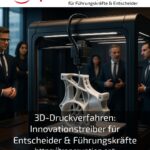
The development of modern 3D printing processes is today a significant driver of innovation for decision-makers and executives. These additive manufacturing technologies support numerous industries in realising products faster, more flexibly, and more cost-effectively. In the dynamic world of industry, 3D printing processes not only enable the rapid production of complex components but also open up new perspectives in product development and process optimisation.
Variety and application of 3D printing processes
The range of 3D printing processes is vast and encompasses different technologies that can be used variably depending on the application. For example, Fused Deposition Modelling (FDM) is primarily used in prototype production and for small series. By layering thermoplastic filaments, robust and functional components are created. This enables the rapid creation of tool holders or assembly aids in the automotive industry.
Processes such as Selective Laser Sintering (SLS) are also widely used and are particularly suited for functional parts and complex geometries. An application example from medical technology illustrates how bespoke implants can be manufactured with high precision. Since unsintered powder supports the component during printing in SLS, even filigree shapes can be produced without additional support structures.
Stereolithography (SLA) uses liquid resins that are hardened by a laser beam. This process is impressive due to its high accuracy and smooth surfaces, and is frequently used in the jewellery and dental industries to create detailed models or small series.
Another noteworthy process is Material Jetting, which allows for the simultaneous printing of multiple materials. This results in coloured, flexible, or particularly detailed prototypes that are used, for example, in product development for design studies.
Practical examples from various industries
In aerospace, 3D printing methods are used to manufacture components with complex internal structures that would be difficult or impossible to produce using conventional methods. This leads to significant weight savings and, consequently, more efficient aircraft.
In mechanical engineering, additive manufacturing offers faster iterations in the development process. This allows mechanical engineers to print spare parts or individual fixtures for production at short notice and with flexibility – without long delivery times and high warehousing costs.
Even in the consumer goods industry, 3D printing technologies enable personalised products, for example with bespoke sports shoes or individually designed jewellery. This fosters customer loyalty through unique product features and small production runs with a high degree of design freedom.
BEST PRACTICE at the customer (name hidden due to NDA contract) The company utilised 3D printing processes to produce complex prototypes in the medical technology sector in a short timeframe. This allowed the team to save valuable development resources and bring the product to market faster, thanks to rapid iteration and precise manufacturing.
Important criteria for choosing the right 3D printing process
Decision-makers should consider various factors when selecting suitable 3D printing processes. These include:
- Material properties and compatibility with the desired component
- Geometric complexity and required level of detail
- Surface quality and post-processing effort
- Cost factors including machine and material costs
- Quantity – from individual custom orders to small production runs
For example, FDM processes are particularly suitable for cost-effective functional components made from standard plastics, while SLS or DMLS are preferred for technically more demanding metal parts. In innovation projects, 3D printing processes support the rapid implementation of prototypes, thereby shortening development cycles and accelerating market launches.
3D printing methods as a companion for executives and project managers
Managers often encounter challenges such as long development times or high production costs for individual or complex components. Here, 3D printing processes provide impetus to support innovative solutions. Transruption coaching helps decision-makers to select the right technologies, establish suitable processes, and thus successfully manage projects.
Customers frequently report that with targeted support in implementing 3D printing processes, they were able to reach important milestones more quickly. The sustainable integration of additive manufacturing into existing production workflows also contributes to expanding competitive advantages and reacting flexibly to market demands.
BEST PRACTICE at the customer (name hidden due to NDA contract) Through supportive coaching, a mechanical engineering company was able to significantly increase internal acceptance of 3D printing methods. The employees learned how the technology can be integrated into the workflow, thereby reducing development times by up to 30 percent.
My analysis
3D printing processes are increasingly developing into a real driver of innovation, opening up diverse opportunities for decision-makers and executives. The variety of technologies allows individual requirements to be met flexibly and resource-efficiently. The combination of rapid prototyping, complex geometry, and cost-effective manufacturing supports competitiveness across many industries.
Dedicated support during the introduction of these processes helps to optimally leverage technological potential and successfully implement strategic projects. For management and project leaders, 3D printing processes thus offer a valuable key to actively shape innovation processes and unlock new product worlds.
Further links from the text above:
What types of 3D printers are there?
What types of 3D printing are there? – 3Dmensionals
For more information and if you have any questions, please contact Contact us or read more blog posts on the topic TRANSRUPTION here.






 Deutsch
  English (UK)