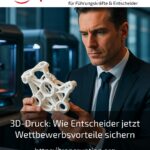
More and more decision-makers are turning to 3D printing to make their companies more flexible, faster and more competitive. The technology opens up new avenues in product development and manufacturing. Many companies are using 3D printing to optimise processes and gain a clear competitive advantage. Flexibility, speed and customisation are just some of the benefits that arise from additive manufacturing.
Flexibility and customisation as a market opportunity
3D printing allows products and components to be manufactured exactly to customer specifications. Even small batches or individual pieces are possible. This is particularly advantageous in the field of prosthetics and the consumer goods industry. This allows companies to develop new business models and strengthen customer loyalty.
A practical example: a manufacturer of medical devices uses 3D printing to produce individual prosthetics. Each product is tailored to the patient's needs. The customisation is fast and cost-effective. In the consumer goods sector, too, more and more personalised products are being created. Another example is a company that offers bespoke jewellery. Customers can directly incorporate their wishes into the design.
Another example is a company that produces limited editions of promotional items. The individuality of the products and the flexibility of production are clear competitive advantages. Customers receive unique products that stand out from the crowd.
Rapid Prototyping and shorter time-to-market
Prototypes in record time
3D printing allows prototypes and sample parts to be manufactured in the shortest possible time. This accelerates product development and makes it possible to react more quickly to market changes. Start-ups and SMEs benefit particularly because they can thus develop innovative products even with limited resources.
An example from the automotive industry: a sports car manufacturer uses 3D printing for the production of special model parts or for component testing in wind tunnels and for assembly components for Formula 1 racing cars. Prototypes are printed and tested within a few days. Companies also benefit from rapid prototyping in the electronics sector. A smartphone manufacturer can thus quickly test and adapt new designs.
Another example is a company that develops medical devices. The prototypes are printed and tested directly in-house. This significantly reduces development time.
3D printing as an innovation driver in day-to-day business
New business models and services
3D printing opens up new business models and services. Companies can fulfil individual customer requests, optimise mould making, and produce promotional items or gifts. New niches are being occupied and pioneering positions established.
An example from the food industry: a confectioner uses 3D printing to create individual cake decorations. Customers can directly incorporate their wishes into the design. In the field of architecture, too, more and more individual models are being created. Another example is a company that produces individual promotional items for corporate events. Customers receive unique products that stand out from the crowd.
Another example is a company that manufactures individual replacement parts for machines. Customers receive the parts quickly and cost-effectively. Production takes place directly on site.
BEST PRACTICE at the customer (name hidden due to NDA contract) A medium-sized company from the mechanical engineering sector uses 3D printing to produce individual spare parts for machines. Customers receive the parts within a few days. Production takes place directly on-site. Customer loyalty is strengthened as a result. The individual customisations are a clear competitive advantage. Customers receive unique products that stand out from the crowd.
Economic considerations and cost analysis in 3D printing
When it comes to introducing new technologies, economic considerations are one of the crucial factors. A comparison between classical manufacturing processes and additive manufacturing quickly shows: 3D printing can be significantly cheaper overall. The decisive advantage of 3D printing is that no costly tooling is required. Injection moulding tools are often very expensive and additionally cause long delivery times.
An example from the consumer goods industry: a toy manufacturer uses 3D printing to produce small batches. The unit prices are significantly cheaper than with traditional manufacturing processes. Companies also benefit from cost-effective production in the electronics sector. Another example is a company that produces individual promotional items for corporate events. Customers receive unique products that stand out from the crowd.
Another example is a company that manufactures individual replacement parts for machines. Customers receive the parts quickly and cost-effectively. Production takes place directly on site.
My analysis
3D printing offers a real competitive advantage for companies. Flexibility, speed, and individual customisation are just some of the benefits derived from additive manufacturing. Companies can optimise their processes, develop new business models, and gain a clear competitive edge. Integrating 3D printing into existing processes is a crucial step for long-term market survival.
Further links from the text above:
3D Printing: Competitive Advantages for Decision-makers and Executives
Competitive advantage thanks to 3D printing
3D printing for small businesses: A competitive advantage
3D printing service providers provide a competitive advantage
New business areas and competitive advantages through 3D printers
3D printer manufacturers for industry
3D printing in the company: Advantages, integration and cost analysis
Success Strategy – 3D Printing
For more information and if you have any questions, please contact Contact us or read more blog posts on the topic TRANSRUPTION here.






 Deutsch
  English (UK)